Civil Works BOQ Templates: A Real Fix for Margin Erosion
Ever find yourself staring at a client’s BOQ, wondering how it got so messy? Too many contractors in India and GCC lose hours—and margins—because of poorly structured BOQs. Let’s fix that.
Why Most BOQs Fail You
Most BOQs fail because they’re inconsistent or incomplete. A typical BOQ for a residential building might list "Excavation" but skip key details like UOM (unit of measurement), productivity rates, or even material specs. The result? Confusion in billing, disputes with clients, and blown budgets.
In my experience, one of the biggest culprits is manual entry. Contractors often copy-paste old BOQs into new jobs without updating rates or quantities. It’s a ticking time bomb. And the worst part? You often don’t notice until the project is already bleeding money.
Real-World Example
Consider a contractor in Maharashtra who reused an outdated BOQ for a commercial building project. The excavation rates were 20% lower than current market prices, and quantities weren’t adjusted for the actual soil composition of the new site. The result? A ₹1.2 crore loss over the course of the project. This isn’t an isolated case—poor BOQs are a widespread problem.
Key Data Point
- According to a study by the Construction Industry Development Council (CIDC), nearly 55% of disputes in Indian construction arise from inaccurate BOQs or rate mismatches.
The Fix: A Practical BOQ Workflow
Here’s how we structure BOQs to avoid chaos:
1. Standardize Your BOQ Format
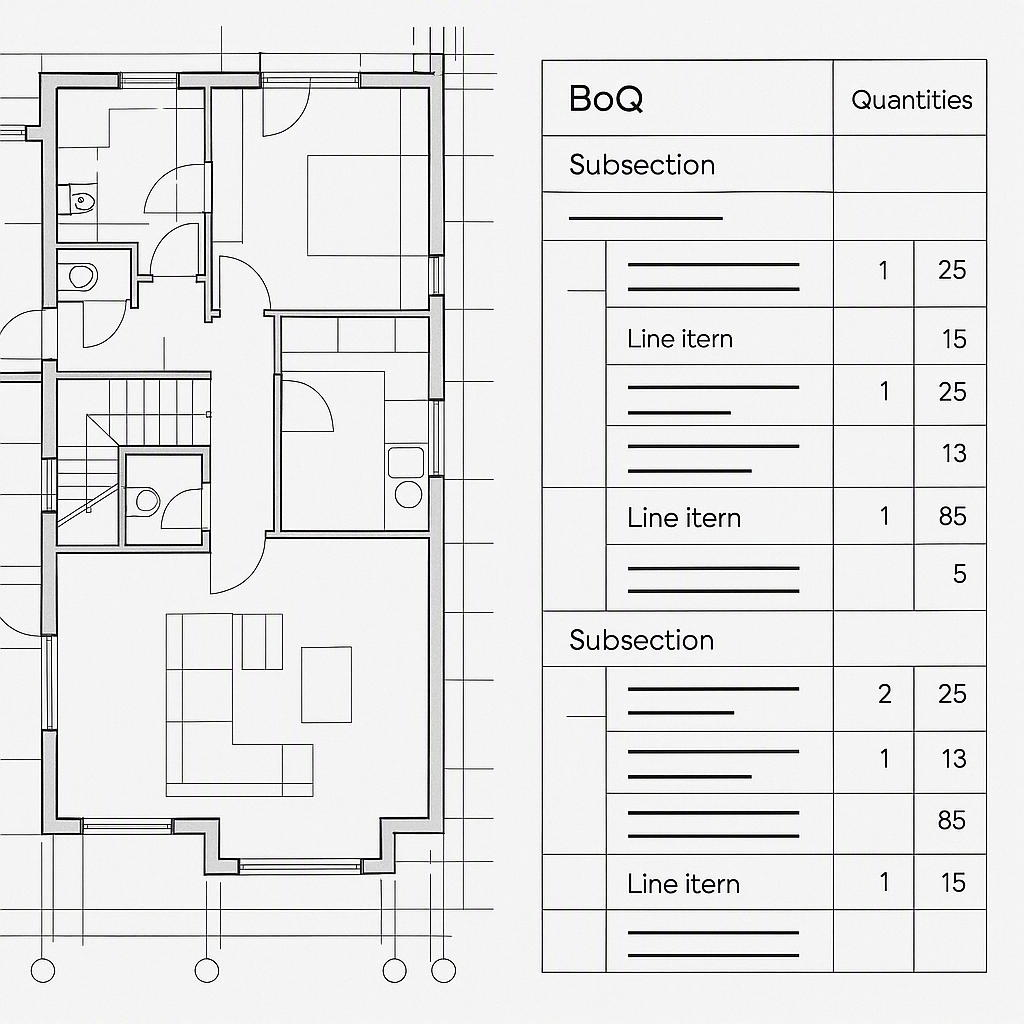
A standardized BOQ format ensures clarity across projects and teams. Every BOQ template for civil works should include:
- BOQ Code: Unique identifier for each line item.
- Description: Clear, detailed scope (e.g., "Excavation for Foundation, Depth 1.5m").
- Unit of Measurement (UOM): Cubic meter, square meter, kilogram, etc.
- Rates: Match market rates or client-specific Schedule of Rates (SOR).
- Quantities: Accurate, based on quantity takeoff.
Actionable Steps:
- Use Excel templates to create reusable BOQ structures. Tools like JobNext provide predefined templates, such as BOQFormat.xlsx.
- Implement a naming convention for BOQ codes that ties into your Work Breakdown Structure (WBS). For instance, "CW-FDN-EXC" can represent Civil Works → Foundation → Excavation.
- Cross-check quantities with site engineers for accuracy.
Case Study
An Abu Dhabi-based contractor reduced BOQ preparation time by 30% using standardized templates. Their team adopted JobNext, which allowed seamless Excel uploads and reduced errors during imports.
2. Use a Work Breakdown Structure (WBS)
BOQs are just client requirements. For execution, you need to break them into Scopes organized in a WBS. For example:
Sample WBS Hierarchy
- Civil Works (Parent Group)
- Foundation (Sub-Group)
- Excavation (Item)
- PCC (Item)
- RCC (Item)
- Superstructure (Sub-Group)
- RCC Columns (Item)
- Brickwork (Item)
- Foundation (Sub-Group)
Actionable Steps:
- Identify recurring scopes in your projects, such as Earthworks, Foundations, Superstructures, Finishes, etc.
- Create a library of WBS templates in tools like JobNext to reuse across projects.
- Align WBS codes with BOQ codes for seamless integration between planning and execution.
3. Automate Rate Analysis
Rate mismatches are margin killers. AI-powered tools like EstimateNext let you match thousands of rates in seconds. Gone are the days of flipping through outdated rate analysis PDFs or relying on gut instinct.
Actionable Steps:
- Upload client-specific SORs into platforms like EstimateNext and let AI validate your rates.
- Compare rates across vendors and suppliers to ensure accuracy.
- Conduct a bi-annual review of your rate database to keep pace with market changes.
Data Point
- Contractors using automated rate analysis tools report an average margin improvement of 7–12%, according to industry surveys.
4. Stage-Wise BOQs for Phased Projects
Big projects often require phased execution. Breaking BOQs into stages (e.g., Foundation, Superstructure) helps track progress and bill accurately.
Example:
Phase 1: Foundation
- Excavation: 1,000 m³
- PCC: 500 m³
Phase 2: Superstructure
- RCC Columns: 300 m³
- Brickwork: 1,200 m²
Actionable Steps:
- Divide BOQs into logical stages based on project scope.
- Allocate percentages of the total budget to each phase.
- Use platforms like JobNext to create and manage stage-wise BOQs.
5. Validate Before Uploading
Always download the latest BOQ template before preparing your data. Templates change, and mismatches can lead to hours of manual rework. After uploading, double-check the import summary for errors.
Actionable Steps:
- Assign a dedicated team member to manage BOQ template updates.
- Use automated validation tools to flag mismatches before final submission.
Real Example: How One Contractor Fixed Their BOQ Process
A mid-size contractor in Oman struggled with BOQs for multi-phase projects. They often missed billing milestones because their BOQs didn’t align with execution stages. After switching to JobNext, they:
- Standardized their BOQ format using templates.
- Used WBS to align BOQs with execution plans.
- Adopted stage-wise BOQs to track progress.
The result? Billing disputes dropped by 40%, and project margins improved by 8% within six months.
Common BOQ Mistakes (And How to Avoid Them)
Mistake 1: Skipping UOMs
- Fix: Always include UOMs like sqm, CUM, or kg for every item. This prevents confusion during billing.
Mistake 2: Ignoring Rate Analysis
- Fix: Use tools like EstimateNext for accurate, automated rate matching instead of relying on manual calculations.
Mistake 3: Poor Grouping
- Fix: Use a consistent WBS hierarchy (e.g., Foundation → Footing → RCC) to organize your BOQs.
Mistake 4: Manual Data Entry
- Fix: Upload BOQs from Excel templates to avoid errors and ensure consistency.
FAQ: Practitioners’ Common Questions
Q1: How do I ensure my BOQs meet client expectations?
- A: Start with the client’s SOR or rate list as a baseline. Standardize your BOQ format with clear descriptions, UOMs, and rates. Tools like JobNext allow you to share draft BOQs for client review before finalization.
Q2: What’s the best way to handle rate disputes?
- A: Use automated rate analysis tools like EstimateNext to validate rates against market benchmarks. Present detailed rate breakdowns to clients to justify pricing.
Q3: How can I prevent BOQ errors during imports?
- A: Validate your BOQ data using Excel formulas or built-in checks in software like JobNext. Always test import summaries for mismatches before execution.
Q4: What’s the advantage of using stage-wise BOQs?
- A: Stage-wise BOQs simplify billing and progress tracking for multi-phase projects. They allow you to allocate budgets and quantities to specific milestones, reducing disputes.
Q5: Can I reuse BOQs across projects?
- A: Yes, but only with adjustments. Use a standardized template and update rates, quantities, and specs to match the new project scope.
Comparison Table: Manual BOQs vs Automated BOQs
| Feature | Manual BOQs | Automated BOQs |
|---|---|---|
| Preparation Time | 10–15 hours per project | 1–2 hours per project |
| Error Rate | High (10–20%) | Minimal (1–3%) |
| Rate Analysis | Manual, error-prone | AI-powered, accurate |
| Template Updates | Inconsistent | Standardized, automated |
| Billing Disputes | Frequent | Rare |
Your Turn: Build an Error-Free BOQ
If you’re losing margins to bad BOQs, it’s time to rethink your process. Start by standardizing your template and integrating tools like JobNext. Trust me, the time you save will be worth it.
Ready to stop losing margins to bad BOQs? JobNext simplifies BOQ management with templates, WBS libraries, and automation tools. Get started free →
Learn more at EstimateNext