Stop Bleeding Margins: Why Markup Misunderstanding Costs You Millions
Markup isn't profit margin. If you're mixing these up, you're losing money—guaranteed. Contractors across trades (MEP, HVAC, general contracting) often rely on gut instinct or outdated formulas to set bid prices. The result? Overpriced bids lose projects; underpriced bids lose margins. Let's fix that.
The Core Problem: Markup vs Margin Confusion
Imagine this: You calculate your project costs at ₹10 lakh and decide to apply a 20% markup. You assume you'll make ₹2 lakh profit. Sounds simple, right?
Wrong. A 20% markup doesn't mean a 20% profit margin. Here's the brutal math:
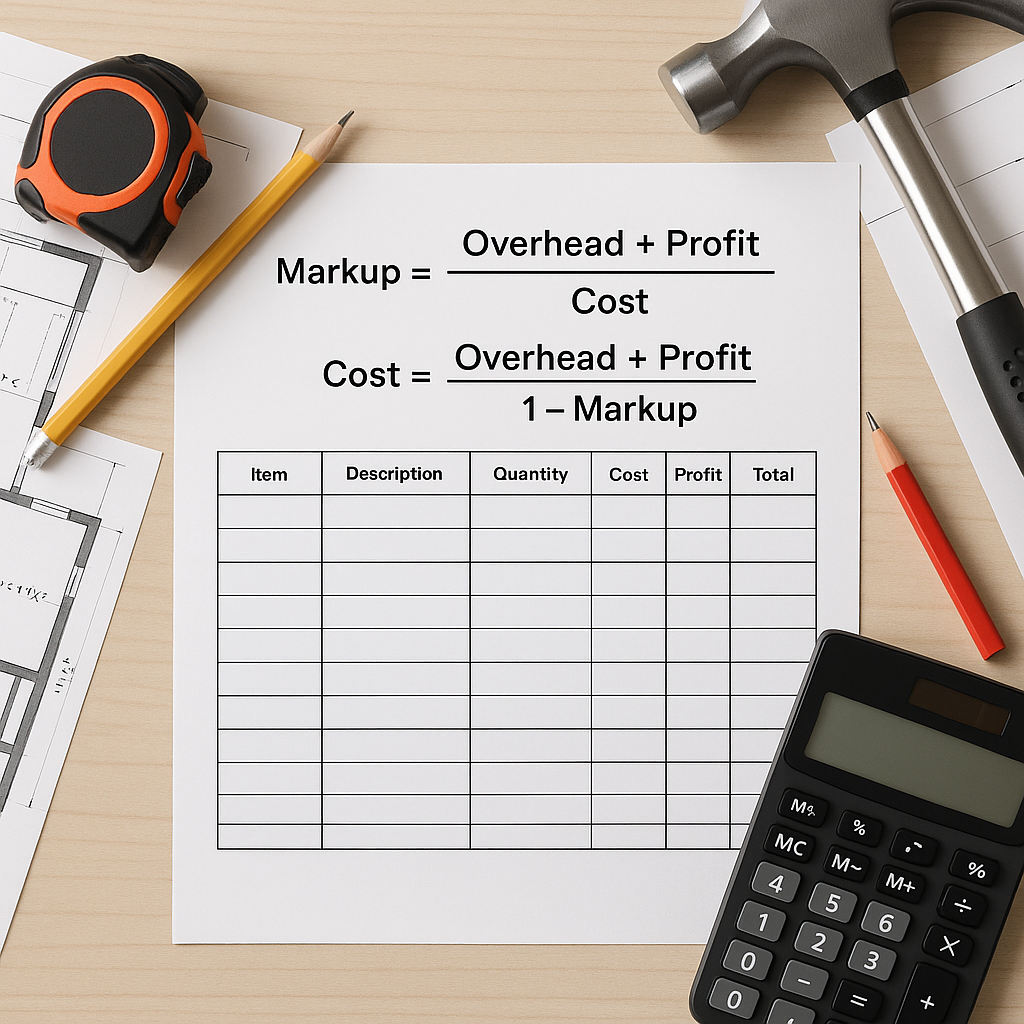
- Markup Formula: Selling Price = Cost × (1 + Markup%)
- Profit Margin Formula: Margin% = (Selling Price - Cost) ÷ Selling Price × 100
In our example:
- Selling Price = ₹10,00,000 × 1.2 = ₹12,00,000
- Margin% = (₹12,00,000 - ₹10,00,000) ÷ ₹12,00,000 × 100 = 16.67%
That 20% markup gives you only a 16.67% profit margin. If your target margin was 20%, you just shortchanged yourself.
Why This Misunderstanding Happens
The confusion stems from misusing the terms interchangeably and not understanding how percentages work in different contexts. For many contractors, the focus is on getting the job or beating competitors, so deep pricing strategies often take a backseat. However, this oversight can leave millions in unrealized profits on the table.
According to a 2021 Deloitte report, 40% of contractors admitted they don’t truly understand their financial metrics, leading to repeated mistakes in pricing strategies. The lack of proper training and reliance on outdated pricing methods makes the problem worse.
Practical Steps to Get Markup Right
1. Define Your Costs Accurately
Your markup strategy is only as good as your initial cost estimate. If you miss key cost items, your markup percentage won’t matter—it’ll be a guess. Here’s how to get your costs right:
Actionable Steps:
-
Labor Costs:
- Calculate labor hours accurately by reviewing historical job data.
- Include overtime rates, benefits, and taxes.
- Example: If 5 workers are needed for 10 days at ₹1,200/day, your labor cost is ₹60,000. If overtime is expected, calculate it upfront.
-
Material Costs:
- Break down every material item.
- Use real-time material pricing tools to avoid inflation surprises. Tools like MaterialTracker can help.
- Example: For a paving project, if you need 50 tons of asphalt at ₹5,000/ton, your material cost is ₹2,50,000.
-
Equipment Costs:
- Factor in rental costs, fuel, and maintenance.
- If you own the equipment, calculate depreciation.
- Example: Renting a backhoe loader for ₹10,000/day over 5 days adds ₹50,000 to your cost.
-
Overheads:
- Include indirect costs like site admin, utilities, and insurance.
- Example: If you estimate site utilities at ₹10,000 and admin costs at ₹20,000, your overheads are ₹30,000.
-
Contingencies:
- Add a buffer (typically 5–10%) for unexpected expenses. This ensures surprises don’t eat into your profits.
Tools to Consider:
- JobNext: Provides line-by-line cost breakdowns for complex projects.
- Procore: Centralizes cost data for easy tracking.
- Buildertrend: Helps manage budgets and projections in real-time.
2. Apply Markup Strategically
Markup should never be a random number. It needs to reflect your business goals, project risks, and market conditions. Here’s how to set it smartly:
Actionable Steps:
-
Research Market Rates:
- Understand your competitors' pricing.
- Tools like Construction Analytics can give insights into regional averages for various services.
-
Analyze Risk Factors:
- Higher risks (e.g., tight timelines, complex projects, or risky clients) warrant higher markups.
- For example, a 25% markup may be appropriate for a high-risk project compared to 15% for a low-risk one.
-
Segment Clients:
- Tailor markups based on client type.
- Example: Government clients may demand lower margins but offer volume, while private clients may pay more for premium service.
3. Validate Against Profit Margin
After applying markup, check the resulting margin to ensure it meets your target. Use the formula:
Margin% = (Selling Price - Cost) ÷ Selling Price × 100
Example:
If your target margin is 20%, and your costs are ₹10,00,000:
- Desired Selling Price = ₹10,00,000 ÷ (1 - 20%) = ₹12,50,000
- Markup = (₹12,50,000 - ₹10,00,000) ÷ ₹10,00,000 × 100 = 25%
So, applying a 25% markup ensures you meet your goal of a 20% profit margin.
4. Automate and Optimize
Manual calculations are time-consuming and prone to errors. Automation tools can save you hours while improving accuracy.
Recommended Tools:
- EstimateNext: Uses AI to match rates across 78,000+ line items.
- Sage Estimating: Offers detailed cost breakdowns and forecasting.
- STACK: Cloud-based takeoff and estimating software.
Why Automate?
- Reduces human error.
- Speeds up bid preparation.
- Ensures consistency across projects.
- Frees up time for client engagement and strategy.
Case Study: Subcontractor Markup Done Right
A landscaping contractor in Oman faced margin erosion on subcontracted irrigation works. Their initial bids were consistently underpriced, leading to slim or negative profits.
The Problem:
- They underestimated subcontractor costs.
- They applied a flat 15% markup across all projects, regardless of complexity or risk.
The Solution:
Using JobNext’s Comparative Statement feature:
- Evaluated Subcontractor Bids: They compared bids based on price, technical capability, and timeline feasibility.
- Adjusted for Risk: Applied a higher markup (25%) to high-risk projects like irrigation systems requiring specialized expertise.
- Validated Margins: Ensured that the markup aligned with their target profit margin of 20%.
The Result:
- Secured a 24% profit margin on the project.
- Improved confidence in their bidding process.
- Built stronger relationships with subcontractors by providing detailed justifications for pricing.
Common Mistakes to Avoid
-
Guessing Markup Percentages:
- Always calculate based on actual costs and market research.
-
Ignoring Overheads:
- Overheads like admin costs and contingencies must be included to avoid eroding margins.
-
Overlooking Subcontractor Costs:
- Ensure all subcontractor fees (including their markups) are accounted for in your total cost.
-
Skipping Automation:
- Manual calculations are error-prone and inefficient. Invest in tools to streamline the process.
Frequently Asked Questions (FAQ)
Q: What’s the difference between markup and margin?
A: Markup is the percentage you add to your costs to set the selling price. Margin, on the other hand, is the percentage of the selling price that represents profit. For example, a 25% markup on ₹10,00,000 costs results in a selling price of ₹12,50,000, but the profit margin is only 20%.
Q: How do I handle subcontractor markup?
A: Use tools like JobNext or EstimateNext to ensure subcontractor costs are fully tracked. Calculate the subcontractor’s markup, add it to their bid, and then apply your own markup on top of it. Always validate the final margin to ensure profitability.
Q: Can I automate markup calculations?
A: Yes. Tools like EstimateNext and Sage Estimating can automate cost breakdowns and markup applications. These tools also help simulate different scenarios to optimize profitability.
Q: What’s the ideal markup percentage?
A: There’s no one-size-fits-all answer. Markup depends on your costs, industry benchmarks, project risks, and client type. Always calculate markup with a clear target margin in mind.
Q: How do I avoid underpricing my bids?
A: Start by getting a detailed breakdown of all costs, including labor, materials, overheads, and contingencies. Apply a strategic markup and validate the resulting margin. Use historical data and tools to ensure accuracy.
Final Thoughts
Markup isn’t guesswork—it’s math. Get your costs right, apply markup strategically, and validate against profit margins. If you’re struggling with cost tracking or bid accuracy, tools like JobNext and EstimateNext can make the process seamless. Don’t leave your profits to chance; master your markup strategy today.
Comparison Table: Markup vs. Margin
| Aspect | Markup | Margin |
|---|---|---|
| Definition | Percentage added to costs to set the selling price. | Percentage of selling price that represents profit. |
| Formula | Selling Price = Cost × (1 + Markup%). | Margin% = (Selling Price - Cost) ÷ Selling Price × 100. |
| Focus | Cost-based. | Selling price and profit-based. |
| Common Misconception | Markup = Margin. | Margin is lower than markup. |
| Use Case | Used to determine what to charge for a product/service. | Used to evaluate profitability and financial health. |
Takeaway: Always calculate both markup and margin to ensure your pricing aligns with your profit goals.
Learn more at EstimateNext