The Importance of BOQ in Preventing Margin Erosion
Margins in construction are razor-thin. You win a contract with a small profit margin, but midway through, you may find yourself wondering where the profit went. One of the biggest culprits is procurement inefficiency. Overordering materials, paying higher-than-quoted rates, or missing the link between client requirements and what gets bought — these issues can silently erode your margins.
A well-structured Bill of Quantities (BOQ) can change that. Think of the BOQ as your project's financial blueprint. It's not just a list of items; it's how you control costs, track progress, and avoid overpaying vendors.
Why BOQ is Critical in Procurement
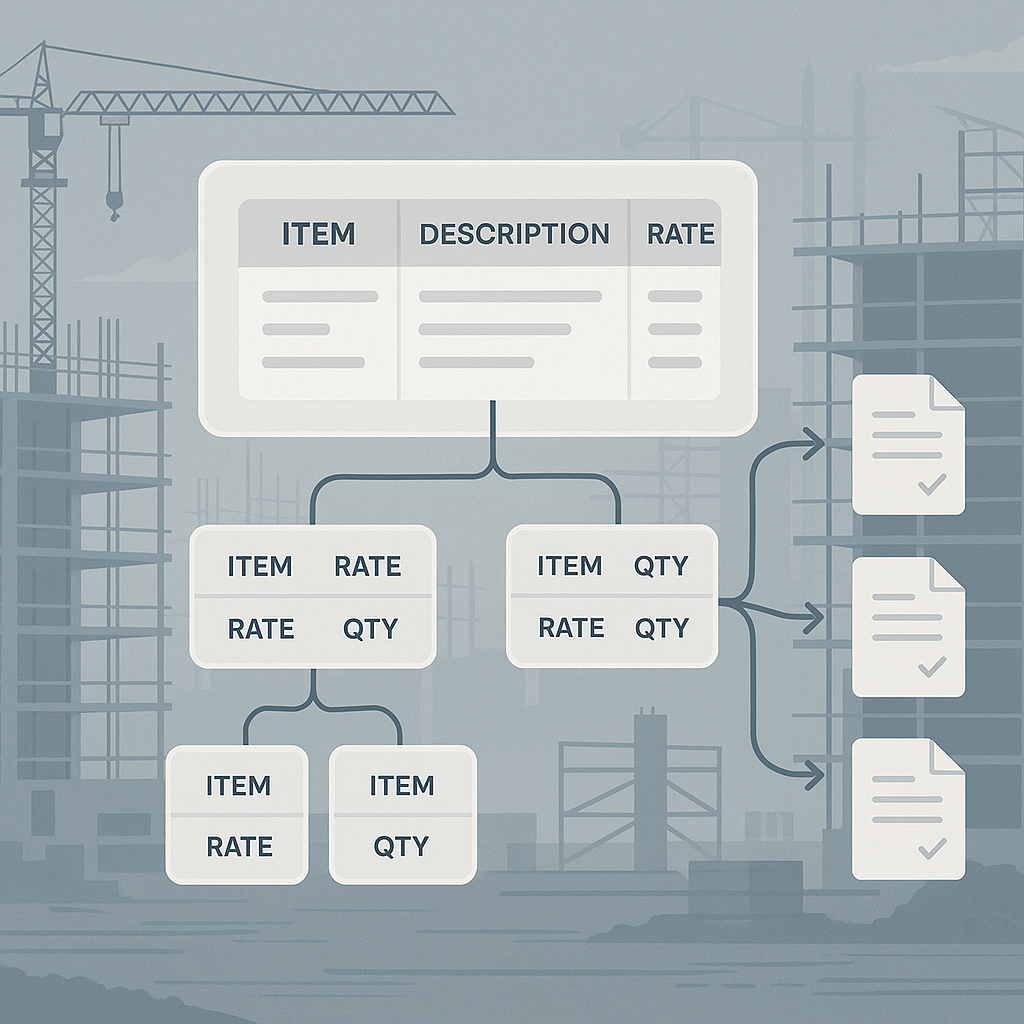
A BOQ isn't just an internal document. It's your bridge between what the client expects and what you need to execute. Every line item in the BOQ connects directly to procurement decisions:
- Defines Scope: The BOQ outlines exactly what needs to be delivered. No vague descriptions, no guesswork.
- Controls Costs: It locks in quantities, units, and rates, ensuring that procurement stays within budget.
- Prevents Overordering: By linking the BOQ to actual progress, you procure only what’s needed when it’s needed.
Without this structure, you're flying blind. Contractors often overspend on materials simply because their procurement isn't tied back to the BOQ. The result is unnecessary costs and reduced profitability.
Practical Example: Linking BOQ to Procurement in JobNext
Illustrative example — Let’s say you’re working on an MEP project. Your BOQ includes:
| Item Code | Description | Unit | Quantity | Rate (₹) | Total (₹) |
|---|---|---|---|---|---|
| MEP-001 | Copper Wiring (XLPE) | Meter | 10,000 | 120 | 12,00,000 |
| MEP-002 | PVC Conduits (40mm) | Meter | 5,000 | 45 | 2,25,000 |
| MEP-003 | Switchboards | Nos | 200 | 1,200 | 2,40,000 |
Here’s how a structured approach can prevent margin erosion:
-
BOQ → Procurement Workflow: Once the BOQ is finalized, it can populate procurement workflows. For example, material requisitions (MRs) can be directly tied to BOQ items (e.g., 10,000 meters of copper wiring).
-
Vendor Rate Locking: Vendor quotes can be captured and matched against BOQ rates. If a vendor quote exceeds the BOQ rate, it can trigger an alert for review.
-
Progress-Based Procurement: Materials are procured in stages, based on actual work progress. For instance, if only 50% of wiring is installed, you ensure that only 50% of the materials are ordered at that stage.
-
Real-Time Cost Tracking: Every purchase order (PO) and material receipt updates the BOQ cost sheet. This allows you to monitor if a line item is going over budget in real time.
This structured approach eliminates guesswork. You’re no longer relying on site engineers to scribble material requests on WhatsApp or email. Everything ties back to the project’s BOQ.
Common Mistakes Contractors Make with BOQs
-
Using Outdated Rates: A BOQ is only as good as its rates. If you’re using outdated prices, expect surprises. Regularly update your rate schedules.
-
Skipping Variations: Projects evolve. When the scope changes — for example, if a client adds a basement floor — update the BOQ immediately. Ignoring variations can significantly impact your margins.
-
Not Linking BOQ to Procurement: Many contractors treat the BOQ as a static document. This is a mistake. If it's not connected to procurement, it’s just paper.
-
Overloading Excel: Managing BOQs in Excel might work for one or two projects. But as you scale up, you’re inviting errors. Dedicated tools can help keep things structured and error-free.
FAQ
1. What’s the difference between BOQ and BOM?
- A BOQ (Bill of Quantities) is client-facing and focuses on deliverables (e.g., “500 CUM excavation”). A BOM (Bill of Materials) is internal and breaks down what materials are needed to execute the BOQ (e.g., “500 cubic meters of soil, 2 excavators, 10 laborers”).
2. How do I ensure my BOQ rates are accurate?
- Use rate analysis tools that break down costs into labor, materials, and equipment. Regularly review and update your rates to reflect market conditions.
3. Can I use BOQs for subcontractor management?
- Absolutely. Subcontractor work can be tracked against BOQ items. Dedicated tools can even let you record subcontractor measurements directly.
Call to Action
If procurement inefficiencies are eating into your margins, consider adopting structured BOQ-driven workflows. These ensure every procurement decision aligns with your project budget.
Learn more at EstimateNext