BOQ and Glinda: What Wicked Can Teach Us About Cost Management
If you’ve seen Wicked, you know Glinda isn’t just bubbly — she’s strategic. She knows how to navigate politics, make alliances, and keep things on track (most of the time). Believe it or not, managing a Bill of Quantities (BOQ) in construction has some parallels. Like Glinda, you need to juggle a lot of moving parts without losing sight of your goals. The stakes? Your project margins. Get it right, and you’re the hero. Get it wrong, and the costs will spiral faster than Dorothy’s tornado.
Let’s break it down in detail.
Why BOQs Are the Hidden Battleground for Margins
For most contractors, the BOQ is just a list of items and rates agreed upon with the client. But here’s the truth: the BOQ is where your profitability is won or lost. Each item links directly to your budget, procurement, and billing. If you’re not tracking these connections in real time, you’re flying blind.
Common Issues with BOQs
-
Overruns on high-risk items: A single item with underestimated labor or material costs can wipe out your profit on an entire project. For instance, if your BOQ assumes a low cost for imported tiles and the exchange rate fluctuates, any adjustments will hit your bottom line.
-
Disconnects between BOQ and execution: What you planned on paper often changes on-site. Without a system to track these changes and update your BOQ, you risk over-ordering materials, underbilling the client, or running into delays.
-
Missed billing opportunities: If your BOQ isn’t integrated with your billing workflows, you’re leaving money on the table. For example, variations requested by the client often go untracked if they’re not tied to the BOQ, leading to underbilling.
Why This Matters
Your BOQ is the foundation of:
- Budgeting: Every item’s cost feeds into your overall project estimate.
- Procurement: Accurate quantities ensure you order the right amount of materials.
- Billing: Your invoices rely on BOQ-linked milestones to ensure you get paid for what you deliver.
In short, poor BOQ management isn’t just an inconvenience — it’s a direct threat to your project margins.
The Glinda Principle: Start with Structure
Glinda’s charm works because she operates within a structure — she knows when to play nice and when to push back. Your BOQ needs the same clarity and structure to keep projects on track and protect your profitability.
Steps to Structure Your BOQ Effectively
-
Direct Conversion from Quote to Execution:
- Your BOQ shouldn’t exist in isolation. When you win a contract, the BOQ must seamlessly integrate into the execution phase. Tools like JobNext allow automatic conversion from quote to execution, linking BOQ items to scopes, billing, and progress tracking. This eliminates manual re-entry and ensures no details are lost.
-
Define Clear Units of Measurement:
- Every BOQ item should have unambiguous units (e.g., cubic meters, square feet). Misinterpreted units can lead to costly errors in procurement or billing.
-
Regular Margin Reviews:
- Conduct weekly BOQ margin reviews to compare contracted values with actual costs across key areas like labor, materials, and overheads. JobNext’s BOQ Margin Report flags negative-margin items, so you can address them proactively.
-
Link BOQ Items to Scopes:
- Each BOQ item must be tied to specific execution activities. Clear conversion factors ensure what the client pays for aligns with how the work gets done — no surprises.
Practical Example: Structuring a BOQ for a Residential Project
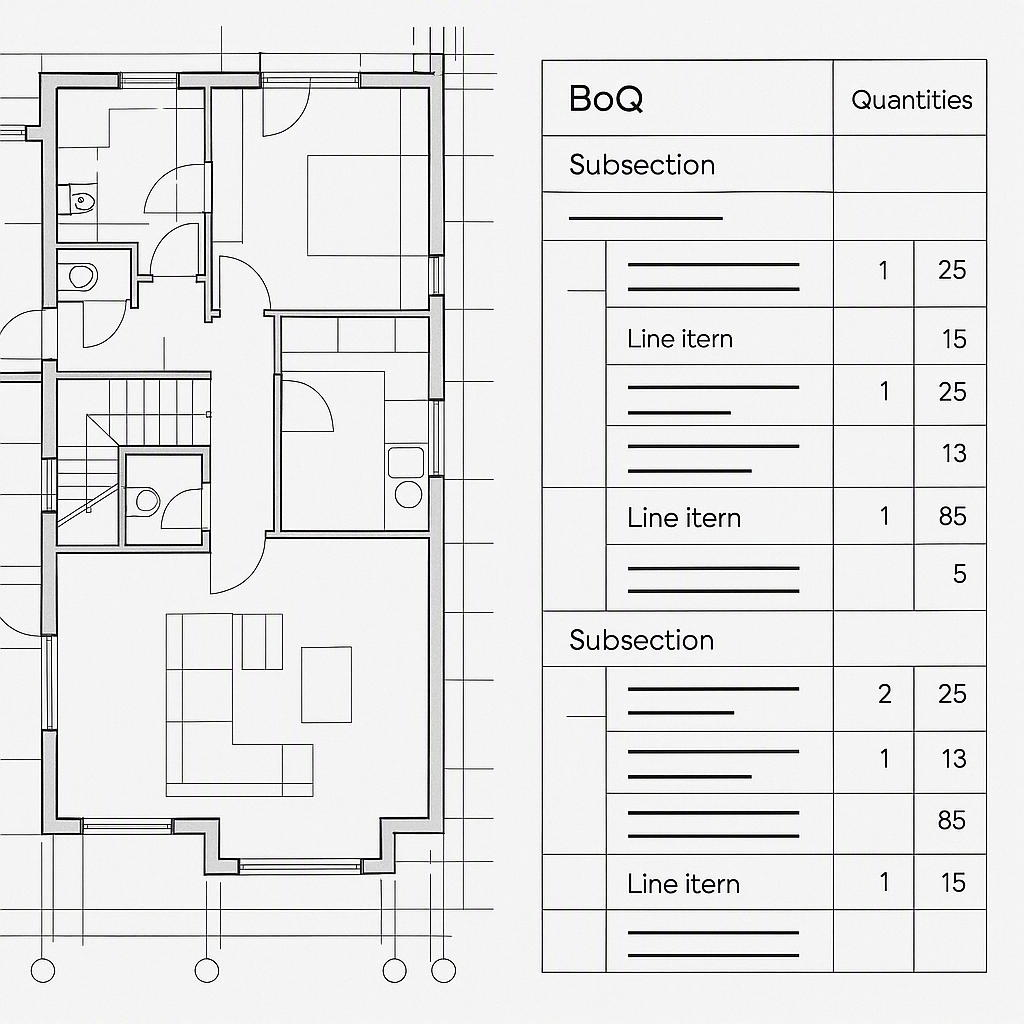
| BOQ Item | Unit | Quantity | Rate (₹) | Total (₹) |
|---|---|---|---|---|
| Concrete (M20 grade) | Cubic meter | 500 | 5,000 | 25,00,000 |
| Steel Reinforcement | Metric ton | 20 | 60,000 | 12,00,000 |
| Formwork | Square meter | 1,000 | 1,200 | 12,00,000 |
By structuring your BOQ clearly, you avoid ambiguities that create expensive mistakes down the line.
Real-Time Tracking: The Key to Staying Ahead
Most contractors treat the BOQ as a static document. That’s a mistake. Construction projects are messy — quantities change, client requests evolve, and procurement costs fluctuate. If you’re not updating your BOQ and tracking costs in real time, you’re setting yourself up for overruns and missed billing opportunities.
Key Tools for Real-Time BOQ Tracking
-
Budget Burn Reports:
- Regularly review Budget Burn Reports to spot areas consuming your budget faster than planned. JobNext offers five Budget Burn Reports (Labor, Material, Machinery, Overhead, Work Item) to ensure no surprises.
Example of a Budget Burn Report:
Category Budgeted Cost (₹) Actual Cost (₹) Variance (₹) Material 12,00,000 13,50,000 -1,50,000 Labor 8,00,000 7,80,000 +20,000 Machinery 3,00,000 3,50,000 -50,000 If material costs exceed the budget by ₹1,50,000, you can investigate immediately: Did procurement overpay? Was material wasted on-site? Early detection allows you to take corrective action.
-
Variation Tracking:
- Use tools that link variation orders directly to your BOQ. For example, if the client requests a change in wall thickness, you can easily update the BOQ and ensure the variation is reflected in billing.
-
Procurement Workflow Integration:
- Integrate your procurement workflows (MR → RFQ → PO) with the BOQ. This ensures your procurement team orders exactly what’s required, avoiding costly overages or shortages.
Collaboration: Lessons from Glinda
In Wicked, Glinda doesn’t work alone. She builds alliances to achieve her goals. Similarly, your BOQ needs to integrate seamlessly with other workflows — procurement, billing, and progress tracking. Disconnected systems force teams into silos, leading to errors, delays, and margin erosion.
Example: Avoiding Procurement Chaos
Picture this: Your BOQ specifies 1,000 cubic meters of concrete, but your procurement team orders 1,200 because they didn’t have visibility into the BOQ. The result? Excess inventory, wasted budget, and potential delays.
With tools like JobNext, procurement workflows are directly linked to BOQ quantities. Everyone operates from the same playbook, reducing errors and ensuring accountability.
Common BOQ Mistakes (and How to Avoid Them)
-
Skipping Rate Analysis:
- Rates should be broken into materials, labor, and plant costs. A lack of detail can lead to underpricing or overpricing. JobNext’s Standard Quote feature ensures consistent pricing across projects.
-
Not Tracking Variations:
- BOQs often change during execution. If you’re not tracking variations, you’re likely underbilling. Tools like JobNext link variation orders directly to the BOQ, so nothing gets missed.
-
Ignoring Compliance Costs:
- GST, TDS, and statutory deductions can turn a profitable item into a loss-maker. Automating compliance tracking with tools like JobNext ensures you’re never blindsided.
Decision Framework: Choosing the Right BOQ Management Tool
| Feature | Manual Systems | JobNext |
|---|---|---|
| BOQ-to-Execution Integration | No | Yes |
| Real-Time Budget Tracking | No | Yes |
| Variation Tracking | Limited | Automated |
| Compliance Cost Management | Manual | Automated |
| Procurement Integration | No | Yes |
FAQ: Your BOQ Questions Answered
Q1: How often should we review BOQ margins? Weekly. Use tools like JobNext’s BOQ Margin Report to catch issues early and take corrective action.
Q2: What’s the best way to handle BOQ changes during execution? Track variations in real time and link them to billing. JobNext’s Variation Order workflow ensures you don’t miss any updates.
Q3: Can small contractors benefit from BOQ tracking tools? Absolutely. JobNext’s Easy Quote feature is designed for small projects and quick proposals, ensuring you stay competitive without extra overhead.
Q4: How do I ensure compliance costs don’t erode my margins? Automate compliance tracking. Tools like JobNext calculate GST, TDS, and other deductions directly within your BOQ workflows.
Q5: What’s the biggest mistake contractors make with BOQs? Treating the BOQ as a static document. Construction projects are dynamic, and your BOQ needs to evolve in real time to reflect changes in scope, quantities, and costs.
Final Thoughts
Managing a BOQ is like managing Glinda’s social calendar — it’s all about clarity, structure, and real-time adjustments. Ignore it, and you’ll lose control (and money). But with the right tools and workflows, you can turn your BOQ into a powerful margin-protection system.
If you’re tired of margin erosion from poor BOQ tracking, JobNext can help. Get started today and take control of your project costs.
Learn more at EstimateNext