BOQ Format Explained: Practical Tips for Contractors in India & GCC
If you've been in construction long enough, you already know this: a poorly managed Bill of Quantities (BOQ) can wreck your project margins before the first brick is laid. It's not just about getting the quantities right — it's about structuring the BOQ to prevent confusion, miscommunication, and revenue leakage. Let’s break down how to do it properly.
Why the BOQ Matters More Than You Think
A BOQ is essentially the client's view of the project. It lists deliverables in their language: item descriptions, units, quantities, and rates. But here's the catch — the BOQ isn’t built for execution; it’s built for contracts and billing. If you don't bridge the gap between the BOQ and how your team executes the work, expect chaos.
For example, contractors often face issues when the BOQ doesn’t align with actual site measurements. A mismatch in measurement methods can lead to disputes and financial losses.
Your BOQ needs to do more than just list items. It should:
- Serve as the foundation for accurate cost estimation.
- Link to execution scopes and billing systems.
- Track progress accurately to avoid disputes.
BOQ Structure: How to Get It Right
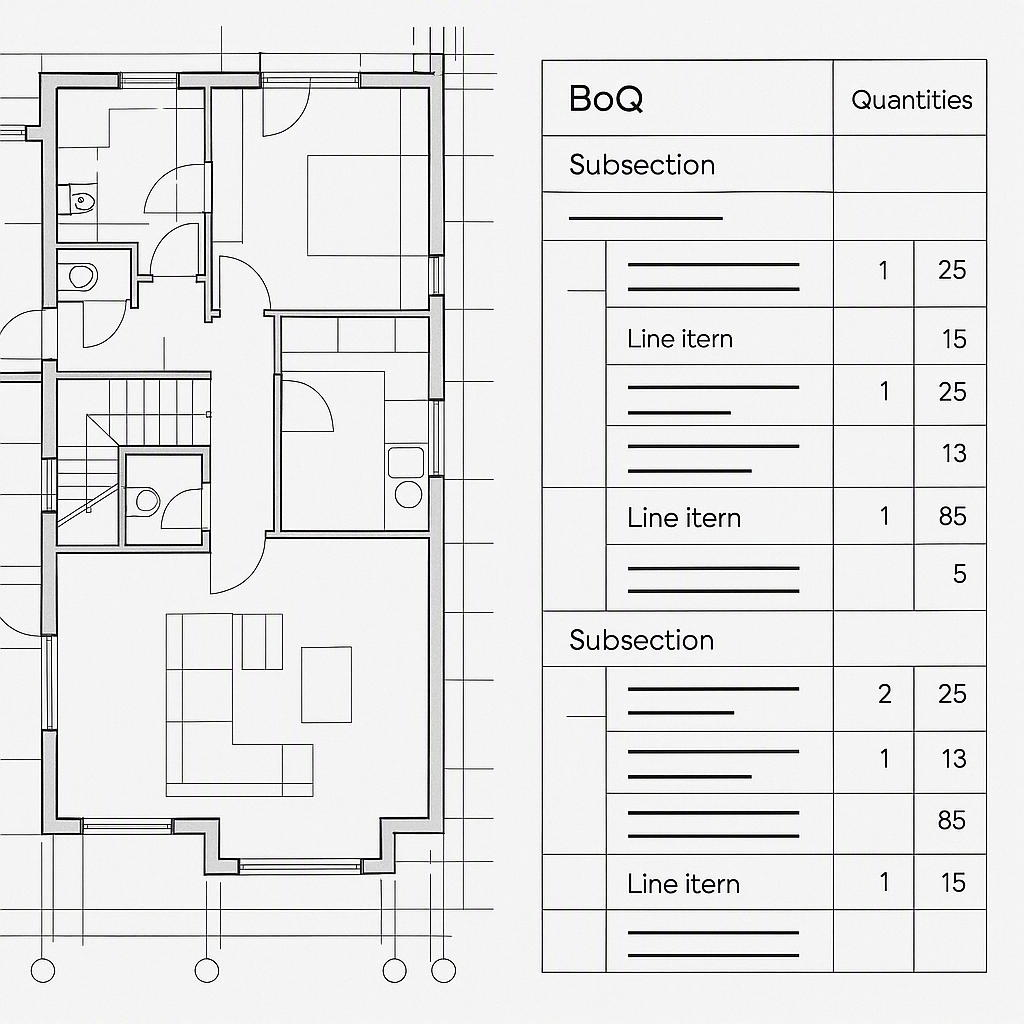
A well-structured BOQ uses a hierarchical format. Here's what that looks like:
| Level | Purpose | Example |
|---|---|---|
| Group | Category container for related items | "Civil Works," "MEP," "Finishing" |
| Sub-section | Organizes specific deliverables within a group | "Foundation," "Superstructure" |
| Item | Lowest level with quantities and rates | "Excavation — 1,000 CUM @ ₹120/CUM" |
Pro Tip: Only leaf-level items (the lowest level in the hierarchy) should carry rates and quantities. Parent items like "Civil Works" are just headers, and their amounts automatically sum up the child items.
This structure keeps things clear for everyone — from your client to your site engineer.
Common BOQ Mistakes (and How to Avoid Them)
-
Using Generic Descriptions: Vague items like "Plumbing Works" leave too much room for interpretation. Instead, break it down: “Supply and install 50mm CPVC pipes" with specific units (e.g., meters).
-
Ignoring Units of Measure: Always use consistent units. For example, excavation might be measured in cubic meters (CUM), while rebar is typically in kilograms. Mixing units leads to billing disputes.
-
Skipping Rate Analysis: If your BOQ uses arbitrary rates instead of detailed rate analysis (materials + labor + machinery), you’re setting yourself up for losses. Tools that standardize rate schedules across projects can ensure consistent pricing by breaking down costs into materials, labor, and plant.
-
Not Accounting for Variations: BOQs are static, but projects aren’t. If you don’t have a system to track variations (additions, omissions, and changes), your billing will fall behind. Automating this process ensures you’re paid for every change.
BOQ Format: Practical Example
Let’s say your project involves foundation work. Here’s how a sample BOQ section might look:
| Item Code | Description | Unit | Quantity | Rate (₹) | Amount (₹) |
|---|---|---|---|---|---|
| CW01 | Excavation for foundation | CUM | 1,000 | 120 | 1,20,000 |
| CW02 | RCC M25 for foundation | CUM | 500 | 7,000 | 35,00,000 |
| CW03 | Backfilling with approved soil | CUM | 800 | 80 | 64,000 |
Illustrative example — This simple format ensures clarity for your team and your client. Each item has a unique code, a clear description, and measurable units.
Linking the BOQ to Execution and Billing
Here’s where most contractors drop the ball: integrating the BOQ into execution and billing workflows.
BOQ items should connect to:
- Scopes: Execution activities tied to each BOQ item.
- Progress Billing: RA bills automatically pull quantities and rates from the BOQ.
- Cost Estimates: The system calculates execution costs for each deliverable, ensuring your margins are intact.
This integration eliminates manual effort and ensures nothing falls through the cracks.
FAQ: BOQ Basics
Q: What’s the difference between BOQ and Scope of Work (SOW)? A: The BOQ defines what the client expects, while the SOW details how you’ll deliver it.
Q: Can I upload a BOQ from Excel? A: Yes, most tools allow BOQ uploads using templates. Just make sure your data matches the column format.
Q: How do I handle stage-wise BOQs? A: For phased projects, split BOQ items into milestones (e.g., Foundation 30%, Superstructure 40%). Ensure that stages add up to 100%.
Q: What if the client changes the BOQ mid-project? A: Use a system that tracks variations. Automated platforms can adjust scopes and billing in real-time.
Final Thoughts: Get Your BOQ Right, Every Time
A clean, structured BOQ isn’t just a nice-to-have — it’s your best defense against margin erosion. Whether you’re building villas in Oman or managing an MEP project in Mumbai, the principles are the same. Structure matters. Accuracy matters even more.
And if you’re tired of juggling Excel sheets and manual errors, consider tools designed to manage the entire BOQ lifecycle. Platforms that link BOQs to execution, billing, and progress tracking can help keep your projects profitable and your clients happy.
Learn more at EstimateNext