What 'Boq from Wicked' Can Teach You About BOQ Mastery
In Wicked, Boq is the loyal, detail-oriented character who often gets overlooked. Contractors, if your BOQ (Bill of Quantities) is the Boq of your project, you’re probably underestimating its role. A poorly managed BOQ can quietly wreck your margins, just like an ignored character can derail a story. Let’s talk about BOQ mastery and how treating it with the respect it deserves can save your project’s bottom line.
The Hidden Margin Killer: Poor BOQ Practices
Every contractor has been there. The client provides a BOQ that looks great on paper, but once the project starts, cracks appear. Quantities don’t align with the actual scope, units are inconsistent, and variation orders pile up. If you’re not tracking these issues from day one, you’re leaving money on the table.
Here’s the brutal truth: a messy BOQ kills margins faster than you think. Why? Because:
- It drives your scope of work. If the BOQ is wrong, your scope is wrong, leading to either overcommitment or underperformance.
- It anchors your billing. Every running account (RA) bill, stage-wise payment, or milestone ties back to the BOQ. Errors here mean underbilling or disputes with clients.
- It dictates procurement. If quantities are off, your purchase orders are too, leading to material shortages or surplus stock.
- It impacts change management. Variation orders that aren’t tied to the BOQ often go untracked, causing additional costs to sneak in unbilled.
Think of the BOQ as your project’s central nervous system. If it’s mismanaged, the whole operation suffers. Let’s break down how you can take control.
BOQ Mastery Step 1: Start with the Right Quoting Method
Not all projects are created equal, and neither are BOQs. Choosing the right quoting method is your first step toward BOQ mastery. Here are four quoting methods, often used in tools like JobNext, that cater to different project complexities:
| Quoting Method | Best For | Key Feature |
|---|---|---|
| Easy Quote | Small, quick jobs | Direct sell rate entry without cost build-up |
| Standard Quote | Mid-size projects needing consistency | Centrally managed rate schedules |
| Estimate-Based Quote | Large, complex projects | Full breakdown of labour, material, and plant |
| Combined Quote | Multi-service-line proposals | Merges multiple quotes into one document |
Choosing the Right Method
- Easy Quote: Use this for straightforward tasks like residential renovations or small civil works where you already know the rates. Avoid this for anything complex.
- Standard Quote: Ideal for mid-sized jobs where rate consistency across similar tasks is critical. This works well for projects like small commercial buildings or road repairs.
- Estimate-Based Quote: Required for larger projects like high-rises, industrial plants, or infrastructure developments. This method allows you to break down costs into granular components for better visibility.
- Combined Quote: Useful for multidisciplinary projects like hospitals or campuses, where electrical, mechanical, and civil works are bundled.
Pro Tip: If you’re new to structured quoting, start with the Standard Quote. It’s versatile and ensures you don’t miss key details while quoting.
BOQ Mastery Step 2: Link BOQ to Scopes and WBS
One of the most common mistakes contractors make is treating the BOQ as an isolated document. This disconnect creates massive inefficiencies during project execution. Instead, your BOQ should directly link to your Scope of Work (SoW) and Work Breakdown Structure (WBS).
Why Linking BOQ to WBS Matters
- Bridges client expectations and execution reality: Clients see deliverables (e.g., “Construct 200 meters of road”), while contractors see tasks and resources (e.g., “Excavate 500 CUM, lay 200 CUM of concrete”). Linking BOQ items to the WBS ensures nothing is lost in translation.
- Simplifies tracking: Progress can be tracked at the task level and rolled up to the BOQ for client reporting.
- Avoids data fragmentation: Any change in the BOQ automatically updates the linked scopes and WBS, reducing manual effort and errors.
Actionable Steps
-
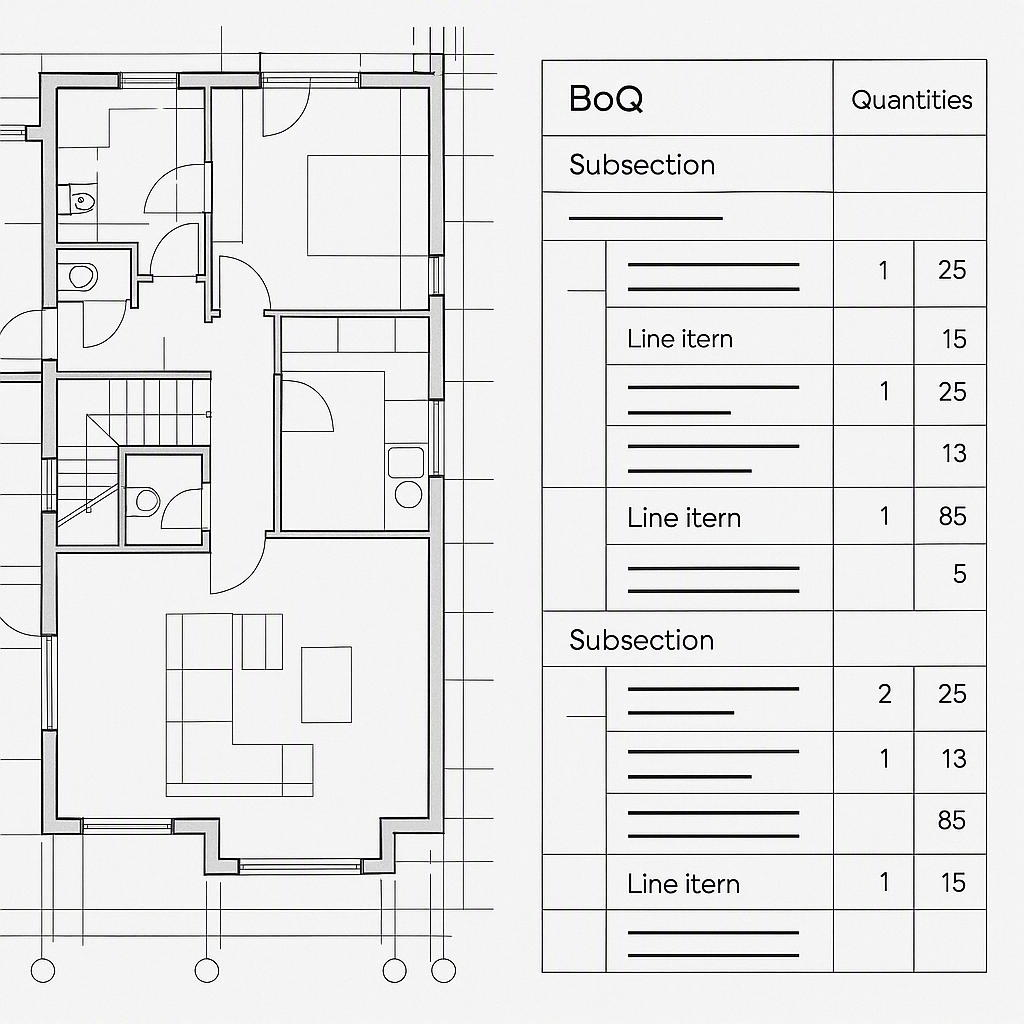
Create a Hierarchical BOQ: Organize your BOQ into categories and subcategories that mirror your WBS. For example:
- Civil Works
- Excavation: 500 CUM @ ₹120/CUM
- Concrete: 200 CUM @ ₹8,000/CUM
- Electrical Works
- Wiring: 1000 meters @ ₹50/meter
- Civil Works
-
Use Pre-Defined WBS Templates: For repetitive activities like excavation or plastering, use templates with default rates and quantities. This saves time and ensures accuracy.
-
Automate Updates: Use software that integrates your BOQ with the scope and WBS. This ensures changes in one area flow through to the others.
BOQ Mastery Step 3: Monitor Progress in Real-Time
“You can’t manage what you don’t measure.” This applies to your BOQ more than anything else. Relying on end-of-month reports or stage reviews is too slow. By the time you find issues, your margins may already be gone.
Key Metrics to Track
- Budget Utilization: Are you spending within the limits defined by your BOQ? For example, if the BOQ allocates ₹6,00,000 for concrete, but your costs already hit ₹5,50,000 with only 60% of the work done, you need immediate corrective action.
- Progress vs. BOQ: Track how much work is completed versus what’s been billed. For example, if 300 CUM of excavation is completed but only 200 CUM is billed, you’re underbilling your client.
- Variation Orders: Real-time tracking of changes ensures you capture and bill every scope adjustment.
Tools to Use
JobNext’s dashboards, for instance, allow contractors to:
- View real-time progress updates.
- Spot discrepancies between planned and actual quantities.
- Generate automatic alerts for untracked variation orders.
Common BOQ Mistakes (and How to Avoid Them)
1. Ignoring the Hierarchy
A BOQ is not just a flat list of items. Without grouping and sub-grouping, you risk losing the structural clarity needed for efficient execution.
Fix: Structure your BOQ hierarchically to mirror your project’s layout.
2. Not Verifying Quantities
Client-provided BOQs often contain errors or omissions. Blindly accepting them leads to issues during execution.
Fix: Cross-check quantities against site conditions before finalizing.
3. Poor Variation Tracking
Changes are inevitable in any project. If they aren’t tied back to the BOQ, you risk losing money.
Fix: Implement a system to link every variation order to a specific BOQ item.
4. Manual Updates
Manual tracking of BOQs using spreadsheets is prone to errors and inefficiencies.
Fix: Automate BOQ management using tools like JobNext.
FAQ
Q1: What’s the biggest risk of a poorly managed BOQ?
A: Margin erosion. Misaligned quantities lead to underbilling, procurement errors, and wasted resources.
Q2: How can I ensure BOQ accuracy?
A: Use software to validate and cross-check BOQ data with site conditions and automate updates when changes occur.
Q3: What’s the benefit of a hierarchical BOQ?
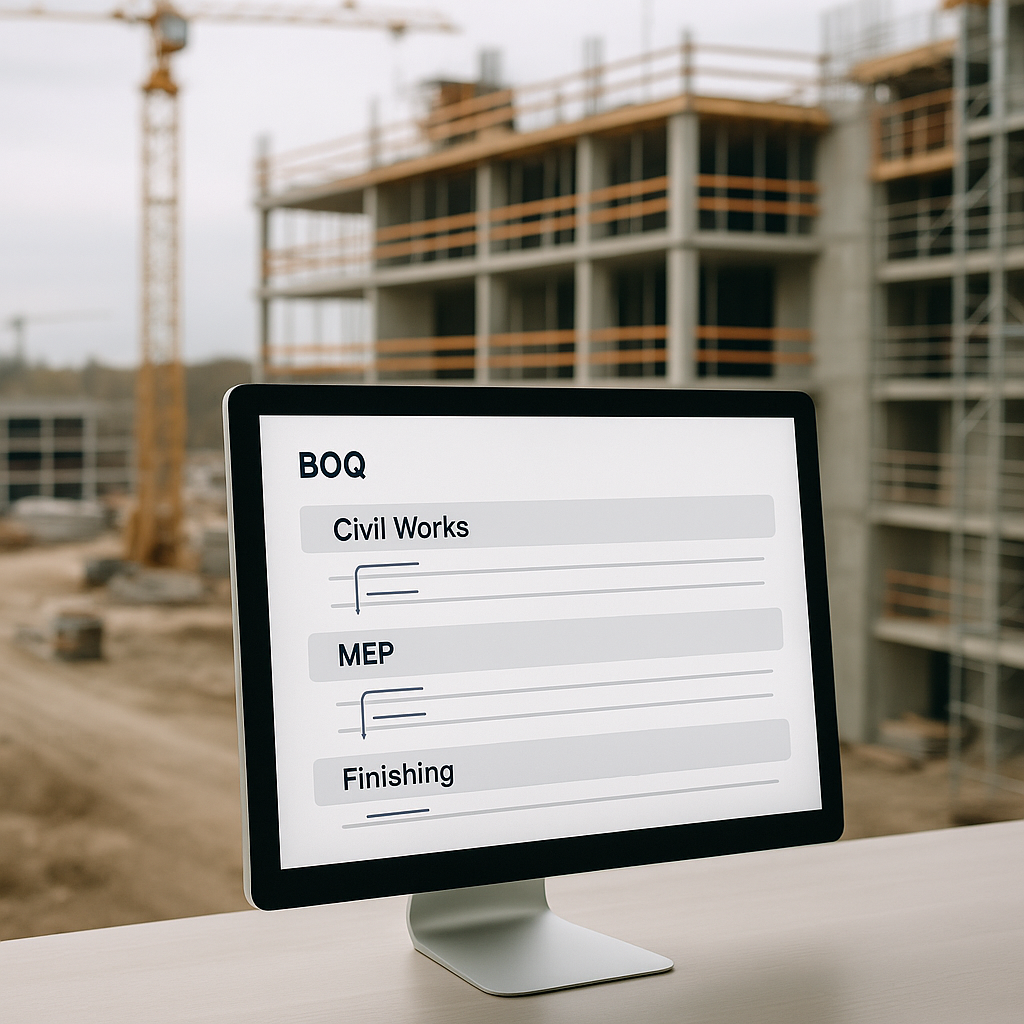
A: It mirrors project structure, making it easier to manage categories and subcategories like Civil Works, MEP, and Finishing.
Q4: How do I handle frequent variation orders?
A: Use integrated tools to link variation orders directly to the BOQ and ensure they’re tracked and billed.
Q5: Can BOQ management software really make a difference?
A: Yes. Automation reduces errors, improves tracking, and saves time, leading to better financial outcomes.
Final Thoughts
In Wicked, Boq’s loyalty and attention to detail play a pivotal role in the story, even if he’s not the star. Similarly, your BOQ may not grab headlines, but its accuracy and management can make or break your project. Treat your BOQ like Boq — with respect and precision — and watch your margins improve.
If you’re struggling with BOQ management, tools like JobNext can help. Its integrated features streamline BOQ creation, linking, and tracking, so nothing slips through the cracks. Get started free →
Learn more at EstimateNext