Why BOQ Estimation Is Crucial for Contractor Margins
Every contractor knows the pain of an inaccurate Bill of Quantities (BOQ). A wrong cost assumption—whether it’s underestimating labor hours or mispricing materials—can turn a profitable project into a financial challenge. Worse, these errors often go unnoticed until halfway through execution, when it’s too late to fix.
But why do BOQ errors happen so often? Manual processes are the number one culprit. Estimators rely on spreadsheets, historical rates, and guesswork, each of which introduces errors. According to a 2023 McKinsey report, manual estimation workflows are a significant contributor to project cost overruns globally.
How AI Fixes BOQ Estimation Errors
AI-powered construction estimating software solves these problems. Here’s how:
-
Rate Consistency Across Projects: AI tools use centrally managed Rate Schedules. Instead of manually entering rates, estimators select predefined values vetted for accuracy. This prevents inconsistent pricing across projects.
-
Bottom-Up Costing Precision: Advanced AI tools allow estimators to break each BOQ line item into material, labor, plant, and subcontract costs. For complex projects, this level of detail ensures nothing is missed, protecting margins.
-
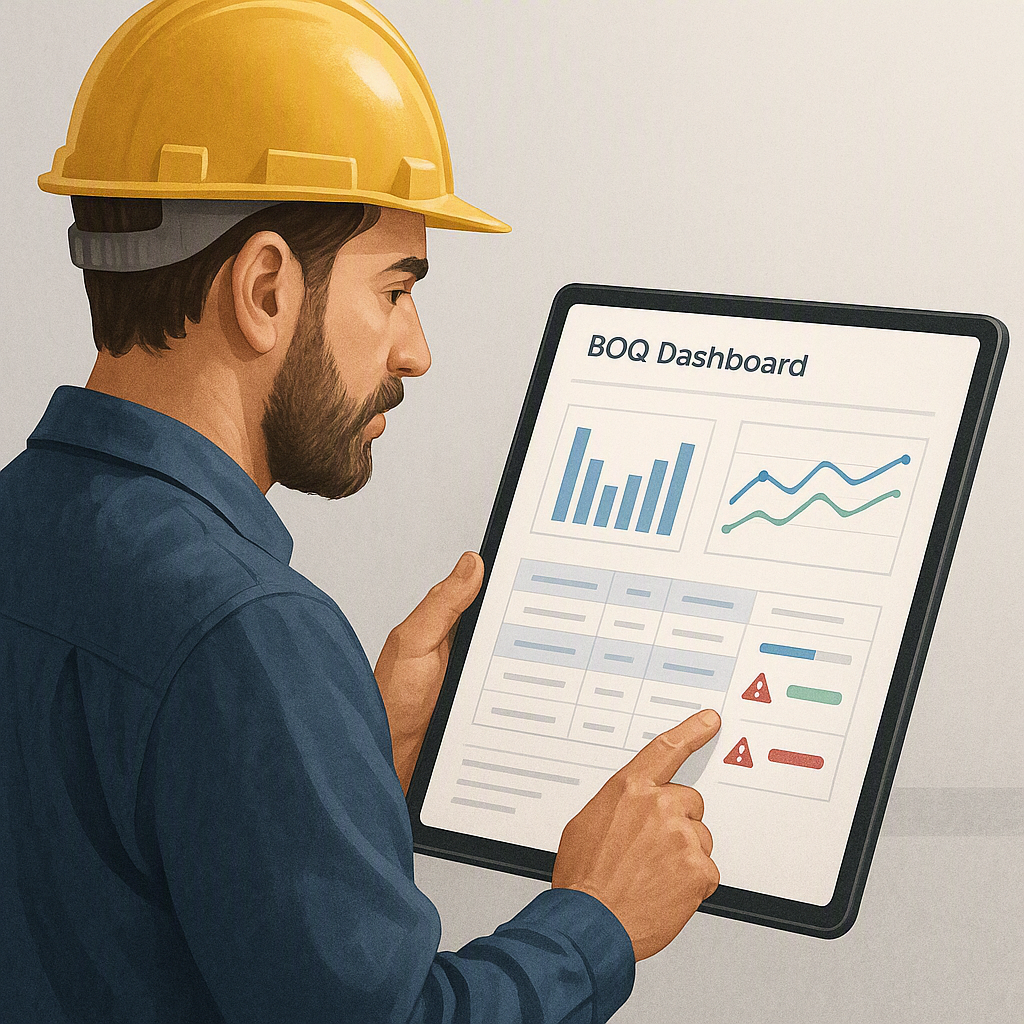
Cost vs. Budget Tracking: AI tools offer real-time dashboards that compare actual costs against BOQ estimates. If material costs spike or labor hours exceed projections, managers get alerts instantly, enabling proactive adjustments.
Illustrative Example — BOQ Rate Analysis Workflow
Let’s say you’re estimating costs for a residential building project.
| BOQ Line Item | Quoted Rate | Billing Rate | Scheduled Rate | Actual Cost Rate | Variance |
|---|---|---|---|---|---|
| Reinforced Steel (MT) | Placeholder | Placeholder | Placeholder | Placeholder | Placeholder |
| Concrete (CUM) | Placeholder | Placeholder | Placeholder | Placeholder | Placeholder |
| Labor (Per Hour) | Placeholder | Placeholder | Placeholder | Placeholder | Placeholder |
Illustrative example — Values shown are placeholders.
In this scenario, your AI software flags variances in costs. Early detection lets you adjust procurement strategy or renegotiate vendor terms before these overruns impact profitability.
Common Mistakes in BOQ Estimation
Mistakes happen. Here’s what to watch for:
- Overreliance on Historical Data: Rates from previous years don’t account for inflation or market volatility.
- Ignoring Resource Validation Errors: AI tools often require estimates to pass validation before approval. Skipping this step leads to bad data downstream.
- Missing Overheads: Contractors often forget hidden costs like insurance and pest control. AI estimation tools ensure all cost categories are included.
FAQ — BOQ Estimation and AI
Q: Can AI tools handle undefined scopes?
A: Yes, AI tools support site surveys for undefined scopes and cater to specific cost breakdowns.
Q: How do AI tools enforce consistency in rate analysis?
A: Features like centrally managed Rate Schedules ensure every estimator uses the same baseline rates.
Q: Do AI tools integrate with accounting systems?
A: Many tools offer integration with accounting systems for statutory reporting.
Q: Is AI estimation suitable for small contractors?
A: Absolutely. Even small firms benefit from AI-driven workflows that reduce errors and improve efficiency.
The Bottom Line
Contractor profitability starts with accurate preconstruction estimates. AI-powered tools protect margins by enforcing rate consistency, flagging cost overruns early, and automating the entire BOQ workflow. If you're looking to improve your estimation process, exploring these tools could be a valuable step forward.
Learn more at EstimateNext