BOQ Standards for Construction: Practical Insights for Indian & GCC Contractors
The problem nobody talks about: A poorly structured Bill of Quantities (BOQ) can wreck your project margins faster than you can say "variation order." In India and the GCC, contractors often struggle with inconsistent BOQ standards, leading to billing errors, scope misalignment, and client disputes. If you've ever tried to reconcile what you bid with what you delivered, you'll know exactly what I'm talking about.
So how do you structure a BOQ that actually works? Let’s break it down.
Why BOQ Standards Matter
A BOQ isn’t just a list of items and rates. It’s your contract with the client, your blueprint for execution, and the foundation of every progress claim you'll make. When done right, it’s the ultimate tool for managing costs, tracking progress, and ensuring profitability. When done wrong? It’s a liability.
Common Issues with BOQs
-
Inconsistent formats: Every client has their own way of structuring a BOQ. Some use CESMM3, others rely on their own templates, and some barely have a structure at all. As a contractor, you’re often left to interpret vague descriptions and unclear units. The absence of standardization can create major headaches during estimation and billing.
-
Poor scope linking: A BOQ defines what the client expects, but it rarely aligns perfectly with how you’ll actually execute the work. Missing this link leads to costly mistakes in estimation and billing. For example, a BOQ may specify "Concrete - 200 Cum" but fail to elaborate on associated scope requirements, such as formwork, rebar, and pouring timelines.
-
Variation chaos: Without a clear BOQ hierarchy, tracking variations becomes a nightmare. You end up losing money on unapproved change orders or inflated subcontractor claims. Poor variation management often results in client disputes and delayed payments.
The takeaway? A standardized BOQ isn’t just a nice-to-have—it’s essential for protecting your margins.
How to Structure a BOQ That Works
1. Adopt a Hierarchical Format
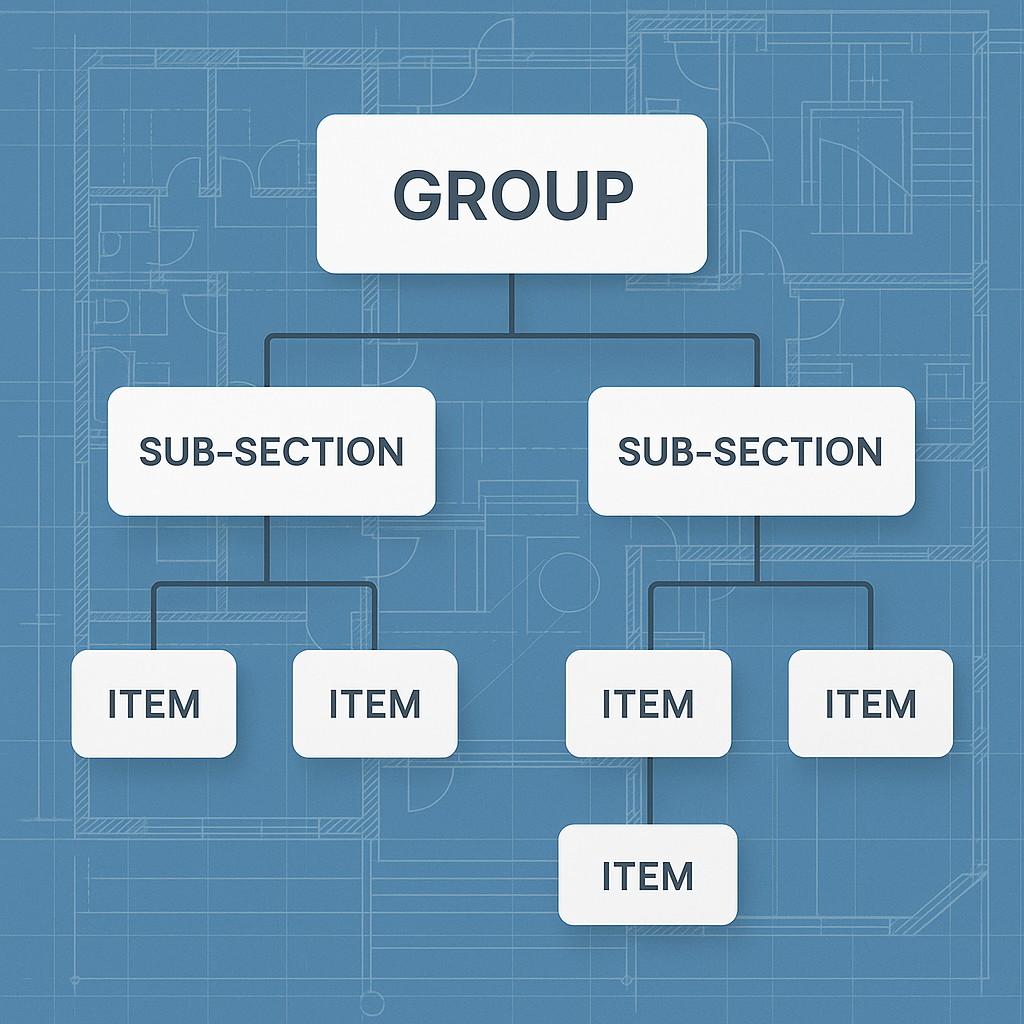
The best BOQs follow a clear hierarchy. This structure ensures transparency and simplifies communication between contractors, clients, subcontractors, and other stakeholders.
BOQ Hierarchy Explained
- Group: High-level categories such as "Civil Works," "MEP," or "Finishing." This provides an overarching view of the project scope.
- Sub-section: Specific work areas within each group, like "Foundation" or "Superstructure."
- Item: Detailed deliverables with clear descriptions, units, quantities, rates, and total amounts.
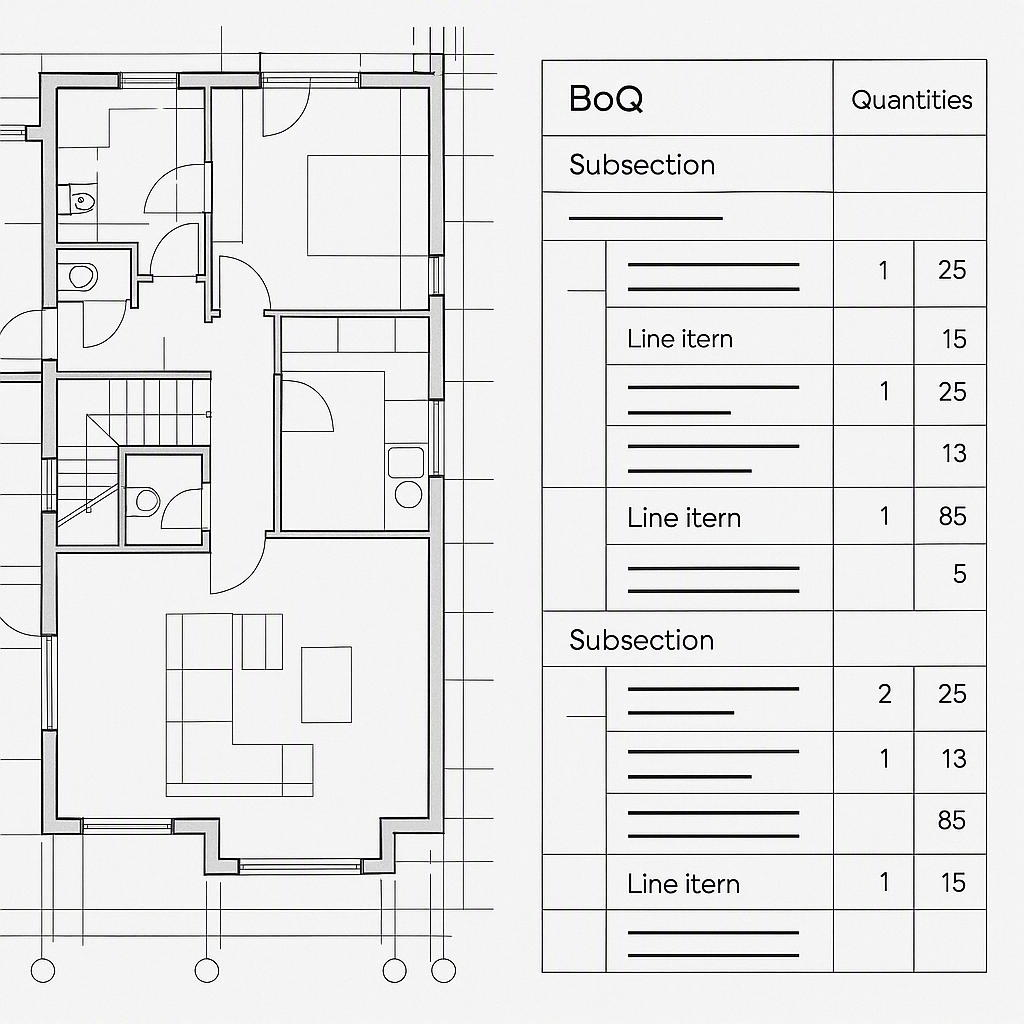
Example BOQ Format
| Level | Description | Unit | Quantity | Rate (₹) | Total Amount (₹) |
|---|---|---|---|---|---|
| Group | Civil Works | ||||
| Sub-section | Foundation | ||||
| Item | Excavation - Soft Soil | Cum | 500 | 120 | 60,000 |
| Item | RCC M25 for Foundation | Cum | 200 | 5,000 | 10,00,000 |
| Group Total | 10,60,000 |
Using this format ensures consistency, which is crucial for accurate estimation and billing. Industry standards like CESMM3 (Civil Engineering Standard Method of Measurement) can act as a guide to structure your BOQ effectively.
Actionable Steps
- Familiarize yourself with prevalent BOQ standards such as CESMM3 or IS 1200 based on your project location.
- Create a template that follows the hierarchy above.
- Present the BOQ in both printed and digital formats to ensure accessibility and ease of use.
2. Link BOQ Items to Scopes
A BOQ represents the client’s perspective, but you need to define how you’ll actually execute each item. This is where scope linking comes in.
Why Scope Linking Is Critical
Linking BOQ items to scopes ensures clarity in execution, prevents misunderstandings, and sets the stage for accurate billing. Without properly linking scopes, you risk misallocating resources or underestimating costs.
Example of Scope Linking
Let’s say your BOQ specifies:
- BOQ Item: RCC M25 for Foundation – 200 Cum
Your scope should break this down into specific tasks:
- Formwork: 250 Sqm
- Rebar: 16 MT
- Concrete Pouring: 200 Cum
Each task should have its own cost allocation and timeline, allowing you to track progress and budget usage accurately.
Tools to Streamline Scope Linking
Using software like JobNext can simplify this process. These platforms allow you to:
- Automatically break down BOQ items into detailed scopes.
- Define cost allocation for each scope.
- Track progress and billing in real-time.
3. Use Standardized Units and Conversion Factors
BOQ items often use units like Cum, Sqm, or Kg, but your execution might measure things differently. Standardized units and conversion factors are essential for alignment.
Example
- BOQ Item: Concrete in Cum
- Scope Measurement: Rebar in Kg
If 1 Cum of RCC work requires 80 Kg of reinforcement steel, this relationship must be documented clearly in the BOQ. Misaligned units can lead to disputes and billing errors.
Conversion Factor Table
| BOQ Unit | Scope Unit | Conversion Factor |
|---|---|---|
| Concrete (Cum) | Rebar (Kg) | 80 Kg / Cum |
| Masonry (Sqm) | Brick Count | 60 bricks / Sqm |
| Excavation (Cum) | Labor Hours | 15 hours / Cum |
Actionable Steps
- Document all conversion factors in the BOQ template.
- Verify unit alignment during estimation and billing.
- Train your team to use these conversion factors consistently.
Avoiding Common BOQ Mistakes
Mistake #1: Ignoring BOQ States
BOQs progress through distinct states:
- CREATED: The initial draft, subject to client approval.
- CONTRACTED: Finalized and signed.
- MEASURED: Quantities tracked for progress billing.
Skipping these transitions often leads to disputes and payment delays. Ensure every BOQ state is clearly documented, and regularly update it during the project lifecycle.
Actionable Steps
- Use software tools to manage BOQ states effectively.
- Train your team to distinguish between different states.
- Regularly review BOQ measurements to improve billing accuracy.
Mistake #2: Overcomplicating Variations
Variations are inevitable, but managing them properly is critical. Track every change order against its parent BOQ item and ensure client approval before execution.
Actionable Steps
- Use a variation log to document and track all changes.
- Include variation management as part of your project workflow.
- Use software like JobNext to automate variation tracking.
FAQ
Q: What’s the difference between CESMM3 and IS 1200?
A: CESMM3 is widely used in GCC countries for civil engineering BOQs, offering clearer guidelines for item descriptions and measurements. IS 1200 is the Indian standard, but it’s less detailed in certain areas. Choose based on your project location and client preferences.
Q: How do I handle BOQs with vague descriptions?
A: Push back for clarification before submitting bids. If that’s not possible, document assumptions clearly in your proposal to avoid disputes later.
Q: Can software really help with BOQ management?
A: Absolutely. Platforms like JobNext automate BOQ hierarchy creation, scope linking, and progress tracking. This reduces errors and saves time.
Q: How do I ensure BOQ items align with my subcontractor contracts?
A: Include subcontractor inputs during BOQ creation. Cross-reference their scope with BOQ items and clarify unit conversions beforehand.
Q: What’s the best way to manage variations during execution?
A: Use a variation log to track changes, and ensure all variation orders are approved in writing by the client before proceeding.
Conclusion
BOQ standards are the backbone of construction contracts in India and GCC countries. Get them wrong, and you’ll bleed money. Get them right, and you’ll protect your margins while improving client relationships.
If you're struggling with BOQ management, JobNext can help. From automated scope linking to accurate progress billing, it’s built to solve the problems discussed here. Get started free →
Learn more at EstimateNext