BOQ Format for Residential Building in PDF: Free Download + Expert Tips
If you’ve ever been handed a BOQ (Bill of Quantities) that looks like someone threw it together in a hurry, you know the frustration. Inaccurate quantities, poorly defined units, missing stages—it’s a recipe for margin erosion. For residential building projects, where margins are already tight, a sloppy BOQ can kill profitability before you even pour the foundation.
This guide gives you a free downloadable BOQ template for residential buildings (in PDF format) and practical tips to use it effectively. We’ll also show you how tools like JobNext can help eliminate BOQ headaches with structured workflows and built-in validation checks.
Why a Proper BOQ Format Matters
A BOQ isn’t just an itemized list. It’s the backbone of your residential project. Done right, it:
- Ensures accurate pricing by breaking down labor, materials, and other costs.
- Prevents scope creep by clearly defining deliverables.
- Sets the stage for transparent progress tracking and payment milestones.
But when done poorly, it invites disaster. Consider this typical scenario: the BOQ specifies "plastering" as a single line item. No details about the area, thickness, or type of plaster. The contractor underestimates the effort, and suddenly you’re absorbing the cost of additional material and labor.
In my experience, these kinds of vague BOQ entries lead to disputes, delays, and—worst of all—losses. To avoid these pitfalls, you need a clear, detailed, and validated BOQ format.
Key Benefits of a Well-Structured BOQ:
| Feature | Benefits |
|---|---|
| Detailed Specifications | Avoid disputes over ambiguous deliverables. |
| Accurate Costing | Prevent underestimation of labor and material costs. |
| Payment Milestones | Tie payments to measurable milestones, reducing financial uncertainty. |
| Scope Management | Clearly define project boundaries to avoid scope creep. |
Free BOQ Template for Residential Buildings
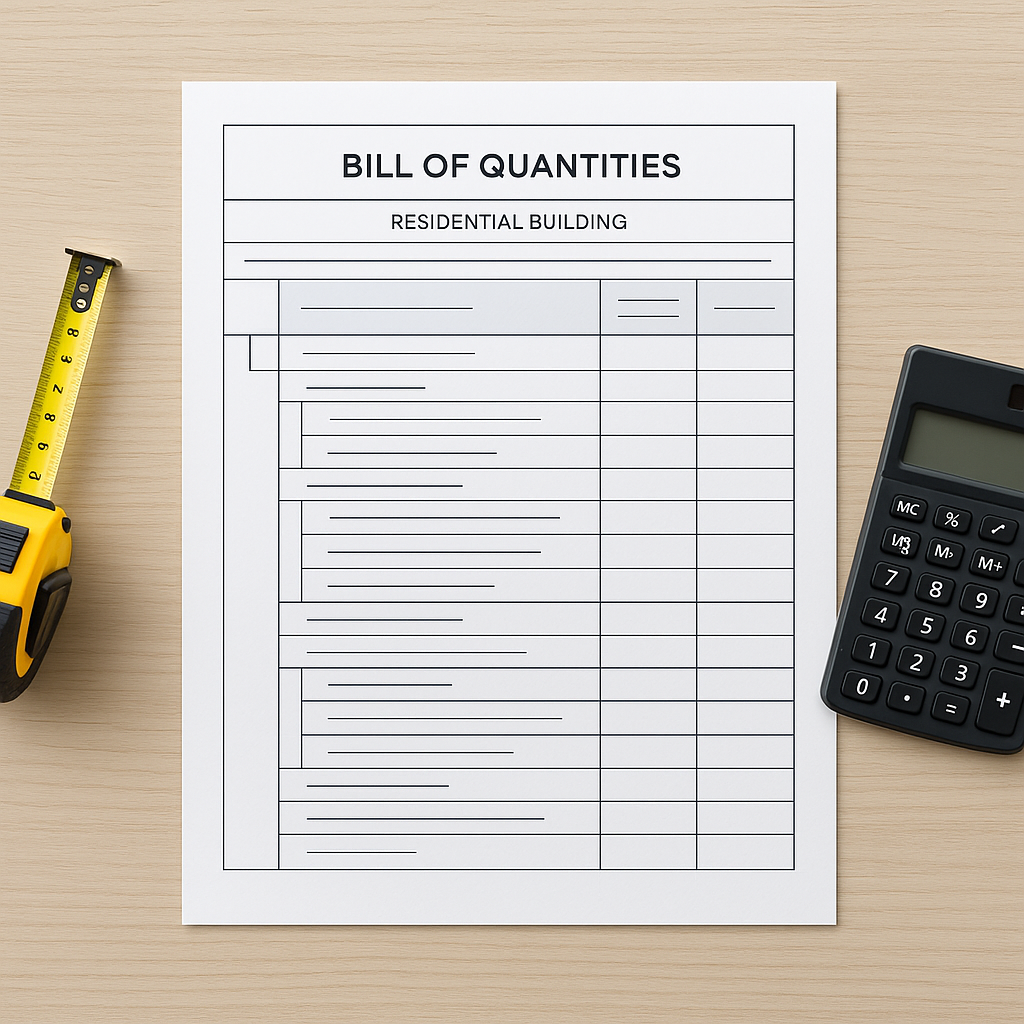
We’ve created a free, downloadable BOQ template in PDF format tailored for residential building projects. It includes:
- Line Items: Pre-filled examples like excavation, foundation, masonry, and plastering.
- Units of Measure (UOM): Cubic meters for concrete, square meters for tiling, etc.
- Stages: Split line items into milestones (e.g., Foundation 30%, Superstructure 40%, Finishing 30%).
Download the Free BOQ Template →
Expert Tips for Using the BOQ Template
Here’s how to make the most of the BOQ template:
1. Customize for Scope
Every residential project has unique requirements. Use the template as a starting point, but adapt it to your project’s specific scope. Some actionable ways to customize:
- Add Site-Specific Line Items: If your project requires site dewatering, piling, or special grade concrete, include these costs upfront.
- Account for Premium Features: For high-end projects, include line items for luxury finishes like marble flooring or imported fixtures.
- Adjust Quantities: Be realistic about quantities based on the actual design and size of the building. Avoid generic estimates.
2. Code Your Line Items
Assigning unique codes to each BOQ line item helps streamline tracking, billing, and procurement. For example:
| Line Item Code | Description | UOM | Quantity | Rate | Amount |
|---|---|---|---|---|---|
| EXC-01 | Excavation Work | CUM | 100 | 500 | 50,000 |
| RCC-02 | RCC Work - Slab | CUM | 50 | 7,000 | 3,50,000 |
Why is coding important? It simplifies documentation and enables integration with project management tools like JobNext.
3. Validate Units and Quantities
Misaligned units of measure (UOM) are a hidden killer. For example, concrete listed in cubic meters but billed in bags of cement can create confusion. Actionable tips:
- Cross-check quantities with design drawings.
- Ensure UOM aligns with your supplier’s billing format.
- Use tools like JobNext to automate unit validation.
4. Use Stage-Wise BOQs for Better Control
Stage-wise BOQs tie payments to measurable milestones, reducing disputes. For residential projects, common stages include:
| Milestone | Percentage of Payment |
|---|---|
| Foundation | 30% |
| Superstructure | 40% |
| Finishing | 30% |
Actionable steps:
- Define clear criteria for milestone completion (e.g., "Foundation complete" means excavation, casting, and inspection).
- Use tools like JobNext to automate progress tracking and milestone billing.
Common BOQ Mistakes (and How to Avoid Them)
Mistake 1: Overlooking Hidden Costs
Example: Your BOQ lists "RCC Slab, 150 mm thick" but skips reinforcement details. As steel costs escalate, you’re left scrambling to cover the shortfall.
Solution: Always include detailed specifications for each line item. For example:
| Description | UOM | Quantity | Rate | Amount |
|---|---|---|---|---|
| RCC Slab (150 mm) | CUM | 50 | 7,000 | 3,50,000 |
| Steel Reinforcement | MT | 5 | 50,000 | 2,50,000 |
Mistake 2: Skipping Validation
A single typo in your BOQ can cost you lakhs. For example, listing "500" cubic meters for concrete when the actual requirement is "50" results in massive over-ordering.
Solution: Double-check quantities, rates, and totals. Use templates with built-in validation fields or automate checks with project management software.
Mistake 3: Ignoring Variations
Projects evolve. If the client changes the scope mid-project, update the BOQ immediately. Failing to capture these changes can lead to disputes and financial losses.
Solution: Maintain a variation order log linked to the BOQ. Tools like JobNext allow you to track scope changes and their impact on costs.
How JobNext Streamlines BOQ Management
Managing BOQs manually can be a nightmare. Tools like JobNext simplify the process and minimize errors. Key features include:
- Excel Uploads: Import your BOQ directly from Excel into the system. No retyping, no errors.
- Stage Validation: Automatically ensures all stages add up to 100%.
- Real-Time Dashboards: Track budget utilization and progress for each BOQ item.
- Integrated Billing: Link BOQ items to subcontractor payments and GST compliance.
FAQ: BOQ for Residential Buildings
Q: Can I use the same BOQ format for commercial buildings?
A: Yes, but you’ll need to adjust for different line items like fire-fighting systems, HVAC, and elevators.
Q: How do I handle GST and TDS in BOQs?
A: Tools like JobNext integrate GST/TDS compliance into billing workflows. For manual BOQs, include a separate line item for taxes and ensure proper documentation.
Q: What’s the best way to manage subcontractor costs?
A: Use measurement-based progress tracking. JobNext ties subcontractor bills directly to BOQ measurements, preventing overpayments.
Q: How often should a BOQ be updated?
A: Update the BOQ whenever there’s a scope change or variation order. Regular reviews prevent disputes and ensure accurate billing.
Q: Are digital tools necessary for BOQ management?
A: While manual methods work, digital tools like JobNext offer automation, validation, and tracking that save time and reduce errors.
The Bottom Line
A well-structured BOQ is your best defense against cost overruns and disputes. Use our free template to get started, and if you’re ready for a more automated approach, tools like JobNext can take your BOQ management to the next level.
Learn more at EstimateNext