Bill of Quantities vs Bill of Materials: Key Differences for Contractors
If you’ve ever worked on a construction project, you know that miscommunication can significantly impact project margins. One area where contractors often face challenges is understanding the difference between a Bill of Quantities (BOQ) and a Bill of Materials (BOM). Confusing these two can lead to cost overruns, delays, and even disputes with clients.
Let’s break it down.
What Is a Bill of Quantities (BOQ)?
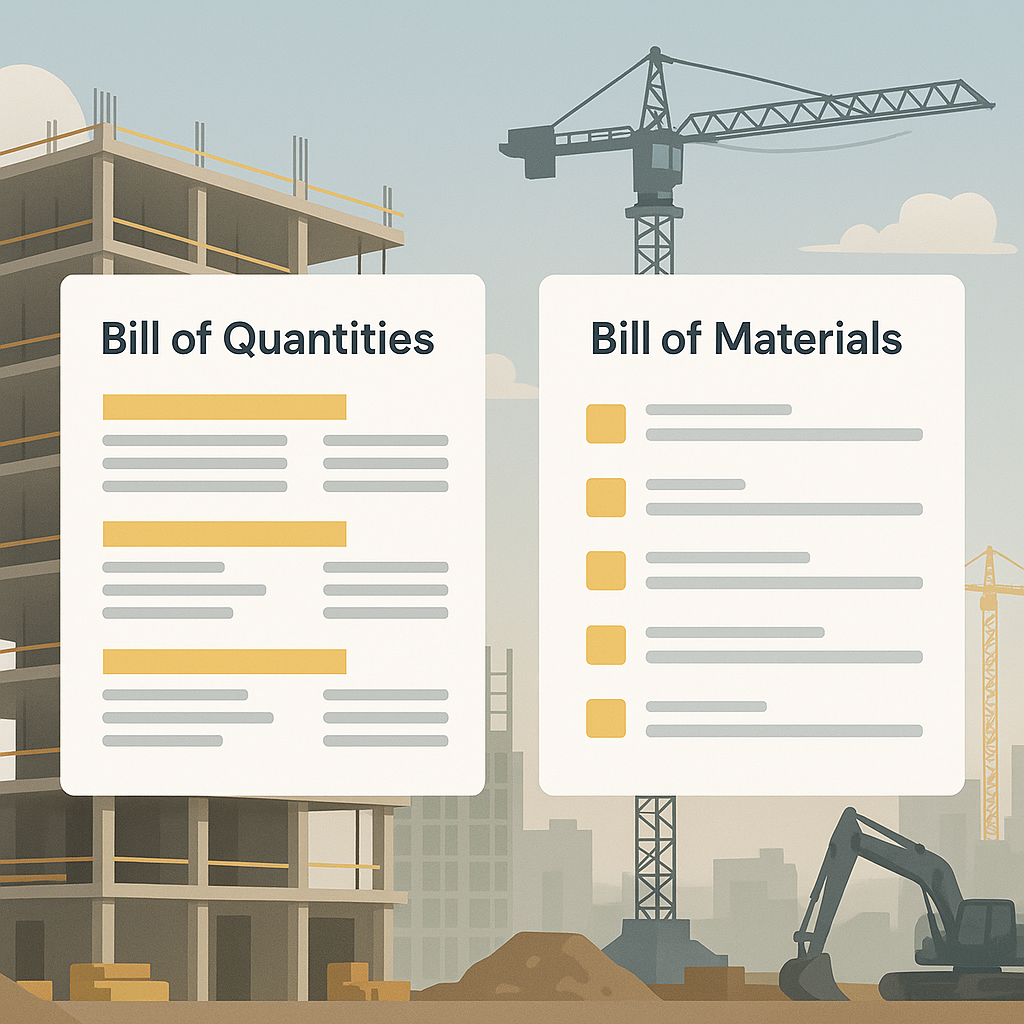
A Bill of Quantities (BOQ) is a structured document that lists all the deliverables a client expects from a contractor. Think of it as the client’s shopping list for the project. It’s organized into a hierarchy of items, each with a description, quantity, unit of measure, and rate. For example:
| Item Code | Description | Unit | Quantity | Rate (₹) | Amount (₹) |
|---|---|---|---|---|---|
| 01 | Excavation | m³ | 250 | 150 | 37,500 |
| 02 | Concrete (M25) | m³ | 150 | 5,000 | 750,000 |
| 03 | Reinforcement Steel | kg | 1,200 | 70 | 84,000 |
Illustrative example — BOQ structure.
A BOQ is the backbone of the entire project lifecycle. It drives:
- Cost estimation: The BOQ’s rates and quantities help estimators build budgets.
- Progress tracking: Measurements recorded against BOQ items allow contractors to prove work completion to clients.
- Client billing: Milestone-based payments often reference BOQ items for calculations.
- Variation tracking: Any changes to client requirements or scope are linked back to the BOQ.
What Is a Bill of Materials (BOM)?
A Bill of Materials (BOM), on the other hand, is a recipe for production. It specifies the raw materials and quantities needed to create a finished product. Contractors typically use BOMs for in-house manufacturing, like producing ready-mix concrete or prefabricated building components.
For example:
| Parent Material | Component Material | Quantity per Unit | Unit of Measure |
|---|---|---|---|
| M25 Ready-Mix Concrete | Cement | 300 | kg |
| Sand | 750 | kg | |
| Aggregate | 1,500 | kg | |
| Water | 180 | L |
Illustrative example — BOM structure.
The BOM is production-focused:
- Procurement planning: Knowing exactly what raw materials are needed avoids over-purchasing or running out.
- Quality control: Standardized recipes ensure consistent product quality.
- Cost control: Tracking raw material consumption helps prevent wastage and reduce costs.
BOQ vs BOM: Where Contractors Go Wrong
Here’s the problem: Many contractors treat BOQs and BOMs interchangeably. That’s a mistake.
- Misaligned expectations: Mixing up deliverables (BOQ) with recipes (BOM) can lead to disputes with clients. For instance, if a client expects 250 m³ of M25 concrete from your BOQ, but your BOM recipe produces slightly less due to wastage, you’ll need to track and justify the difference.
- Poor cost tracking: Using a BOM to price a project instead of a BOQ can lead to underestimation—especially if you forget overheads like labor and equipment.
- Billing errors: BOQs drive client billing, while BOMs guide internal production. Confusing the two can result in billing discrepancies.
How to Avoid BOQ-BOM Confusion
Here’s what we recommend:
-
Separate BOQ and BOM workflows: Use the BOQ for client-facing deliverables and the BOM for internal production planning. Many ERP systems create separate modules for this exact reason.
-
Track progress at the BOQ level: Measurements should align with BOQ items—not BOM recipes. This ensures that client bills reference BOQ items and their contracted rates, avoiding disputes over internal material usage.
-
Use software to link BOQs and BOMs: ERP platforms provide structured workflows. A BOQ item for “M25 concrete” can auto-link to its BOM recipe, ensuring seamless tracking from procurement to production to billing.
-
Validate rates with estimation tools: Estimators can use rate-matching tools to ensure BOQ rates are competitive and defensible.
FAQ: Common Questions About BOQ and BOM
1. Can a single project have both a BOQ and a BOM?
Yes, especially on design-build contracts or projects involving significant in-house manufacturing. The BOQ defines what the client expects; the BOM helps you produce components to meet those expectations.
2. How do I handle variations between BOQ and BOM quantities?
Use progress tracking and measurement tools to document actual quantities. This helps reconcile discrepancies between what was delivered (BOQ) and what was consumed (BOM).
3. Are BOQs used for subcontractor management?
Absolutely. BOQ items often feed directly into subcontractor work orders and progress tracking.
4. Can I bill directly from a BOM?
Not for client-facing contracts. BOMs are internal documents focused on production. Client billing should always reference BOQs to align with the contract.
5. How do I create BOQs and BOMs?
Most contractors use spreadsheets, but this can lead to errors. ERP platforms offer dedicated BOQ and BOM modules with built-in validation checks.
Common Mistakes and How to Avoid Them
-
Not updating the BOQ after contract changes: Always revise BOQs to reflect scope variations. Structured BOQ tools can ensure all changes are tracked and linked to contracts.
-
Overlooking wastage in BOM recipes: Factor in material losses when creating BOMs. For example, ready-mix concrete may lose a percentage during transport and pouring.
-
Using the wrong billing method: Match your billing method to the BOQ structure. For milestone projects, stage-wise billing is ideal, while monthly billing works better for recurring service contracts.
The Bottom Line
BOQs and BOMs aren’t just technical documents—they’re tools to protect your margins. Mixing them up can lead to miscommunication, cost overruns, and disputes. But when managed effectively, they become powerful allies.
Understanding the differences and using the right tools to manage these documents can help contractors streamline their workflows and improve project outcomes.
Learn more at EstimateNext