Why BOQs Matter for Your Margins
Every contractor knows the pain of a project running over budget. But the problem often starts before the first bag of cement is poured — in the Bill of Quantities (BOQ). If your BOQ is sloppy, your estimates are wrong. And if your estimates are wrong, your margins vanish.
BOQs aren’t just paperwork; they’re the foundation of your project’s financial health. They define deliverables, quantities, and rates. But here’s the catch: even small mistakes in a BOQ can snowball into significant cost overruns.
So, how do you avoid these mistakes? The answer is a structured BOQ process. Let’s break it down.
Step 1: Structure Your BOQ Hierarchically
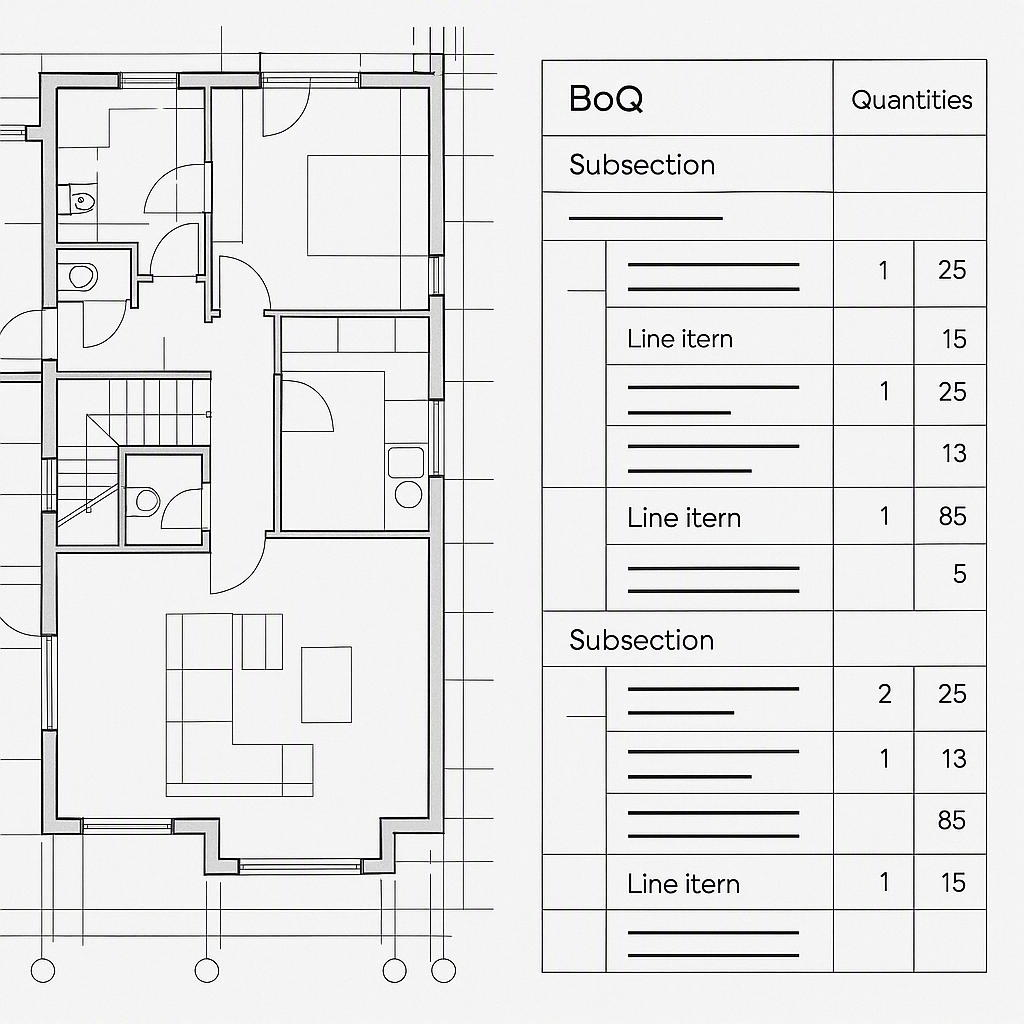
A BOQ isn’t just a list of items. It’s a hierarchy. Here’s how:
- Groups: Broad categories like “Civil Works” or “Electrical.”
- Sub-sections: Specific parts within a category, e.g., “Foundation.”
- Items: Individual deliverables like “RCC M25 for foundation.”
Each item includes a description, unit of measure (UOM), rate, and quantity. Only leaf-level items (the lowest level in the hierarchy) carry rates and quantities. Parent items act as headers.
Illustrative example:
| Group | Sub-section | Item | Quantity | Rate | Total Amount |
|---|---|---|---|---|---|
| Civil Works | Foundation | RCC M25 for foundation | 500 CUM | ₹1200 | ₹6,00,000 |
| Civil Works | Foundation | Excavation for foundation | 400 CUM | ₹300 | ₹1,20,000 |
| Civil Works | Superstructure | RCC M30 for columns | 200 CUM | ₹1500 | ₹3,00,000 |
Step 2: Use Templates to Standardize
Standardization is key to accuracy. Using templates allows you to create BOQs directly from your organization’s Work Breakdown Structure (WBS) library. This ensures consistent units, descriptions, and rates across all projects.
Here’s how it works:
- Open the enquiry and navigate to the Requirements (BOQ) section.
- Use your organization’s standardized templates.
- Select items relevant to the project and confirm.
- Edit quantities or rates if needed.
This approach eliminates manual errors and ensures your BOQ aligns with your execution plan.
Step 3: Validate Rates and Quantities
BOQ errors often come from incorrect rates or quantities. Avoid these pitfalls by validating:
- Rates: Use centrally managed rate schedules. Break down each rate into materials, labor, and plant costs to ensure consistent pricing.
- Quantities: Cross-check against drawings and site conditions. For complex projects, consider estimate-based quotes for bottom-up costing.
Pro tip: Never lump provisional sums and contingencies into a single line item. They’re not the same money.
Step 4: Link BOQs to Execution
A BOQ isn’t just for preconstruction. It drives execution. Each BOQ item can be linked to scopes, estimates, and progress tracking.
For example, as work progresses, you can record measurements against BOQ items. These measurements flow into RA Bills, ensuring accurate client billing.
Example:
- Record completed quantities for “RCC M25 for foundation.”
- Approve measurements internally.
- Generate RA Bill based on BOQ rates × measured quantities.
Step 5: Track Progress and Variations
BOQs are dynamic. As the project evolves, variations happen. Maybe the client changes the scope or site conditions require adjustments.
Tracking progress at the scope level and rolling it up to the BOQ level ensures:
- Accurate reporting to clients.
- Real-time visibility into cost impacts.
Common BOQ Mistakes (and How to Fix Them)
- Missing Items: Always cross-check with drawings.
- Wrong UOM: Ensure units match site practices.
- Provisional Quantities: Tag them clearly as “P” to avoid confusion.
- Lumped Rates: Break rates into components — materials, labor, plant.
- Unclear Hierarchy: Use a structured format to avoid chaos.
FAQ
Q: How do I handle BOQ variations during execution?
Track them using scope linking. Update progress measurements and adjust RA Bills accordingly.
Q: Can I use BOQs for supply-only projects?
Yes, BOQs can be adapted for supply-only contracts by focusing on inventory and delivery requirements.
Q: What’s the best quoting method for large projects?
Use Estimate-based Quotes for detailed costing. For simple jobs, faster quoting methods may suffice.
Call to Action
If you're tired of losing margins to BOQ errors, structured BOQ workflows can help ensure accuracy from estimation to billing.
Learn more at EstimateNext