5 Key Purposes of a Bill of Quantities (BOQ) Contractors Often Overlook
When was the last time you looked at a Bill of Quantities (BOQ) and thought, "This is more than just a pricing document"? For most contractors, the BOQ is treated as a simple tool to break down project costs. But if that's all you're using it for, you're leaving money on the table—or worse, risking margin erosion and project disputes.
Here’s the thing: a BOQ can be one of the most powerful tools in a contractor’s arsenal if used properly. It’s not just about pricing items; it’s about communication, risk management, and control.
Let’s dive into five often-overlooked purposes of a BOQ that can significantly impact your project margins and overall efficiency when managed properly.
1. Establishing Scope Clarity
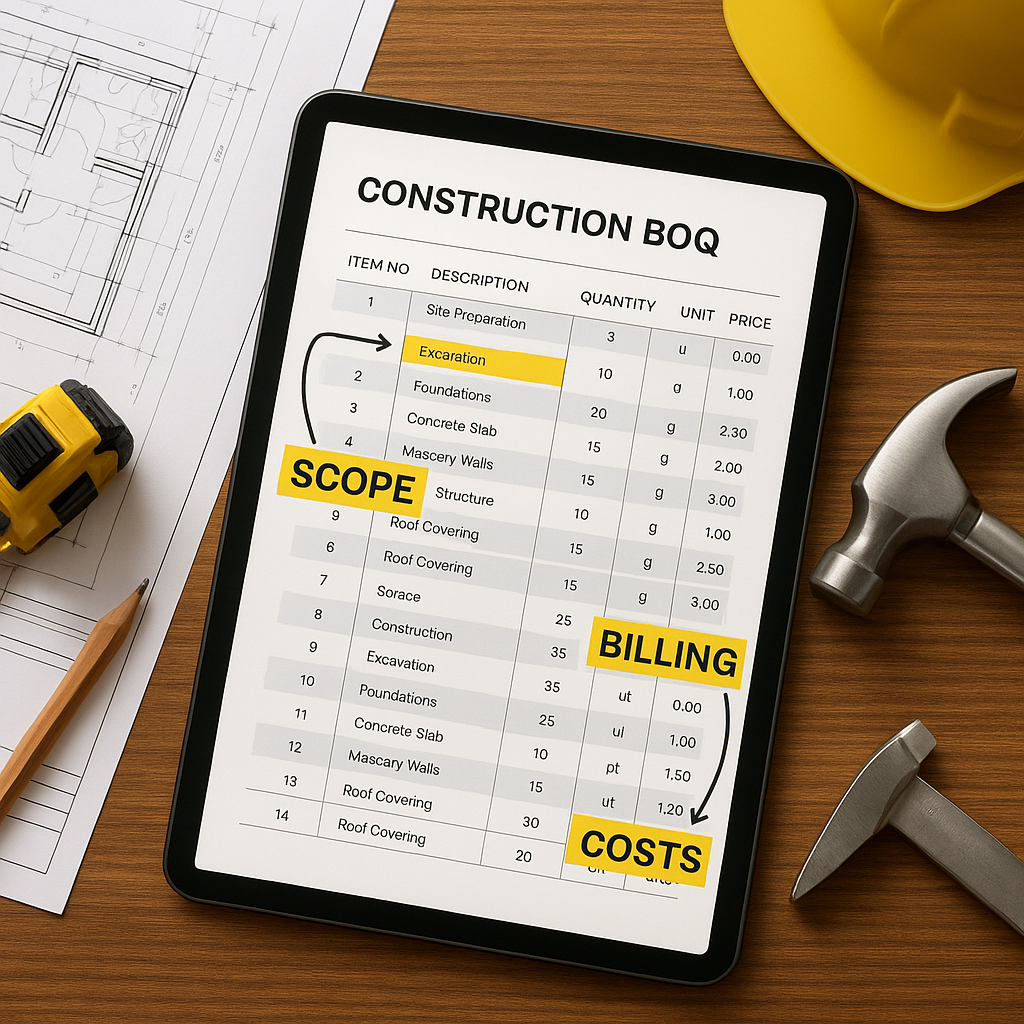
A BOQ is not just a pricing sheet; it’s a scope-defining document. Every single line item in the BOQ represents a deliverable that the client expects. Here’s where many contractors falter: vague or incomplete BOQs. If items are poorly defined or overly broad, you’re setting yourself up for disputes, delays, and costly rework when the client inevitably claims, "This wasn’t included."
Why Scope Clarity Matters
When a BOQ lacks precision, you open the door to misunderstandings. For example, let’s say your BOQ has a line item for "Wall Finishing." That might seem straightforward, but does it include:
- Surface preparation (filling cracks, leveling)?
- Primer?
- One coat of paint or two?
- Special finishes like texture or waterproofing?
If the BOQ doesn’t spell out these details, you’re left guessing—and guessing costs money, time, and reputation.
Actionable Steps to Improve Scope Clarity
- Be Specific: Break down ambiguous tasks into granular line items. For instance, instead of "Wall Finishing," you could list:
- Surface Preparation (per square meter)
- Primer Application (per square meter)
- Painting (per coat, per square meter)
- Establish a Hierarchy: Organize your BOQ into work breakdown structures (WBS), which group tasks into logical categories (e.g., substructure, superstructure, finishes).
- Cross-Reference Specifications: Align the BOQ with the contract’s technical specifications. If there’s a mismatch, address it before the project starts.
Tools to Help
Platforms like JobNext allow you to structure BOQs hierarchically and tie each item to a specific scope, ensuring that everyone—clients, project managers, and subcontractors—is on the same page. This eliminates ambiguity and reduces the likelihood of disputes.
2. Accurate Progress Billing
Many contractors see the BOQ as a tool for setting up initial budgets, but its real value comes during the execution phase. A detailed BOQ provides the foundation for progress-linked billing, ensuring you’re paid fairly and on time for the work you’ve completed.
The Problem with Poor Progress Tracking
Without a system to track progress against BOQ items, you risk:
- Underbilling: Leaving money on the table for work already completed.
- Overbilling: Billing ahead of progress, which can lead to disputes or strained client relationships.
Both situations can hurt your cash flow and profitability.
How to Leverage BOQs for Progress Billing
- Define Measurable Units: Ensure every item in the BOQ has a clear unit of measure (e.g., cubic meters, square meters, kilograms, etc.) and a corresponding rate.
- Regularly Update Quantities: Track completed work on a weekly or monthly basis and update quantities in the BOQ.
- Automate Billing: Use tools that allow you to link completed quantities directly to invoices, ensuring accuracy and timeliness.
Real-World Example
Let’s say your BOQ has the following line item:
- Concrete (M³): Quantity = 500 M³, Rate = ₹5,000 per M³
After pouring 200 M³ of concrete, you can immediately bill ₹1,000,000 if your BOQ is set up for progress billing. Without this structured approach, you risk delaying payments or underbilling.
Why It Matters
Progress billing ensures steady cash flow, reduces financial strain, and keeps clients accountable for payments. Contractors who wait until major milestones are completed often struggle with delayed payments and cash flow bottlenecks.
3. Variation Management
Let’s be honest: variations are a profit-killer for unprepared contractors. Clients change their minds, designs evolve, and suddenly you’re doing extra work without extra pay—unless your BOQ is set up to handle it.
The Role of BOQs in Managing Variations
A well-crafted BOQ captures not just base deliverables but also provides a framework for handling variations. When the scope changes, you can link the new work directly to the original BOQ to ensure you’re compensated fairly.
How to Handle Variations Effectively
- Document Everything: When a client requests a change, document it immediately. Include details like:
- Description of the change
- Additional quantities or tasks required
- Impact on timelines and costs
- Revisit the BOQ: Add the variation as a new line item in the BOQ or update the quantities for existing items.
- Agree on Pricing Upfront: Ensure the client approves the variation cost before starting work.
Pro Tip
Tools like JobNext allow you to add variations directly within your BOQ’s hierarchy, ensuring changes are documented, priced, and billed without delays. This minimizes disputes and ensures transparency.
4. Cost-to-Deliver Analysis
A BOQ isn’t just for client pricing—it’s also a critical tool for internal cost control. Each BOQ item represents an opportunity to analyze your cost-to-deliver and identify margin risks.
Common Mistakes
- Static Pricing: Many contractors price BOQ items based on outdated data or gut feel, only to discover later that their actual costs exceed estimates.
- Ignoring Breakdown Costs: Failing to break down costs (e.g., materials, labor, plant) leaves you blind to inefficiencies.
Steps for Conducting Cost-to-Deliver Analysis
- Break Down Costs per Item: For every BOQ item, calculate:
- Material cost
- Labor cost
- Plant and equipment cost
- Analyze Margins: Compare your estimated cost against the client rate to ensure profitability. For example:
| BOQ Item | Client Rate (₹) | Estimated Cost (₹) | Margin (₹) |
|---|---|---|---|
| Concrete (M³) | 5,000 | 4,200 | 800 |
| Painting (M²) | 200 | 180 | 20 |
- Update Regularly: As costs fluctuate (e.g., material price hikes), update your BOQ to reflect the new reality.
5. Audit Trail for Compliance
In regions like India and the GCC, compliance is non-negotiable. Whether it’s GST, TDS, or GCC-specific statutory deductions, your BOQ can serve as a critical audit trail if properly linked to financial and regulatory frameworks.
What’s Often Missed
Many contractors don’t integrate their BOQs with compliance requirements. This leads to gaps during audits, penalties, or even delayed payments.
How to Ensure Compliance
- Link BOQs to Taxation Systems: Ensure every BOQ item aligns with GST, VAT, or other local tax requirements.
- Track Deductions: Use software to automate deductions like TDS or retainage.
- Maintain Documentation: Keep a record of every change, invoice, and payment tied to the BOQ.
FAQ
Q1: Can a BOQ prevent disputes with clients?
A: Absolutely. A detailed BOQ clarifies scope, reducing the chances of disagreements over deliverables.
Q2: How do I handle variations in a BOQ?
A: Document variations as they occur, price them fairly, and ensure client approval before execution. Tools like JobNext can help manage this seamlessly.
Q3: What’s the best way to link BOQs to compliance?
A: Integrate your BOQ with finance modules to automate GST, TDS, and other statutory deductions.
Q4: Can I use a BOQ for internal cost control?
A: Yes. Break down each BOQ item into material, labor, and plant costs to monitor margins and avoid cost overruns.
Q5: Should provisional sums be included in the BOQ?
A: Yes, but clearly label them as placeholders to avoid confusion during execution.
Final Thoughts
A BOQ is much more than a pricing document—it’s a roadmap for scope clarity, progress tracking, variation management, cost control, and compliance. If you’re not leveraging it fully, you’re leaving money—and peace of mind—on the table.
Take the time to craft detailed, accurate BOQs and use the right tools to manage them. Platforms like JobNext can make the process more efficient, ensuring you maximize profits while minimizing risks.
Learn more at EstimateNext