BOQ Management: Your Profitability Depends on It
If you’re a contractor, you probably have a love-hate relationship with BOQs (Bill of Quantities). They’re the backbone of your project planning and billing, but they’re also where your margins quietly disappear.
Ever finished a project only to find your profits were half of what you expected? You’re not alone. The culprit is often buried in your BOQ: inaccurate estimates, untracked changes, or mismatched actuals versus budgets. Let’s talk about how a good BOQ app can change that.
The Problem: BOQs Are a Margin Minefield
At its core, a BOQ is supposed to make your project manageable. It breaks down work into specific deliverables, assigns quantities, and helps you price everything out. Sounds simple, right? But here’s the catch: BOQs are only as good as the data behind them.
1. Estimation Errors
A 2021 McKinsey report revealed that poor cost estimation leads to 80% of construction projects going over budget. Estimation errors can happen for several reasons:
- Lack of historical data: Contractors often rely on best guesses instead of actual costs from previous projects.
- Overlooking contingencies: Small unforeseen issues, like material shortages or delays, can compound into significant cost overruns.
- Unit rate mismatches: If your BOQ pricing is outdated or inconsistent with current market rates, you’re setting yourself up for failure.
2. Scope Creep
Scope creep is the silent killer of profitability. It happens when additional work sneaks into the project without formal adjustments to the BOQ. Examples include:
- Client-requested changes without proper documentation.
- Miscommunication between stakeholders about what is included in the scope.
- Failure to account for necessary rework or extra deliverables.
3. Disconnected Systems
If your BOQ lives in Excel, while procurement and billing are handled in separate tools (or manually), you’ve already lost control. Disconnected systems make it impossible to:
- Track changes to the BOQ in real time.
- Ensure procurement and invoicing align with BOQ quantities and rates.
- Compare projected costs versus actuals without manual reconciliation, which takes time and introduces errors.
The Fix: A BOQ App That Actually Works
Here’s where a tool like JobNext comes in. It doesn’t just digitize your BOQ; it integrates it into your project’s lifecycle. Here’s how that works:
1. BOQ Creation and Import
Forget manually entering 500 BOQ items. JobNext allows for seamless BOQ creation and imports from Excel. Here’s why this is game-changing:
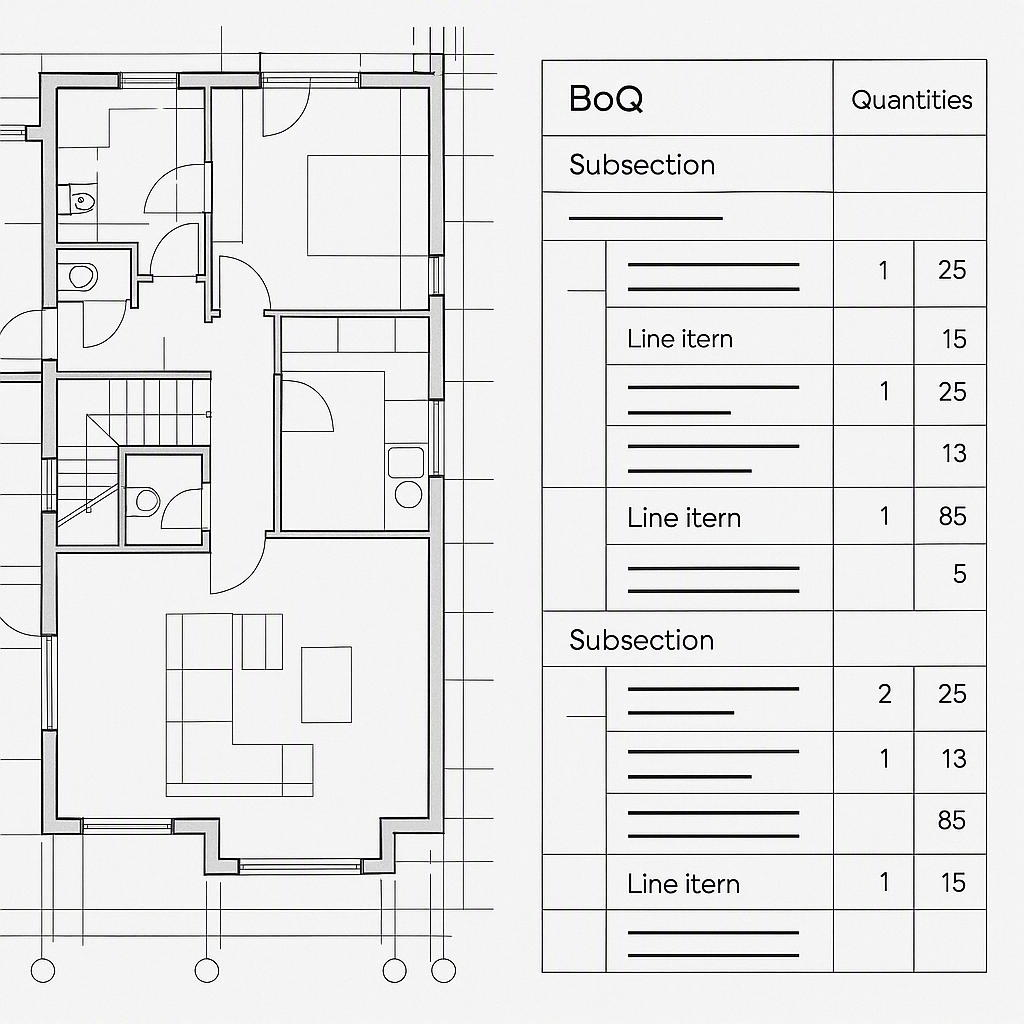
- Structured Hierarchy: BOQs can be grouped into categories (e.g., Civil Works, MEP) with individual items under each group. This organization helps contractors visualize costs at both macro and micro levels.
- Unit Rate Flexibility: Each item can have its unit, rate, and quantity assigned—ensuring precise tracking against budgets.
- Eliminating Manual Errors: Automating BOQ entry reduces the likelihood of transcription mistakes or skipped items.
Actionable Steps:
- Use standard templates for BOQs to simplify imports.
- Regularly update your database of unit rates and quantities to reflect market conditions.
- Categorize BOQ items logically to ensure quick identification and tracking.
2. Real-Time Cost Tracking
Real-time tracking is crucial for spotting margin erosion before it becomes a problem. JobNext’s BOQ Margin report compares contracted rates with actual costs for labor, materials, subcontractors, and more.
- Weekly Margin Checks: Contractors should review margin reports on a weekly basis to identify discrepancies early.
- Labor and Material Tracking: By linking procurement and labor costs directly to BOQ items, you’ll see exactly where overspending occurs.
- Cost Alerts: Good BOQ apps flag overspending automatically, so you can address issues immediately.
Actionable Steps:
- Set up notifications for margin erosion in your BOQ app.
- Create a checklist for weekly margin report reviews.
- Train your team to update actual costs as they occur.
3. Measurement-Based Billing
Revenue leakage often happens during billing. JobNext prevents this by tying invoices directly to measured BOQ items. This ensures:
- Accuracy: You only bill for work that’s actually completed, reducing disputes with clients.
- Transparency: Clients can see detailed measurements tied to invoices, building trust.
- Avoiding Under-Billing: Teams often forget to bill for completed work. BOQ-based billing ensures nothing falls through the cracks.
Actionable Steps:
- Conduct regular site inspections to verify measurements before invoicing.
- Use your BOQ app to automate RA Bills (Running Account Bills).
- Share progress reports with clients to minimize disputes.
4. Progress Dashboards
How do you know if you’re on track? JobNext’s BOQ dashboard gives real-time updates on:
- Percentage Completion: Monitor how much of each BOQ item has been completed.
- Quantity Updates: Keep tabs on quantities completed versus total planned quantities.
- Cost vs. Budget: Compare actual spending with projected budgets to identify problem areas.
Actionable Steps:
- Use dashboards as part of weekly project review meetings.
- Train site engineers to update progress daily.
- Integrate dashboards with procurement and billing workflows for a seamless view.
Why Other Solutions Fall Short
Excel: Too Manual
While Excel is flexible, it’s not built for long-term BOQ management. Common pitfalls include:
- Manual entry errors.
- Lack of real-time integration with procurement and billing.
- No automated margin tracking.
Generic ERPs: Too Rigid
Generic ERP systems often fail because they don’t cater to the specific needs of contractors. For example:
- Limited support for hierarchical BOQ structures.
- Complex workflows that slow teams down.
- Poor integration with construction-specific tools like measurement-based billing.
Why JobNext Stands Out
JobNext is designed specifically for contractors. Its features align directly with how construction teams work, making it easier to:
- Manage large BOQs without errors.
- Track costs in real time.
- Integrate workflows across procurement, billing, and progress tracking.
FAQ: BOQ Apps and Profitability
1. Can’t I just track BOQs in Excel?
You can, but it’s inefficient and error-prone. Excel lacks automation features like margin tracking, real-time updates, and integration with procurement and billing systems. Switching to a purpose-built BOQ app saves time and reduces costly mistakes.
2. How does a BOQ app handle scope changes?
Good BOQ apps like JobNext allow you to update BOQs mid-project and track the impact on costs and margins. This ensures you can account for scope changes while maintaining profitability.
3. Do BOQ apps work for smaller contractors?
Absolutely. Structured workflows prevent mistakes, even for small teams. Features like automated billing and margin tracking can save smaller contractors significant time and money.
4. How do BOQ apps improve client relationships?
BOQ apps bring transparency to the process. Clients can see detailed measurements tied to invoices, reducing disputes and building trust. Real-time dashboards also give clients a clearer sense of project progress.
5. What’s the ROI on a BOQ app?
The ROI comes from reduced labor hours, fewer billing disputes, and better margin tracking. Contractors often find that the cost savings from avoiding margin erosion far outweigh the app subscription fees.
Decision Framework: Choosing the Right BOQ App
| Feature | Excel | Generic ERP | JobNext |
|---|---|---|---|
| BOQ Import/Creation | Manual | Basic | Automated |
| Real-Time Tracking | No | Limited | Yes |
| Measurement-Based Billing | No | No | Yes |
| Progress Dashboards | No | Limited | Comprehensive |
| Integration | None | Basic | Seamless |
| Margin Alerts | No | No | Yes |
Don’t Let Your BOQ Sink Your Profits
If you’re tired of losing margins due to poor BOQ management, a tool like JobNext can help. It’s not just software—it’s a way to run your projects profitably. Learn more here →
Learn more at EstimateNext