Beam AI Takeoff: How Contractors Can Avoid Quantity Errors and Boost Margins
The Cost of Quantity Errors in Construction
Construction projects are often plagued by one persistent issue: quantity errors in takeoffs. These errors are a silent killer of profitability, and they can derail even the most meticulously planned projects. Ever had to explain why material costs overshot estimates or why labor stretched two weeks longer than planned? Missed quantities in takeoffs are often the main culprit.
In my experience, quantity errors are far more common than contractors admit. A missed line item here, an incorrectly calculated volume there—it all adds up quickly. And these aren’t just rookie mistakes. Even experienced estimators fall victim, often due to outdated processes like relying on spreadsheets or working off static PDFs.
Let’s break down exactly why these errors happen and how AI-powered tools like Beam AI Takeoff can help contractors avoid them.
Why Manual Takeoffs Fail
Manual takeoffs have been the standard for decades, but they’re riddled with inefficiencies and prone to human error. Here’s why they fail:
1. Flat PDFs and Manual Entry
Many construction teams still work with flat PDFs, requiring painstaking manual measurements and data entry. Every line item has to be measured, entered into spreadsheets, and double-checked. Human fatigue, distractions, or even a simple misclick can lead to errors that snowball downstream.
2. Version Confusion
Have you ever had two teams working off different drawing revisions? By the time you realize the mistake, you may already have the wrong quantities on-site, leading to delays, rework, and ballooning costs. Version control is often neglected in manual workflows, and the consequences can be severe.
3. Scope Gaps
When Bills of Quantities (BOQs) aren’t directly linked to the actual project scope, hidden costs can surface. Subcontractor scopes or material requirements might not align perfectly with the BOQ, leaving contractors exposed to expensive surprises.
4. Overlooked Accumulated Errors
Small errors on individual line items can seem negligible, but across hundreds (or thousands) of items, the cumulative impact can be devastating. A 2% inaccuracy on 20 material line items might result in thousands—or even millions—of dollars lost over the course of a project.
The Financial Toll
A 2022 Construction Dive report found that rework caused by bad data costs the construction industry $31 billion annually. Think about that: $31 billion lost due to preventable errors. For individual contractors, these losses could mean the difference between profit and financial instability.
How Beam AI Takeoff Fixes the Problem
AI-powered tools like Beam AI Takeoff are transforming the quantity takeoff process by automating the hardest parts and drastically reducing the margin for error. Here’s how they work:
1. Automated Quantity Extraction
Beam AI scans drawings directly, identifying and extracting quantities with precision. This eliminates manual measurements and data entry, reducing the chances of error while saving hours of work. For example, instead of manually calculating the square footage of flooring from a drawing, Beam AI does it instantly and accurately.
2. Direct Integration with BOQs
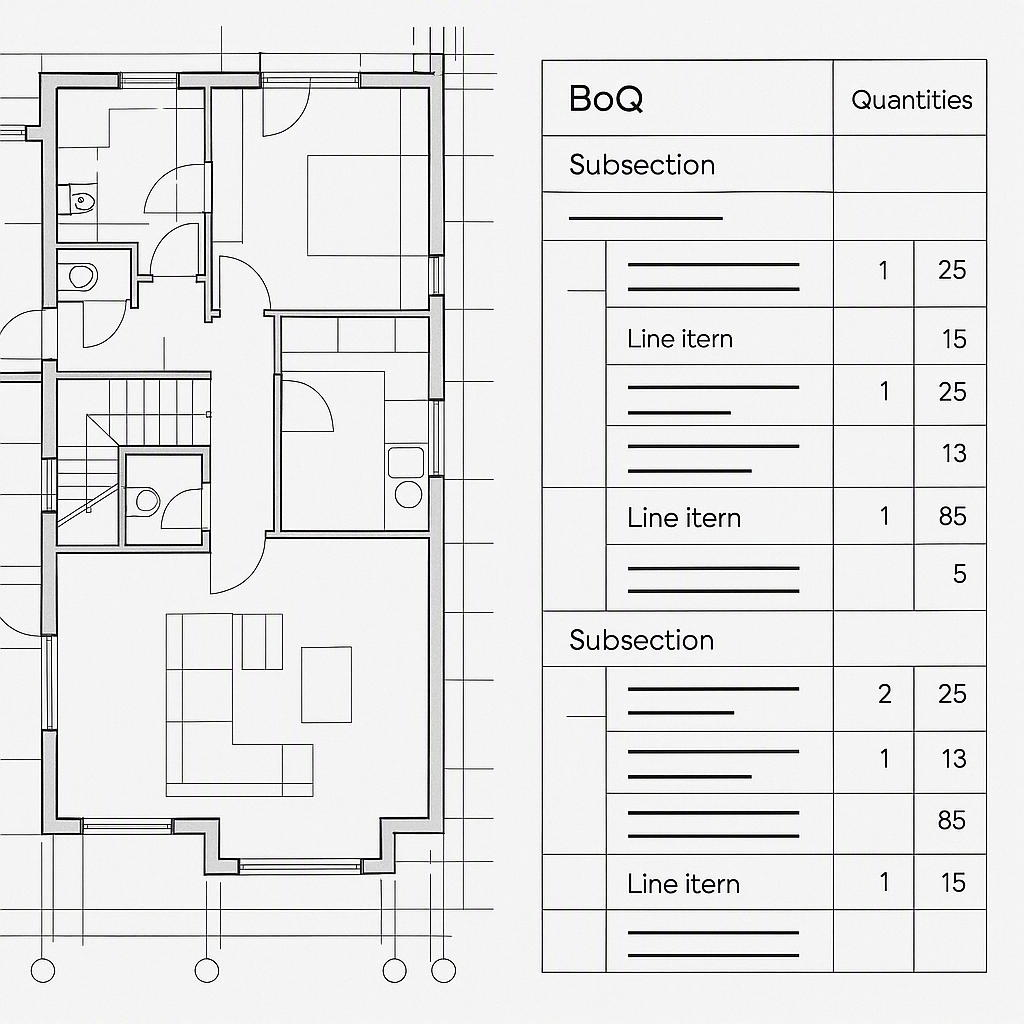
One of the standout features of Beam AI is that BOQ items can be directly linked to project scopes and execution plans. This ensures that every quantity is accounted for and tied to a purpose, whether it’s labor, material, or equipment.
3. Error Detection and Validation
Beam AI doesn’t just generate quantities—it also validates them. The tool can flag discrepancies like missing resources, mismatched units, or unrealistic measurements before they’re passed on to procurement or execution teams. Think of it as an automated second set of eyes.
4. Real-Time BOQ Monitoring
Tools like Beam AI and JobNext enable real-time monitoring of BOQ items, allowing contractors to catch errors or variances early. For instance, JobNext’s BOQ Margin Report highlights negative margin items weekly. If actual costs start exceeding estimates, contractors can take immediate corrective action, such as renegotiating supplier rates or revising procurement strategies.
Imagine catching a $6,000 variance on concrete procurement before the supplier invoice is approved. That’s the kind of impact these tools deliver.
5. Scalability
Beam AI is scalable for projects of all sizes. Whether you’re working on a small residential build or a massive infrastructure project, the tool adapts to your needs. Smaller contractors can implement it for high-risk areas, while larger firms can use it across their entire portfolio.
How to Get Started with AI Takeoffs
Transitioning to AI-powered tools might seem daunting, but it doesn’t require a complete overhaul of your workflow. Follow these steps to get started:
1. Identify High-Risk Areas
Start by using AI takeoff tools for high-risk areas like structural quantities or MEP (Mechanical, Electrical, and Plumbing) works. These areas are complex and prone to errors, making them ideal candidates for automation.
2. Integrate BOQs and Scope Management
Ensure your BOQs are directly linked to project scopes and execution plans. This integration eliminates scope gaps and ensures every quantity has a clear purpose and cost.
3. Monitor BOQ Margins Weekly
Don’t wait until a project is 70% complete to check your profitability. Use tools like JobNext to monitor BOQ margins weekly and address variances as they arise.
4. Train Your Team
Invest time in training your team to use AI tools effectively. Most platforms, including Beam AI, offer user-friendly interfaces, but a bit of upfront training can go a long way in maximizing efficiency.
5. Pilot a Single Project
Before implementing AI tools across your entire portfolio, pilot them on a single project. This allows your team to familiarize themselves with the software and identify any gaps in your workflow.
Common Mistakes to Avoid
Even with the best tools, mistakes can still happen. Here are some common pitfalls to watch out for:
1. Ignoring Small Overages
A 2% overage might not sound like much, but when it compounds across dozens of line items, the financial hit can be significant. Always investigate even small variances.
2. Relying on Outdated Rate Schedules
AI tools can only be as effective as the data they’re working with. Ensure your rate schedules are updated regularly to reflect current market conditions.
3. Skipping Reviews
While AI tools significantly reduce errors, they’re not infallible. Always have a second set of eyes review critical quantities and estimates.
4. Overlooking Training
AI tools are only as good as the people using them. Don’t skimp on training—ensure your team knows how to fully leverage the software.
FAQ
Q: How accurate is AI takeoff compared to manual methods?
A: AI takeoffs are generally more accurate because they eliminate human error in measurement and data entry. However, their accuracy depends on the quality of the input data, including drawings and rate schedules. High-quality inputs yield high-accuracy outputs.
Q: Can AI tools handle scope changes mid-project?
A: Yes, most AI tools, including Beam AI, allow you to revise BOQs and update linked scopes seamlessly. This ensures changes are reflected across procurement, billing, and execution workflows, minimizing disruptions.
Q: Are AI takeoff tools expensive?
A: While AI tools require an upfront investment, the time, labor, and cost savings they deliver often outweigh the expense. Additionally, catching errors early can prevent significant financial losses.
Q: What types of projects are best suited for AI takeoff tools?
A: AI takeoff tools are versatile and can be used for projects of any size. However, they’re particularly beneficial for complex projects with high-risk areas like structural elements, MEP works, or projects with tight margins.
Q: Do AI tools replace human estimators?
A: No, AI tools are designed to assist, not replace, human estimators. They handle repetitive, error-prone tasks, freeing up estimators to focus on higher-level decision-making and strategy.
Comparison: Manual vs. AI Takeoffs
| Feature | Manual Takeoffs | AI Takeoffs |
|---|---|---|
| Accuracy | Prone to human error | High accuracy with automation |
| Speed | Time-consuming | Fast and efficient |
| Error Detection | Manual review required | Automated error detection |
| Scalability | Limited | Highly scalable |
| Cost Over Time | High due to inefficiencies | Cost-effective |
Conclusion
Quantity errors don’t have to be the silent killer of your project margins. AI-powered tools like Beam AI Takeoff and platforms like JobNext are revolutionizing preconstruction workflows. By automating quantity extraction, integrating BOQs with scopes, and enabling real-time monitoring, these tools bring unparalleled accuracy and control to the takeoff process.
If you’re tired of dealing with missed quantities or margin erosion, now is the time to make the switch. Tools like Beam AI Takeoff can save you time, money, and headaches—allowing you to focus on what you do best: building great projects. Get started free →
Learn more at EstimateNext