The Hidden Drain on Project Margins: Camp Costs
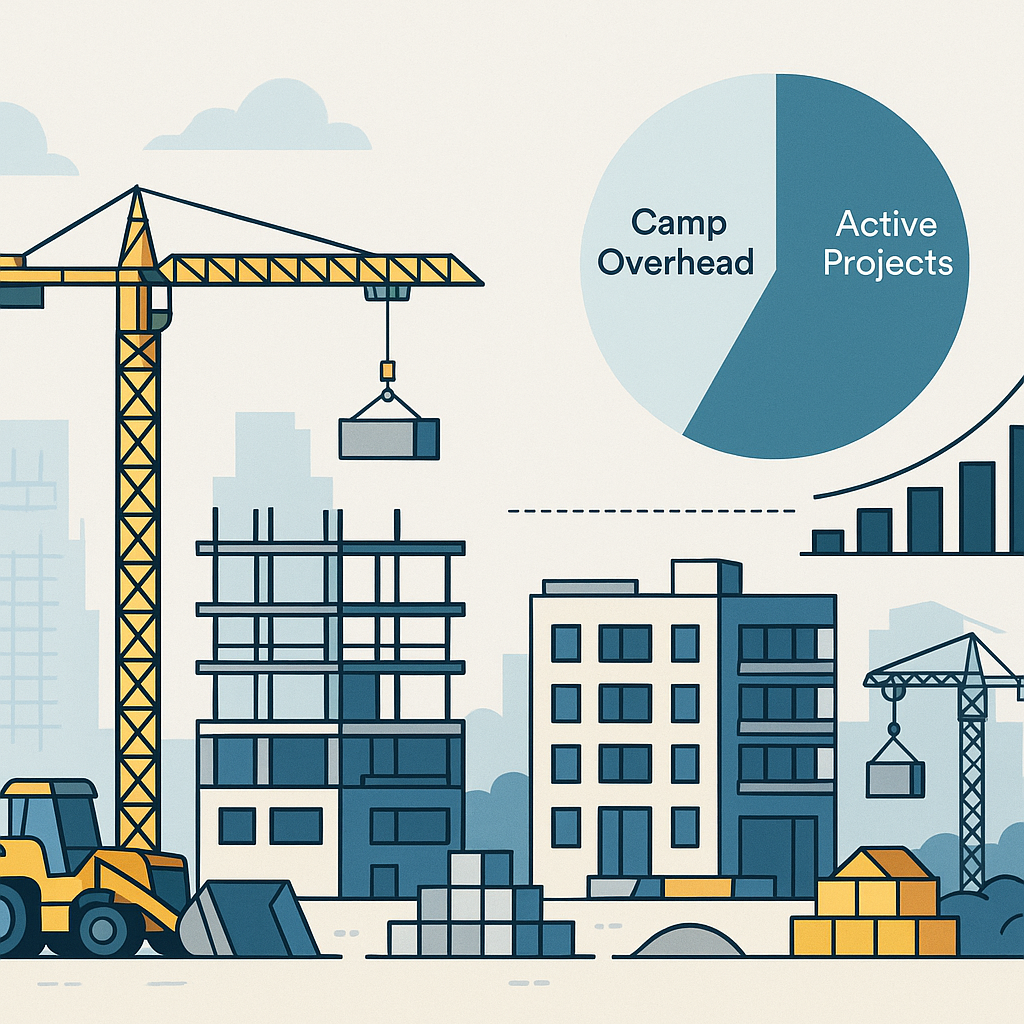
Most contractors focus their cost management efforts on direct expenses like materials and labor. But what about the shared overhead costs from worker camps, regional offices, and equipment yards? These "Camp Jobs" are critical to operations but don't directly generate revenue. The problem? When these costs aren't allocated correctly to active projects, your margins take a silent hit.
Why This Happens
In my experience, many contractors treat camp expenses as a lump sum. They pay for food, utilities, rent, and salaries at these shared facilities but fail to distribute those costs fairly across the projects that benefit from them. The result? Projects appear more profitable than they actually are, while others may unfairly carry the weight of shared overhead. Over time, this distorts your financial visibility and leads to poor decision-making.
A Real-World Example
Consider a mid-sized construction company in India running four concurrent projects. The shared worker camp incurs monthly expenses of ₹12 lakh. Instead of allocating these costs based on each project’s actual usage, the company spreads them evenly across all four projects. Project A, a small road repair project requiring only 5% of the camp’s resources, ends up absorbing the same ₹3 lakh as Project D, a large-scale residential complex consuming 60% of the camp’s resources. The result? Project A looks artificially unprofitable, while Project D’s profitability is overstated, leading management to make skewed decisions about future bids and resource allocation.
How Misallocation Erodes Margins
Let’s break it down in more detail. Misallocating camp costs creates multiple ripple effects:
1. Underestimation of Project Costs
When camp costs are not accurately distributed, your project estimates fail to capture the real expenses. For example, a contractor bidding for a new ₹50 crore highway project might base their estimate on incomplete cost data. This leads to aggressive bidding strategies that eat into margins or, worse, result in financial losses.
2. Distorted Profitability Reports
Without accurate cost allocation, financial reports become unreliable. Management might look at a project and think it’s performing well when, in reality, it’s receiving hidden subsidies from shared overhead.
3. Missed Tax Deductions
In many jurisdictions, camp-related expenses are deductible if linked to active projects. Misallocating or ignoring these costs means you’re likely leaving tax benefits on the table. For instance, the Oman-based construction company from our earlier example saved ₹2 crore in taxes after reallocating camp costs accurately.
4. Strained Relationships with Clients
Clients increasingly demand transparency in project cost breakdowns. If they suspect you’re inflating costs or mismanaging shared expenses, it could strain your relationships and jeopardize future work.
The Fix: Proper Cost Allocation
The solution is straightforward, but execution requires discipline and the right tools. Tools like JobNext’s Finance Cost Allocation feature have made this process manageable and efficient. Here’s how you can implement a robust cost allocation framework:
Step 1: Categorize Expenses
Break down camp expenses into distinct, trackable categories. Common categories include:
- Rent or Lease Costs: Monthly payments for the camp premises
- Utilities: Electricity, water, and internet bills
- Food and Catering: Daily meal costs for workers
- Maintenance: Repairs and upkeep of the camp facilities
- Salaries: Wages for camp staff, such as cooks, cleaners, and security personnel
Step 2: Choose Allocation Metrics
Select allocation metrics that reflect actual resource usage. Common metrics include:
- Headcount: Distribute costs based on the number of workers assigned to each project.
- Equipment Hours: Allocate based on the hours equipment from the camp is used per project.
- Material Consumption: Assign costs based on the materials used by each project.
For instance, if a camp serves three projects with respective headcounts of 50, 30, and 20 workers, costs can be allocated as 50%, 30%, and 20%.
Step 3: Automate Transfers
Manual allocation using spreadsheets is prone to errors and delays. Tools like JobNext automate this process, ensuring allocations are accurate and updated in real time. For example, JobNext can integrate with your payroll and procurement systems to dynamically adjust allocations as project headcounts or material consumption changes.
Step 4: Reconcile Monthly
Reconciliation ensures that allocations reflect actual expenditures. For example, if utility bills spike during the summer, your allocation model should adjust accordingly to avoid discrepancies.
Real-World Impact
To illustrate the benefits, let’s revisit the Oman-based contractor mentioned earlier. Before adopting JobNext, they allocated ₹15 crore in annual camp costs evenly across seven projects. This masked the fact that two smaller projects were subsidizing the larger ones. After switching to a usage-based allocation model, they uncovered the following insights:
- The two smaller projects saw a 12% increase in profitability.
- The company identified ₹1.2 crore in tax deductions they had previously overlooked.
- Management used these insights to refine their bidding strategies, increasing win rates on new contracts by 8%.
Another Example: A Canadian Oilfield Project
A Canadian contractor operating in remote oilfields implemented a similar strategy. By allocating camp costs based on equipment hours, they:
- Reduced cost overruns by 15%, as projects were held accountable for their actual resource use.
- Improved client trust by providing transparent cost breakdowns in project reports.
- Enhanced operational efficiency by identifying underutilized equipment.
Common Pitfalls to Watch Out For
While cost allocation sounds simple in theory, execution can be tricky. Here are some common pitfalls to avoid:
1. Ignoring Small Projects
Small projects often fly under the radar, but they still benefit from shared resources. Skipping them in your allocation model distorts financial accuracy.
2. Delayed Allocations
Reconciling camp costs quarterly or annually leads to discrepancies that are difficult to fix. Monthly reconciliation ensures your books stay accurate.
3. Overcomplicating the Process
While it’s tempting to create a detailed allocation model with dozens of metrics, stick to a few key metrics that are easy to track and justify to clients.
Why It Matters
Construction margins are razor-thin, often hovering around 5%. Every rupee counts, and accurate cost allocation can mean the difference between a profitable project and a financial loss. Camp expense allocation is just one piece of the puzzle, but it’s a critical one. Without it, your financial reports are incomplete, and your decision-making suffers.
Comparison Table: Manual vs. Automated Allocation
| Feature | Manual Allocation | Automated Allocation (e.g., JobNext) |
|---|---|---|
| Accuracy | Prone to errors | High accuracy with real-time updates |
| Time Required | High (manual data entry) | Low (automated processes) |
| Scalability | Limited | Easily scales with project complexity |
| Transparency for Clients | Low | High (detailed breakdowns provided) |
| Cost Savings | Minimal | Significant |
FAQs
1. How do I choose the right allocation metric?
Choose a metric that reflects actual resource usage. For instance, use headcount for labor-intensive projects, and equipment hours for machinery-heavy projects. Avoid overcomplicating by sticking to 1-2 primary metrics.
2. Can I allocate costs retroactively for past projects?
Yes, but it’s challenging. Start by gathering historical data on resource usage. While it’s not ideal, retroactive allocation can help you learn from past mistakes and refine future cost management practices.
3. What tools can help with cost allocation?
Tools like JobNext, Procore, and CMiC offer features specifically designed for cost allocation. Evaluate these tools based on your company’s size, budget, and specific needs.
4. How often should I reconcile camp expenses?
Monthly reconciliation is ideal. It ensures your financial reports are up-to-date and minimizes the risk of discrepancies.
5. What’s the ROI of implementing automated allocation?
The ROI varies, but contractors typically see a 5-15% improvement in project profitability, reduced tax liabilities, and increased client satisfaction. For example, the Oman-based contractor saved ₹1.2 crore annually.
Final Thoughts
If camp expense allocation isn’t on your radar, it should be. It’s a straightforward fix with outsized impact on your margins. Tools like JobNext make it easy to implement without adding complexity to your workflows.
Tired of margin erosion? Get started with JobNext →
Learn more at EstimateNext