Why Markup Mistakes Kill Construction Margins
Most contractors lose money because they don’t understand the difference between markup and margin. They think adding a 20% markup to their costs guarantees 20% profit. It doesn’t. This misunderstanding often leads to underpriced bids — and brutal surprises later when profits vanish.
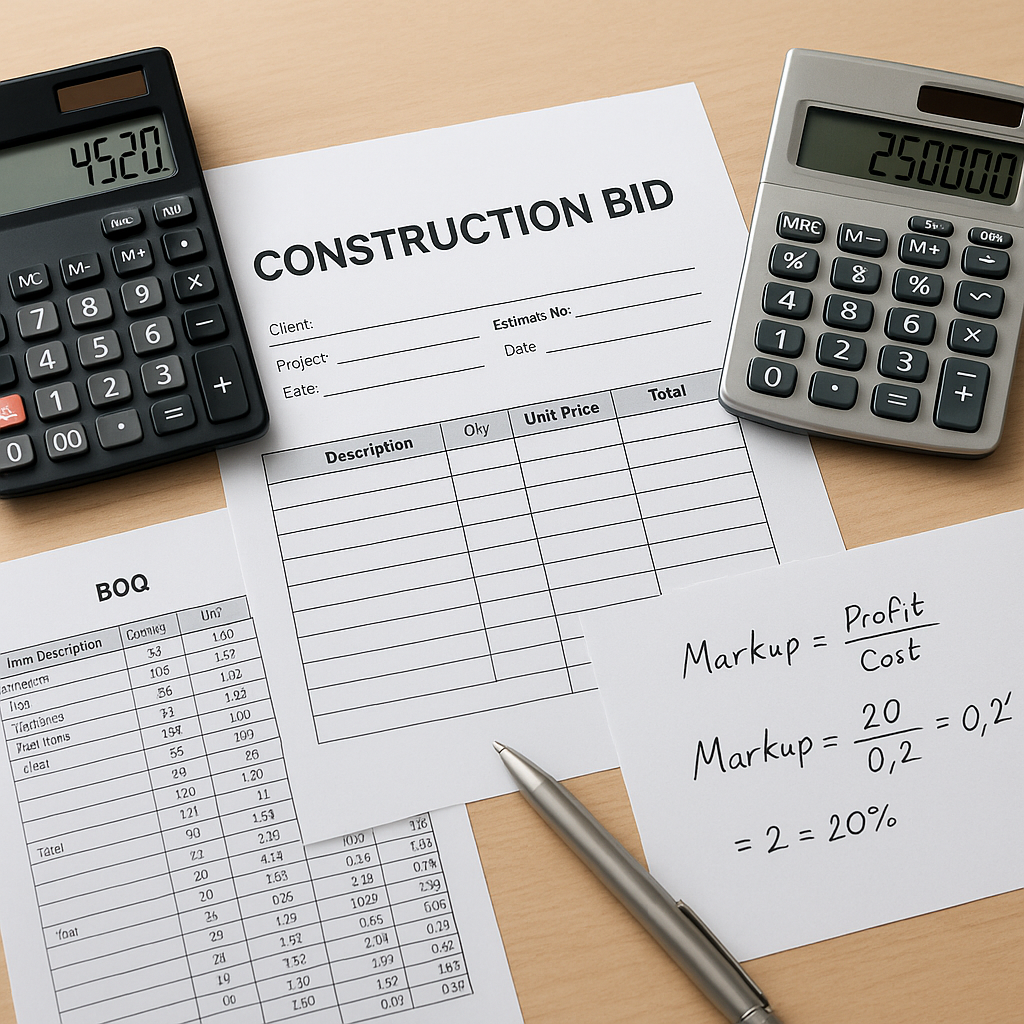
Markup is the percentage you add to your direct costs to calculate the selling price. Margin, on the other hand, is your profit expressed as a percentage of the selling price. Confusing the two will make your bids look competitive but kill your bottom line.
The Real Math Behind Markup
Here’s the formula:
def markup_formula(costs, markup_percentage):
    selling_price = costs * (1 + markup_percentage / 100)
    margin = ((selling_price - costs) / selling_price) * 100
    return selling_price, margin
Let’s say your direct costs for a project are ₹10,00,000. You decide to add a 20% markup:
- Selling Price = ₹10,00,000 * (1 + 20/100) = ₹12,00,000
- Margin = ((₹12,00,000 - ₹10,00,000) / ₹12,00,000) * 100 = 16.67%
Here’s the kicker: even though you applied a 20% markup, your actual profit margin is only 16.67%. Why? Because the markup is calculated on costs, but the margin is calculated on the final selling price.
To make this concept even clearer, let’s compare markup and margin using multiple examples:
| Costs (₹) | Markup (%) | Selling Price (₹) | Margin (%) |
|---|---|---|---|
| ₹10,00,000 | 10% | ₹11,00,000 | 9.09% |
| ₹10,00,000 | 20% | ₹12,00,000 | 16.67% |
| ₹10,00,000 | 50% | ₹15,00,000 | 33.33% |
| ₹10,00,000 | 100% | ₹20,00,000 | 50% |
Notice how the margin always ends up being lower than the markup percentage.
Common Pitfalls and How to Avoid Them
1. Misestimating Indirect Costs
Most contractors focus only on direct costs — materials, labor, equipment — and forget indirect costs like overhead, contingency, and financing. These hidden costs can add 10-20% to your project budget, but they’re often ignored in markup calculations.
Actionable Fix:
- Build a detailed cost estimate using a bottom-up approach. Break down costs into specific categories: labor, materials, plant, subcontracting, and overhead.
- Use software tools like JobNext or Excel templates to map indirect costs into your estimate.
- For example, if your overhead costs for a ₹50,00,000 project are ₹5,00,000 (10%), you should include this before calculating markup.
2. Guessing Markup Percentages
Many contractors pick markup percentages arbitrarily — 10%, 15%, 20%. But markup should be data-driven, based on your company’s overheads, desired profit margin, and market conditions.
Actionable Fix:
- Use historical data to calculate realistic markup rates. Analyze profit margins from similar past projects.
- For instance, if your last three ₹20,00,000 projects averaged 18% margin, use that as a baseline.
- If you lack historical data, start tracking it now via tools like JobNext’s CRM module or Excel sheets.
- Perform market research to ensure your markup aligns with competitive pricing trends.
3. Ignoring Subcontractor Costs
Subcontractor bids often include their own markup, which can inflate your project costs. If you don’t level these bids properly, your markup might be applied to already marked-up rates, leading to overpriced proposals.
Actionable Fix:
- Always evaluate subcontractor bids using Comparative Statements. Compare costs, timelines, and technical capabilities.
- For example, if one subcontractor quotes ₹5,00,000 and another quotes ₹4,80,000, check the scope differences before accepting.
- Use tools like JobNext to link subcontractor RFPs to their source work requisitions for traceability.
4. Overlooking Risk and Contingency
Construction projects are never risk-free. Weather delays, material shortages, and scope changes can blow up your costs. If you don’t include contingency in your markup, you’re gambling with your profits.
Actionable Fix:
- Add contingency (5-10%) to your cost estimate before applying markup.
- For example, if your project costs are ₹10,00,000, add ₹50,000 as contingency. Then calculate markup on ₹10,50,000.
- Use risk management frameworks like Monte Carlo simulations for large projects to quantify contingencies more accurately.
Case Study: Calculating Markup for a BOQ Item
Imagine you’re bidding on a project with the following BOQ item:
| Resource | Quantity | Unit Cost (₹) | Total Cost (₹) |
|---|---|---|---|
| Cement | 100 bags | 400 | 40,000 |
| Labor (Masons) | 10 days | 1,500/day | 15,000 |
| Equipment | 5 days | 3,000/day | 15,000 |
| Overheads | - | - | 10,000 |
| Total Costs | - | - | 80,000 |
You decide on a 25% markup:
- Selling Price = ₹80,000 * (1 + 25/100) = ₹1,00,000
- Margin = ((₹1,00,000 - ₹80,000) / ₹1,00,000) * 100 = 20%
This markup ensures your profit margin aligns with your business goals. However, if you had ignored overheads or contingency, your costs would’ve been underestimated, and the margin would shrink further.
Decision Framework: Should You Adjust Your Markup?
Use the following table to decide if you need to adjust your markup:
| Criteria | Recommendation |
|---|---|
| High overhead costs | Increase markup to cover expenses |
| Competitive market pricing | Lower markup to win bids |
| High risk or uncertainty | Add contingency before markup |
| Subcontractor bids include markup | Evaluate bids individually |
| Historical margins are shrinking | Analyze cost tracking data |
FAQs
Q: What’s the difference between markup and margin?
A: Markup is added to costs to determine selling price, while margin is profit expressed as a percentage of the selling price. For example, a 20% markup on ₹10,00,000 yields ₹12,00,000 selling price, but the margin is only 16.67%.
Q: How can I calculate the right markup percentage?
A: Use the formula: Selling Price = Costs * (1 + Markup Percentage / 100). Track historical data to ensure your markup aligns with desired profit margins.
Q: What tools can help simplify cost estimates and markup?
A: Tools like JobNext or Buildertrend can automate cost breakdowns, markup calculations, and bid traceability, saving time and improving accuracy.
Q: Should contingency be included in project costs?
A: Yes. Contingency (5-10%) cushions against unforeseen expenses like material delays or scope changes. Always add it before applying markup.
Q: How do I avoid overpaying subcontractors?
A: Compare subcontractor bids using Comparative Statements. Ensure their markup doesn’t inflate your overall project costs.
Call to Action
If you're tired of losing margins to bad bid calculations, JobNext can help. Get started free →
Learn more at EstimateNext