Why Contractors Get Markup Wrong (And What It Costs You)
Let’s start with the brutal truth: most contractors confuse markup with profit. They slap a percentage on top of their costs and call it a day. Then they wonder why, halfway through the project, their margins are bleeding. Sound familiar? You’re not alone.
Here’s the problem: markup and profit are not the same. If your job costs ₹1 crore and you add a 20% markup, you’re not making 20% profit. You’re making 16.67%. Why? Because that 20% markup is calculated on costs, not revenue. Small math error, big financial hit.
Want the fix? Let’s break it down.
The Correct Formula for Bid Markup
The formula you need is simple, but it’s often ignored:
Markup (%) = (Profit Margin / (1 - Profit Margin)) x 100
Let’s say you want a 20% profit margin. Plug it in:
Markup = (0.2 / (1 - 0.2)) x 100 = 25%
That means if your costs are ₹1 crore, your bid price should be ₹1.25 crore. Not ₹1.2 crore. Get this wrong, and you’ve already lost ₹5 lakh before the project even starts.
Why This Formula Matters
This formula isn’t just about avoiding financial losses—it’s about setting the foundation for a healthy, sustainable business. When contractors consistently miscalculate markup, they:
- Undervalue their work: Clients expect you to know your numbers. A price that’s too low signals incompetence, not generosity.
- Risk cash flow issues: With razor-thin margins, unexpected costs (like labor overruns or material price hikes) can wipe out profits entirely.
- Damage long-term reputation: A contractor who consistently delivers under-budget bids but fails to complete projects profitably risks losing trust in the industry.
Actionable Steps
- Use the formula for every bid: Don’t assume a flat markup percentage applies to all projects. Tailor your markup based on desired profit margins and risk factors.
- Educate your team: Train your estimators and preconstruction staff on the difference between markup and profit margin.
- Double-check your math: Even if you’re using software, manually verify key calculations to ensure accuracy.
Why BOQ-Based Estimation Matters
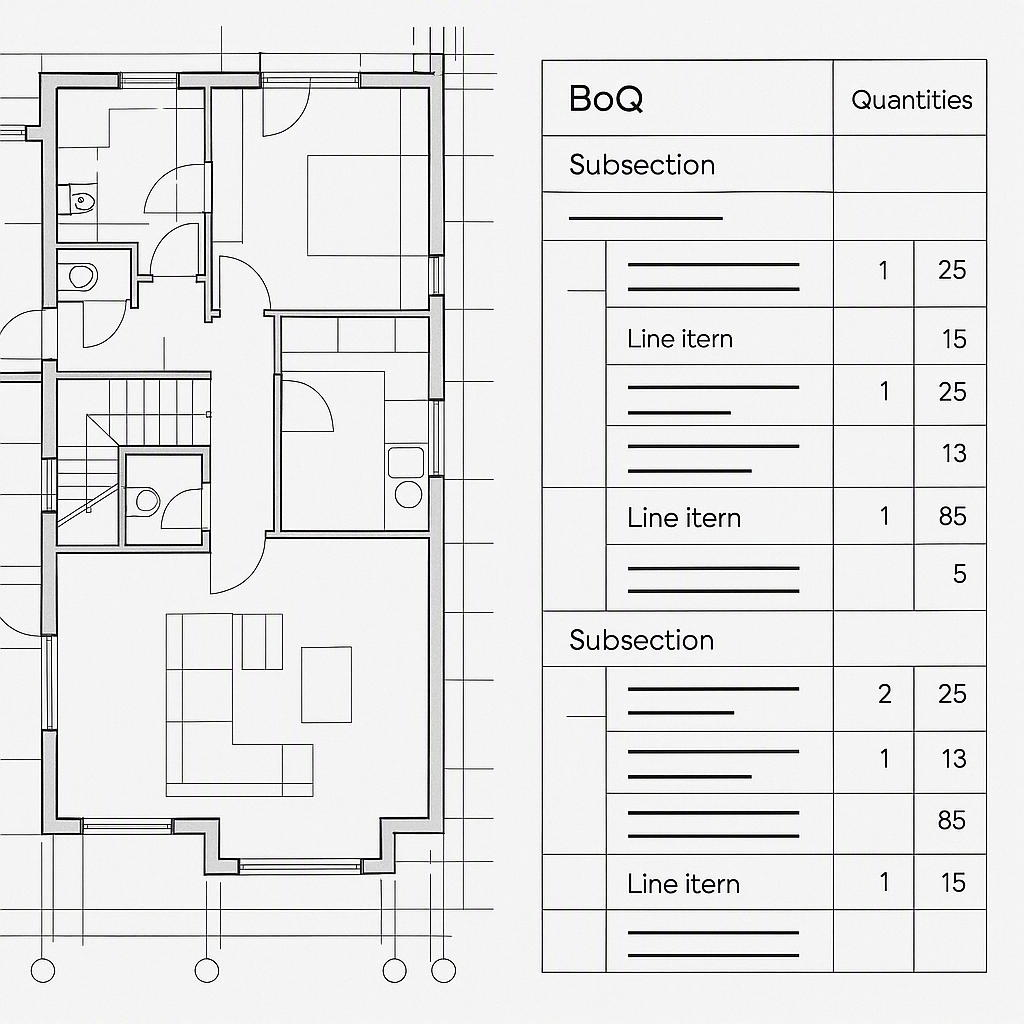
Here’s another common mistake: treating your BOQ (Bill of Quantities) as a casual checklist instead of a financial backbone. Every BOQ item represents a cost that needs to be accounted for—materials, labor, machines, subcontractors, and overheads. If you miss even one, your bid markup won’t save you.
The Role of BOQ in Financial Accuracy
A BOQ isn’t just a document; it’s a blueprint for your costs. Here’s why:
- Labor Costs: Misestimating labor hours or skill levels can lead to massive overruns. For example, assuming a carpenter takes 5 days for a task that actually requires 8 days will throw off your calculations.
- Material Costs: Building materials fluctuate in price. Ignoring market trends or failing to lock in supplier rates can lead to ballooning expenses.
- Machine Costs: Forgetting to account for machinery downtime or unexpected repairs can eat into your margins.
- Subcontractor Costs: Subcontractors often submit higher rates than expected—if you didn’t budget for this, your profits take the hit.
- Overheads: Administrative costs, compliance fees, and site management need to be factored into every project, yet many contractors underallocate.
Case Study: ₹10L Margin Loss on a ₹5 Cr Bid
A mid-size contractor in Delhi recently shared their story with us. They won a ₹5 crore tender for an MEP job but ended up losing ₹10 lakh in margins. Why? Their preconstruction team applied a flat 15% markup on costs, assuming it would give them a 15% profit margin. It didn’t.
When we dug into their BOQ, we found:
- Labor costs were underestimated by 12%.
- Subcontractor bids came in 8% higher than expected.
- Overheads like site offices and compliance were missing entirely.
Using JobNext’s Estimate-Based Quote, their team could’ve applied precise markups per BOQ item and adjusted for true costs. That ₹10 lakh loss? Avoidable.
Tools to Streamline BOQ Estimation
This is where tools like JobNext come in. Using its Estimate-Based Quoting method, you can break down costs for every BOQ item into five categories: labor, material, machine, subcontractor, and overhead. Here’s how it works:
- Labor: Estimated as hours or days per cadre (e.g., carpenter, mason).
- Material: Quantities of specific items, or a value-based budget when unknown.
- Machine: Total time the equipment is needed.
- Subcontractor: Quantities of outsourced work items.
- Overhead: A lump-sum allocation for admin or site costs.
JobNext ensures every cost is captured and calculated into your bid. No more guesswork, no more surprises mid-project.
Common Objections (And Why They Don’t Hold Up)
Contractors often push back when asked to adopt better estimation and markup practices. Let’s tackle the most common objections:
Objection 1: “I don’t have time for detailed estimates.”
You’re right—manual estimates take forever. But tools like EstimateNext automate rate analysis and BOQ breakdowns in minutes, not days. It’s faster, and you don’t miss hidden costs.
Objection 2: “My competitors undercut me. I can’t afford higher bids.”
Undercutting is a race to the bottom. Instead of lowering your markup, focus on precision. A well-calculated bid protects your margins and builds trust with clients. They’ll pay for reliability.
Objection 3: “Markup formulas are too complicated.”
They’re not. Once you understand the difference between markup and profit margin, it’s just math. Plug your numbers into the formula above, or use JobNext to calculate it automatically.
Practical Takeaways for Contractors
- Stop guessing your markup: Use the formula: Markup = (Profit Margin / (1 - Profit Margin)) x 100.
- Break down every BOQ item: Include labor, material, machines, subcontractors, and overheads.
- Invest in tools like JobNext: Automate cost tracking and markup calculation to save time and protect margins.
- Review your estimates weekly: Use BOQ margin reports to catch errors before they spiral.
- Educate your team: Ensure everyone understands the financial implications of markup and profit margin.
FAQ: Common Questions About Markup and BOQ
1. What’s the difference between margin and markup?
Profit margin is the percentage of your revenue that is profit. Markup is the percentage added to your costs to determine your selling price. For example, a 20% profit margin requires a 25% markup.
2. How do I handle fluctuating material costs?
Use tools like JobNext to track market trends and lock in rates with suppliers. Build contingency costs into your bids to account for price hikes.
3. Can small contractors afford tools like JobNext?
Yes! Many tools offer tiered pricing for small businesses. The upfront cost is minimal compared to the savings from better cost tracking and bid accuracy.
4. How can I explain higher bid prices to clients?
Focus on transparency. Break down costs clearly and show clients how your bid protects against overruns. Emphasize reliability and quality.
5. What’s the best way to train my team on better estimation practices?
Conduct regular workshops and use software tools that simplify the process. Ensure key staff understand the financial math behind markups and margins.
Comparison Table: Markup vs Profit Margin
| Aspect | Markup | Profit Margin |
|---|---|---|
| Definition | Percentage added to costs to determine selling price. | Percentage of revenue that is profit. |
| Basis for Calculation | Costs | Revenue |
| Formula | (Profit Margin / (1 - Profit Margin)) x 100 | Profit / Revenue x 100 |
| Example (₹1 crore costs, 20% margin) | 25% markup = ₹1.25 crore selling price | 20% margin = ₹1.25 crore revenue = ₹25 lakh profit |
| Misunderstanding Impact | Leads to underpricing | Leads to overestimating profits |
Ready to Protect Your Margins?
If you’re tired of losing profits to bad math and incomplete BOQs, tools like JobNext can help. From estimate-based quoting to automated BOQ margin tracking, it’s built for contractors who care about their bottom line.
Learn more at EstimateNext