The Hidden Cost of Manual Takeoffs
If you're still doing takeoffs manually, you're burning time and money. According to industry estimates, contractors spend an average of 40 hours per bid just on manual takeoffs. That’s an entire week — gone — for just one project. And for what? Human error is almost guaranteed to creep in. A decimal point off here, a missed measurement there, and suddenly, your project margin is wiped out.
The construction industry is one of the least digitized sectors globally. A 2022 McKinsey report highlighted that inefficiencies in preconstruction processes, like takeoffs, contribute to 35% of project overspends. It’s not just about wasted time; it’s about a cascade of financial leaks that start with bad numbers. This is where machine learning (ML) is stepping in and changing the game.
Why Manual Takeoffs Are a Financial Liability
Human Error: The Silent Profit Killer
Even the most experienced estimators are not immune to errors. Misreading dimensions, overlooking specifications, or simply making calculation mistakes can result in costly errors. A study published by the Construction Management Association of America (CMAA) found that manual errors in preconstruction processes cause an average of 3-5% margin erosion per project.
Example: A mid-sized contractor bidding on a $5 million project could lose $150,000 due to incorrect takeoff measurements if margins erode by just 3%. That’s enough to turn a profitable project into a financial headache.
The Time Sink
Spending 40 hours per bid on manual takeoffs is not just inefficient — it’s unsustainable. Consider a small contractor handling 10 bids per month. That’s 400 hours of labor per month, or the equivalent of two full-time employees dedicated solely to takeoffs. At an average estimator salary of $70,000 per year, that’s $140,000 annually just for the labor cost of manual takeoffs.
Lack of Scalability
Manual processes are not scalable. As your business grows and the number of bids increases, your team will struggle to keep up without additional hires. This limits your ability to take on more projects and grow your revenue.
How Machine Learning Fixes the Takeoff Problem
Machine learning isn’t just a buzzword; it’s a game-changer. Here’s how it addresses the core issues of manual takeoffs:
1. Automated Quantity Recognition
Machine learning algorithms can scan digital blueprints and automatically identify and quantify materials. This eliminates the need to manually scroll through PDFs or CAD drawings, significantly reducing the likelihood of missed items.
Case Study: A general contractor using EstimateNext reported that their average takeoff time dropped from 40 hours to just 10 minutes per project. Over the course of a year, this saved the company 4,800 hours of labor across 120 bids.
2. Improved Accuracy with Machine-Learning Models
Machine learning models trained on thousands of previous takeoffs can deliver accuracy rates exceeding 90%. While human estimators can miss details due to fatigue or oversight, machines consistently apply the same level of precision.
Example: A contractor bidding on a $20 million project used AI-powered takeoff tools and achieved a 98% accuracy rate. By catching an error in the steel reinforcement quantities, they avoided a potential $200,000 cost overrun.
3. Dynamic BOQ Integration
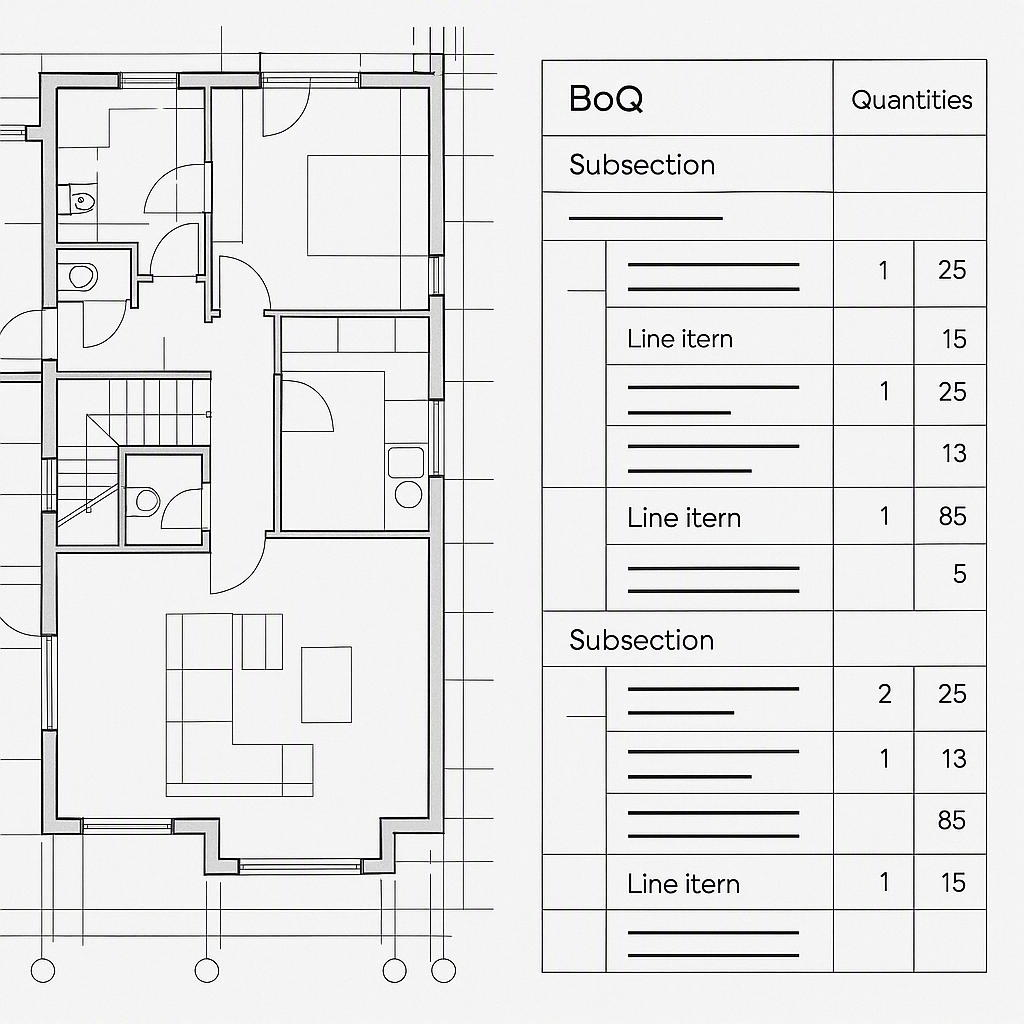
Tools like JobNext allow seamless integration of takeoff data into the Bill of Quantities (BOQ). This eliminates the need for manual data entry and ensures consistency across project phases.
How It Works:
- The system auto-populates the BOQ with quantities derived from takeoffs.
- Rate schedules and cost breakdowns are centrally managed, ensuring alignment with real-world costs.
Result: Contractors can transition from bid to execution seamlessly, with fewer opportunities for errors.
Real-World Results: Time and Money Saved
Let’s dive into the numbers:
- Time Savings: AI-powered takeoffs save contractors an average of 36 hours per bid. For a contractor handling 10 bids a month, that’s 360 hours saved monthly — equivalent to hiring an additional estimator.
- Financial Impact: A 1% error in takeoff accuracy can lead to a 5-10% margin loss. AI tools help reduce this risk dramatically.
Example: A medium-sized firm saved $50,000 annually by switching to AI-powered takeoffs. Their win rate improved as they were able to submit more bids with greater confidence in their numbers.
Overcoming Objections to AI Takeoff Tools
Objection 1: “AI Tools Are Too Expensive”
While there’s an upfront cost, the ROI is undeniable. By saving time and reducing errors, contractors often recoup their investment within a few projects. Many platforms, like JobNext, offer scalable pricing models suitable for small and mid-sized firms.
Objection 2: “What If the AI Gets It Wrong?”
AI tools are not infallible, but they allow for human oversight. Estimators can review, adjust, and approve the takeoff data before it’s finalized. Think of AI as an assistant, not a replacement.
FAQ
1. How accurate are AI-powered takeoffs? Most systems achieve over 90% accuracy. Human oversight ensures that any edge cases or anomalies are addressed.
2. Can these tools handle complex projects? Yes. Advanced platforms like JobNext support detailed BOQs and WBS-based cost breakdowns, making them ideal for complex projects.
3. What’s the ROI on AI takeoff tools? Significant. Many contractors report saving hundreds of hours and thousands of dollars within months of adoption.
4. Do I need specialized training to use these tools? Most platforms are user-friendly, with minimal training required. Many also offer tutorials and customer support.
5. Is AI replacing human estimators? No. AI is a tool to assist estimators, not replace them. Human expertise remains critical for quality control and decision-making.
Comparison Table: Manual vs. AI-Powered Takeoffs
| Feature | Manual Takeoffs | AI-Powered Takeoffs |
|---|---|---|
| Time per Bid | ~40 hours | ~10 minutes |
| Accuracy | 80-90% (with errors) | 90-98% |
| Scalability | Limited | High |
| Labor Cost | High | Low |
| Risk of Error | Significant | Minimal |
| Initial Investment | None | Moderate |
| ROI | Low | High |
Ready to Stop Losing Margins?
If manual takeoffs are eating into your profits, it’s time for a change. AI-powered solutions like JobNext and EstimateNext can help you streamline your preconstruction process and protect your margins. Get started today →
Learn more at EstimateNext