Why Your BOQ Matters More Than You Think
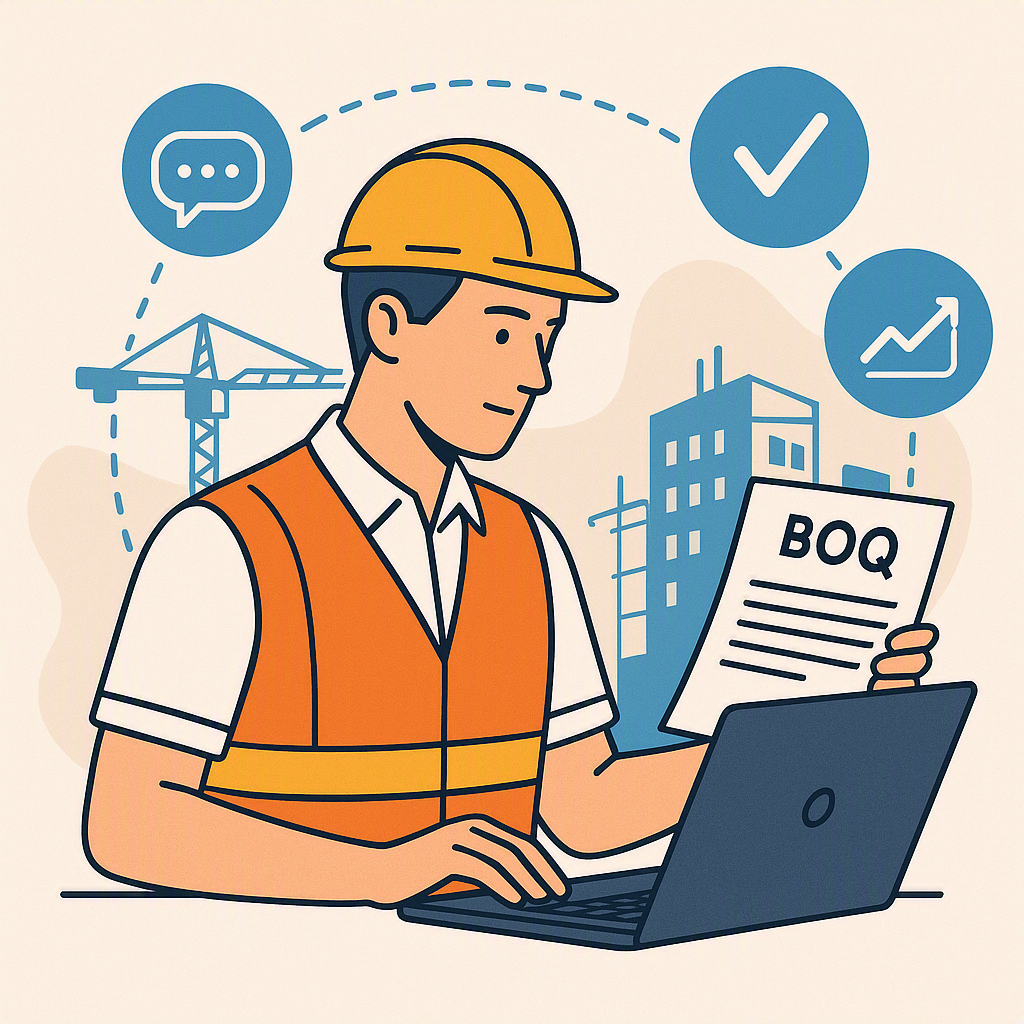
BOQs (Bill of Quantities) are a critical tool for project planning and billing in construction. However, poorly structured BOQs can lead to unexpected costs and reduced profitability. Many contractors assume that accurate quantities are enough, but the reality is that BOQs need to account for execution dynamics to truly reflect project costs.
Common Issues in BOQs
BOQs often fail to account for:
- Material wastage: Site conditions, cutting losses, and other factors can lead to higher material usage than estimated.
- Labour inefficiencies: Labour costs on paper may not match actual hours due to idle time, rework, or site delays.
- Equipment underutilization: Idle equipment can incur costs that are not reflected in the BOQ.
- Scope creep: Change orders and client requests can increase costs unexpectedly.
Structuring Your BOQ for Better Cost Tracking
A well-structured BOQ does more than list items. It connects quantities, costs, and progress tracking. Here’s how to improve your BOQ:
1. Organize Your BOQ into Logical Groups
Your BOQ should follow a group → item hierarchy:
| Level | Purpose | Example |
|---|---|---|
| Group | Category container for related items | "Civil Works" |
| Item | Individual deliverable with quantity | "Excavation — 500 CUM @ ₹120/CUM" |
This structure helps categorize costs and pinpoint problem areas. For instance, if your "Civil Works" group consistently shows negative margins, you know where to focus.
2. Use Rate Analysis for Accurate Pricing
Rate analysis breaks each BOQ item into materials, labour, plant, subcontractor, and overhead costs. This method ensures that you understand the components of each cost and can adjust estimates accordingly.
3. Import Large BOQs Instead of Manual Entry
For BOQs with hundreds or thousands of items, manual entry is inefficient. Use software that allows you to import BOQs from Excel to save time and reduce errors.
4. Track Margins Weekly
Run a BOQ Margin Report weekly to compare contracted values against actual costs for each BOQ item. Investigate any negative margins immediately to address issues such as material price hikes or labour inefficiencies.
Common Mistakes to Avoid
- Lumping items together: A single line for "Civil Works" hides problems. Break it into specific tasks (e.g., excavation, concreting).
- Ignoring progress tracking: If you don’t link BOQ items to scopes, you’ll struggle to track cost overruns.
- Not reviewing margins: If you only check BOQs at the start and end of a project, you’re missing crucial mid-project insights.
- Underestimating wastage: Always add a buffer for materials — site conditions are rarely perfect.
FAQ
What’s the best way to price a BOQ?
Use rate analysis to break down costs into materials, labour, plant, and overhead.
How often should I review BOQ margins?
Weekly. Negative margins compound fast, so catching them early is key.
Can I import my BOQ from Excel?
Yes. Many tools allow you to upload BOQs directly, saving time and reducing errors.
What’s the biggest BOQ mistake contractors make?
Not linking BOQ items to scopes and progress tracking. It’s impossible to see where costs are leaking without this connection.
How can I fix a BOQ with negative margins?
Investigate the cause — material price hikes, labour inefficiencies, or scope changes. Adjust estimates and rebalance budgets.
The Bottom Line
Your BOQ isn’t just a document. It’s a living map of your project’s profitability. By structuring your BOQ effectively, tracking margins regularly, and using tools to streamline processes, you can minimize cost overruns and improve project outcomes.
Learn more at EstimateNext