How AI Enhances General Contractor Estimating Workflows
For years, I thought AI tools were just a gimmick in construction estimating. I believed that human intuition and experience trumped any algorithm, especially in the chaotic world of general contracting. My own experience in the field taught me that no AI could understand the nuances of a project as well as a seasoned estimator. But something changed my mind.
The Moment of Change
In 2024, I attended a seminar where a demonstration of an AI-powered estimating tool caught my attention. It wasn't the usual marketing pitch. They showed real-time estimation scenarios using AI to process thousands of rate items in seconds. This wasn't just talk—it was backed by demonstrations of how AI can streamline processes and improve efficiency. Seeing AI handle complex data processing tasks was my wake-up call.
Real-Time Data Processing
One of the key aspects of the demonstration was how AI could process vast amounts of data in real-time. Traditional methods often require manual input and cross-referencing of spreadsheets, which can be time-consuming and prone to errors. AI algorithms, on the other hand, can quickly analyze data from multiple sources, identifying patterns and inconsistencies that might not be immediately obvious to a human estimator. This capability allows for more accurate and timely estimates, which is critical in competitive bidding environments.
Actionable Steps for Real-Time Data Processing
- Integrate Data Sources: Ensure your AI tools can access all necessary data sources, including historical estimates, supplier rates, and market trends.
- Customize Algorithms: Work with your AI provider to customize algorithms to suit your specific project needs, enhancing the relevance of data insights.
- Implement Regular Updates: Keep your data sources updated to ensure AI is working with the most current information available.
Improved Efficiency
Efficiency isn't just about speed—it's also about reducing redundancies and optimizing resources. AI tools can automate repetitive tasks, such as data entry and initial cost calculations, allowing estimators to focus on higher-order analysis and decision-making. This shift not only saves time but also leverages human expertise where it is most valuable—interpreting complex scenarios and making strategic decisions.
Methods to Enhance Efficiency
- Automate Routine Tasks: Identify repetitive tasks within your workflow that AI can automate, such as data entry and initial calculations.
- Focus on Critical Analysis: Use the time saved through automation to engage in deeper analysis of project variables and strategic planning.
- Regularly Review Processes: Continuously assess your processes to identify new areas where AI can be integrated for further efficiency.
Why My Old Belief Held On
The belief that AI couldn't replace human expertise was deeply rooted in the industry's culture. Estimating has always been seen as an art, not just a science. The human touch in understanding client needs, adjusting for project-specific variables, and leveraging past project experiences seemed irreplaceable. Many of us in the industry were skeptical of AI's ability to adapt to the unique challenges posed by each project.
The Art of Estimating
Estimating in construction is as much about understanding qualitative factors as it is about crunching numbers. Experienced estimators use their intuition to gauge client priorities, anticipate project hurdles, and adapt estimates to reflect local market conditions. These are areas where AI still struggles, as it primarily relies on quantitative data and predefined parameters.
Maintaining the Art in Estimating
- Blend AI and Human Insight: Use AI for data-driven insights, but rely on human experience for interpreting client needs and project nuances.
- Develop Intuitive Skills: Encourage estimators to continue developing their intuitive skills to complement AI outputs.
Cultural Resistance
There's often a cultural resistance to adopting new technologies in traditional industries like construction. Many professionals have built their careers on tried-and-true methods, and there's a natural reluctance to change. Additionally, there's a fear that AI might make certain roles obsolete, leading to job insecurity.
Overcoming Cultural Resistance
- Educate on AI Benefits: Conduct workshops and seminars to educate teams on the benefits and limitations of AI, focusing on how it complements human roles.
- Highlight Success Stories: Share real-world examples of successful AI integration to build confidence and reduce fear of obsolescence.
What I Do Differently Now
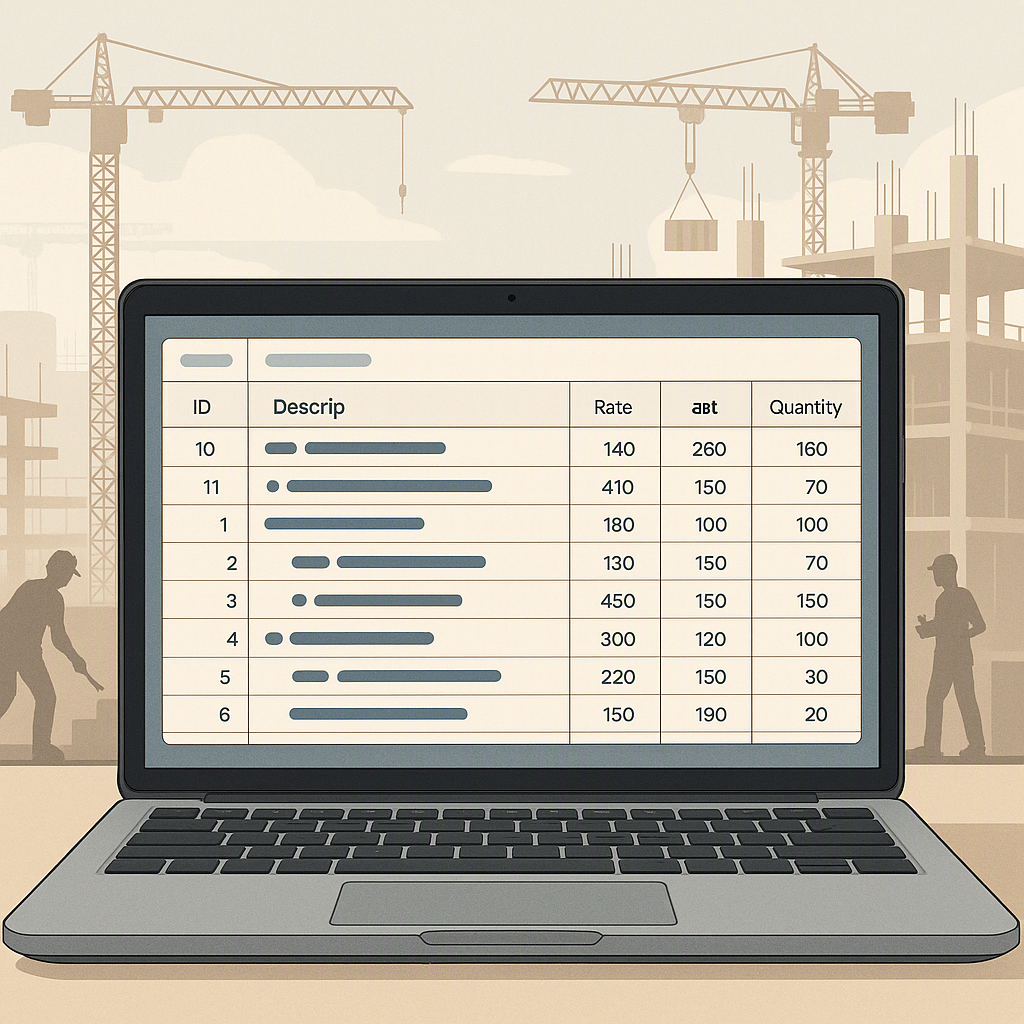
I've integrated AI tools into my workflow, specifically for handling large datasets in preconstruction estimating. AI tools allow for bottom-up costing with full breakdowns of labor, materials, plant, and subcontractor inputs. This method ensures precision and consistency across estimates, something I used to spend hours manually verifying. Now, I rely on AI to perform rate analysis and match SOR items efficiently, freeing up my time to focus on strategic project decisions.
Bottom-Up Costing
Bottom-up costing involves breaking down a project into its component parts and estimating the cost of each part individually. AI tools are particularly well-suited for this task because they can handle large datasets and complex calculations with ease. This method not only improves accuracy but also provides a transparent view of where costs are allocated, which is invaluable for both estimators and clients.
Implementing Bottom-Up Costing
- Break Down Projects: Start by breaking down projects into smaller components for detailed analysis.
- Leverage AI for Data Handling: Use AI to manage and process large datasets, ensuring accuracy and consistency.
Rate Analysis and SOR Matching
Rate analysis involves comparing current rates with historical data to ensure estimates are competitive and reflective of market conditions. AI can quickly analyze historical data and current market trends to adjust rates accordingly. Similarly, Standard Order of Rates (SOR) matching allows for quick retrieval of standardized cost items, ensuring consistency across estimates.
Steps for Effective Rate Analysis
- Access Comprehensive Data: Ensure AI tools have access to both historical and current market data.
- Regularly Update Rates: Continuously update rate databases to reflect market changes and ensure competitive estimates.
What Being Wrong Cost Me
Being slow to adopt AI tools meant I missed out on potential efficiency gains. My team spent countless hours on tasks that could have been automated. The hesitation cost us not just time, but also increased the risk of human error, which often resulted in costly project revisions.
Efficiency Loss
The most tangible cost of not adopting AI sooner was inefficiency. Tasks that could have been automated—such as data entry, initial cost calculations, and routine analysis—continued to consume valuable time. This inefficiency not only delayed project timelines but also limited our capacity to take on more projects, effectively capping our growth potential.
Risk of Human Error
Manual processes are inherently prone to error. Inaccuracies in data entry or oversight in calculations can lead to significant cost overruns or project delays. AI tools help mitigate this risk by providing consistent, data-driven outputs that reduce the likelihood of human errors.
Strategies to Mitigate Risks
- Implement AI Gradually: Start with small-scale projects to understand AI's impact and improve processes iteratively.
- Develop Error-Checking Protocols: Use AI for initial checks and human oversight for final validation.
Remaining Uncertainties
Despite the clear benefits, I still have reservations about AI's ability to handle the subjective aspects of estimating, like gauging client preferences or foreseeing future project-specific challenges. AI is a tool, not a replacement. Estimators will continue to play a crucial role in overseeing and interpreting AI outputs, ensuring they align with real-world expectations.
Subjective Decision-Making
AI excels at processing data and making predictions based on patterns, but it lacks the ability to understand context or make subjective judgments. For example, AI might struggle to understand a client's personal preferences or anticipate changes in project scope based on evolving client needs. These are areas where human judgment remains essential.
The Role of Human Oversight
AI tools are only as good as the data they are fed and the parameters they are given. Human oversight is crucial to ensure AI outputs are accurate and relevant. Estimators need to validate AI-generated estimates, adjusting for any anomalies or overlooked factors. This collaborative approach ensures the best of both worlds—AI efficiency combined with human insight.
Conclusion
AI has transformed how I view construction estimating. Integrating AI into our workflows can significantly enhance efficiency and accuracy. If you're dealing with similar challenges, consider exploring AI tools to improve your estimating processes.
Actionable Steps for Integration
- Evaluate Needs: Identify areas within your estimating process that could benefit from automation or improved data analysis.
- Research Tools: Explore different AI tools available in the market, focusing on those that align with your needs and budget.
- Implement Gradually: Start with small projects to test how AI tools fit into your workflow. Gradual implementation allows for adjustments and learning.
- Train Your Team: Ensure your team is comfortable using AI tools. Provide training sessions and support to facilitate the transition.
- Monitor and Adjust: Continuously assess the performance of AI tools and make necessary adjustments to optimize their use.
For further insights, check out michels construction for a deeper dive into effective estimating methods.
Comparison Table: Traditional Estimating vs. AI-Assisted Estimating
| Aspect | Traditional Estimating | AI-Assisted Estimating |
|---|---|---|
| Data Processing Speed | Slow, manual input | Fast, automated processing |
| Accuracy | Prone to human error | Reduced error, data-driven predictions |
| Human Involvement | High, all tasks manual | Focus on oversight and strategic tasks |
| Adaptability | Limited by human capacity | High, adapts quickly to new data inputs |
| Cost Efficiency | Higher labor costs | Lower costs due to automation |
| Risk of Errors | Higher due to manual processes | Lower with automated checks |
| Innovation Adoption | Slow due to cultural resistance | Rapid, technology-driven improvements |
Learn more at EstimateNext