Why BOQs Are Non-Negotiable for Contractors
You know the drill—every construction project starts with a Bill of Quantities (BOQ). It’s the list that defines everything you’re delivering, down to the last cubic meter of concrete or square meter of tile. But here's the problem: a poorly structured BOQ can destroy your margins before the first shovel hits the ground.
How? Simple. Errors in rates, units, or quantities snowball. Overpriced items scare clients. Underpriced ones gut your profits. And let’s not even talk about vague descriptions that subcontractors exploit for variation claims. If you’re not careful, your BOQ can become a liability instead of a tool.
Our team at KhaasDiscount has worked with contractors across India and the GCC. We’ve seen the same mistakes again and again. This post is your guide to avoiding them.
What is a BOQ, and Why Does It Matter?
A Bill of Quantities (BOQ) is the backbone of a construction project. It’s a detailed document that outlines the work required, including quantities, units of measurement, and rates for each item. The BOQ serves as a shared understanding between contractors, clients, and subcontractors—it’s the one document that ensures everyone is on the same page.
Why BOQs Are Critical:
- Cost Management: A precise BOQ prevents over- or underestimating costs.
- Bidding Accuracy: It helps contractors submit competitive yet realistic bids.
- Progress Tracking: BOQs allow easy comparison between planned and actual execution.
- Dispute Avoidance: Detailed descriptions reduce ambiguity, minimizing disputes over scope or variation claims.
Without a well-prepared BOQ, you're essentially flying blind, risking your profitability and reputation.
The Core Structure of a BOQ (With an Example)
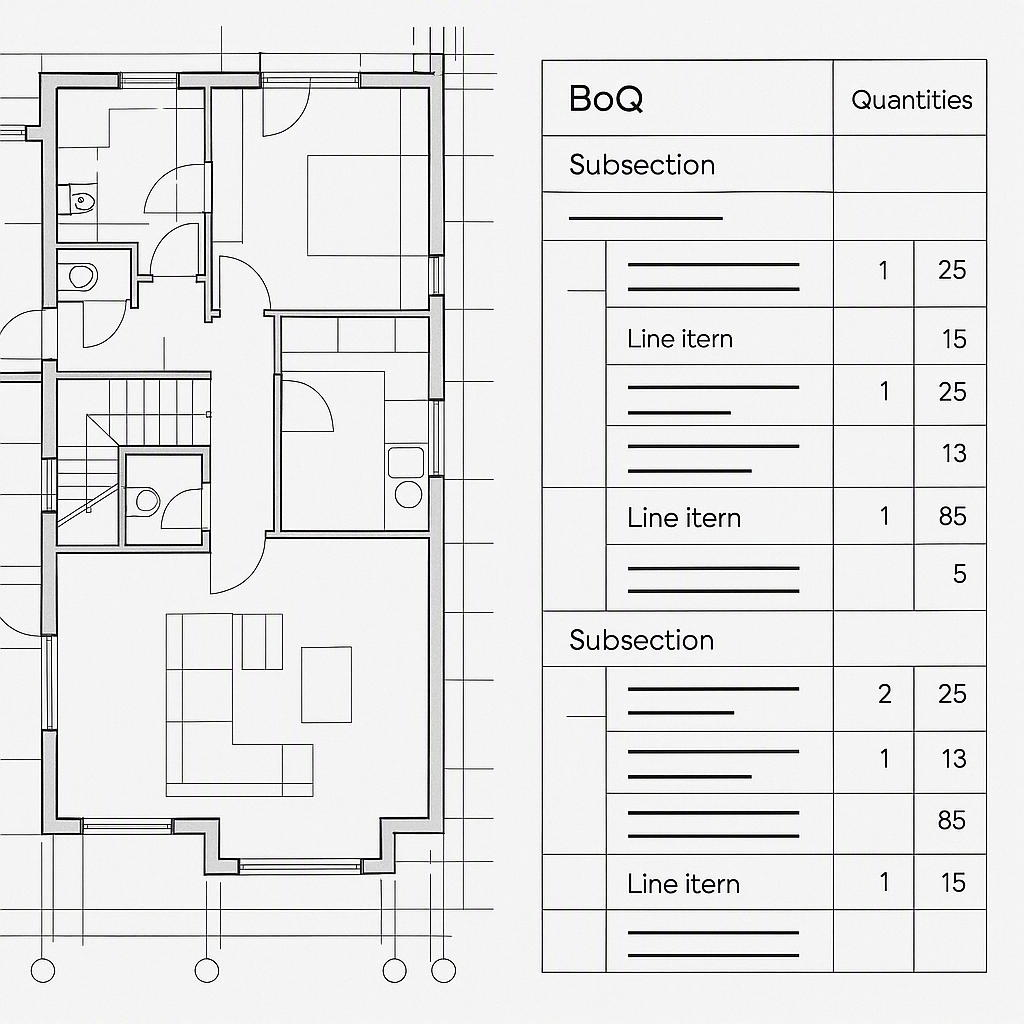
A solid BOQ has three levels of hierarchy that keep everything organized:
| Level | Purpose | Example |
|---|---|---|
| Group | High-level category of work | "Civil Works", "MEP" |
| Item | Specific deliverable with a rate and quantity | "Excavation — 500 CUM @ 120/CUM" |
| Sub-item | Additional detail, if needed | "Excavation in loose soil" |
Why This Structure Works:
- Client Alignment: It reflects how clients think about deliverables, making it easier for them to approve.
- Ease of Estimation: It simplifies the estimation process by breaking down categories logically.
- Streamlined Billing: It ensures that progress tracking and invoicing are consistent.
Example Breakdown:
Imagine you’re preparing a BOQ for civil works:
- Group: Civil Works
- Item: Excavation (500 cubic meters @ ₹120 per cubic meter)
- Sub-item: Excavation in loose soil (200 cubic meters @ ₹130 per cubic meter)
This clarity ensures everyone—from the client to the execution team—understands what is being delivered.
Trade-Specific Tips for BOQs
1. Civil Contractors: Avoid Unit Confusion
Unit-of-measure (UOM) errors are a common problem, particularly in civil works. For example, a client requests excavation quantities in cubic meters, but someone quotes it in square meters. This mismatch can derail the entire project.
Actionable Steps:
- Standardize UOMs: Use predefined templates with consistent UOM fields.
- Cross-Check: Always review quantities and units before sharing BOQs with clients.
- Use Software: Tools like JobNext automatically flag mismatches between scope and execution data.
2. MEP Contractors: Standardize Rate Analysis
Mechanical, Electrical, and Plumbing (MEP) works often require detailed rate analysis. Your rates should include components like material, labor, and equipment.
How to Break Down Rates:
- Material: Cost per unit of material (e.g., ₹3,500 for 50 meters of conduit).
- Labor: Hourly or per-unit labor costs (e.g., ₹2,000 for installation).
- Equipment: Rental or usage costs (e.g., ₹1,000 for machinery).
Tools for Consistency:
JobNext's "Standard Quote" feature lets you break down rates into components, ensuring accuracy across projects. Check out EstimateNext’s blog for practical tips on rate analysis.
3. Interior Fit-Out: Detail Your Specifications
Interior projects are notorious for disputes due to vague BOQ descriptions. If you write "Paint walls," you’re inviting debates over paint type, finish, and coverage.
Better Approach:
- Specify brand: "Asian Paints Royale"
- Define application: "Two coats"
- Include coverage: "15 SQM per liter"
This level of detail eliminates ambiguity and ensures clients and subcontractors know exactly what to deliver.
4. HVAC & Firefighting: Track Stage-Wise Progress
HVAC and firefighting installations are often phased, requiring detailed BOQs that align with project milestones.
Example:
Instead of writing "Install ductwork," break it down:
- Foundation Stage: 40% ductwork installation
- Superstructure: 60% ductwork installation
JobNext supports stage-wise BOQs, making it easy to allocate quantities to milestones. This ensures billing and execution are always in sync.
Common BOQ Mistakes (and How to Fix Them)
Mistake 1: Copy-Pasting Templates Without Review
Using outdated or irrelevant BOQ templates is a recipe for disaster. Old rates, missing items, or mismatched categories can derail your project.
Fix:
- Start Fresh: Always begin with a new BOQ template.
- Software Integration: Use tools like JobNext to ensure templates are up-to-date and aligned with modern standards.
Mistake 2: Ignoring Variations
Construction projects rarely go according to plan. If your BOQ doesn’t account for variations, you’ll end up absorbing unexpected costs.
Fix:
- Link BOQ Items to Scopes: Software like JobNext lets you link BOQ items to scopes, making it easy to track variations and renegotiate rates.
- Document Changes: Always update your BOQ to include approved variations.
FAQ: BOQs in Construction
Q1: Can I use the same BOQ template for all trades?
No. While the overall structure is consistent, the specifics vary by trade. Civil BOQs focus on bulk quantities, while MEP BOQs require detailed rate breakdowns.
Q2: What’s the best software for BOQ management?
Look for tools that integrate BOQs with billing, procurement, and progress tracking. JobNext is one option that covers these bases.
Q3: How do I handle large BOQs?
Use Excel upload features to save time. Ensure your template matches the required format to avoid errors.
Q4: How do I price items accurately in a BOQ?
Break each rate into components: material, labor, and equipment. Use industry benchmarks or tools like JobNext for accurate pricing.
Q5: Can a BOQ help with subcontractor disputes?
Yes. A detailed BOQ minimizes disputes by clearly outlining scope, quantities, and specifications.
Comparison Table: BOQ Tools vs Manual Methods
| Feature | Manual BOQs | BOQ Software (e.g., JobNext) |
|---|---|---|
| Accuracy | Prone to errors | Automated checks for accuracy |
| Time Efficiency | Time-consuming | Excel uploads save hours |
| Variation Tracking | Manual updates needed | Linked scopes handle variations |
| Progress Tracking | Limited visibility | Stage-wise tracking |
| Integration | None | Links to billing and procurement |
Final Thoughts
A well-structured BOQ is more than a list. It’s your roadmap to profitability. Follow the tips above to create BOQs that protect your margins and streamline project execution. If you're struggling with BOQ management, JobNext simplifies the process. From templates to progress tracking, it eliminates the chaos. Get started free →
Learn more at EstimateNext