BOQ Meaning in Construction: Practical Insights for Contractors
What’s the one document that can make or break your construction margins? It’s the Bill of Quantities (BOQ). Yet, many contractors treat it as a compliance task — fill the columns, submit the bid, move on. That’s a mistake.
In my view, the BOQ isn’t just a client’s checklist of deliverables. It’s your project blueprint. Everything from cost estimation to subcontractor payments ties back to this document. If your BOQ isn’t airtight, you’re setting yourself up for scope creep, billing disputes, and wasted money.
What Is a BOQ?
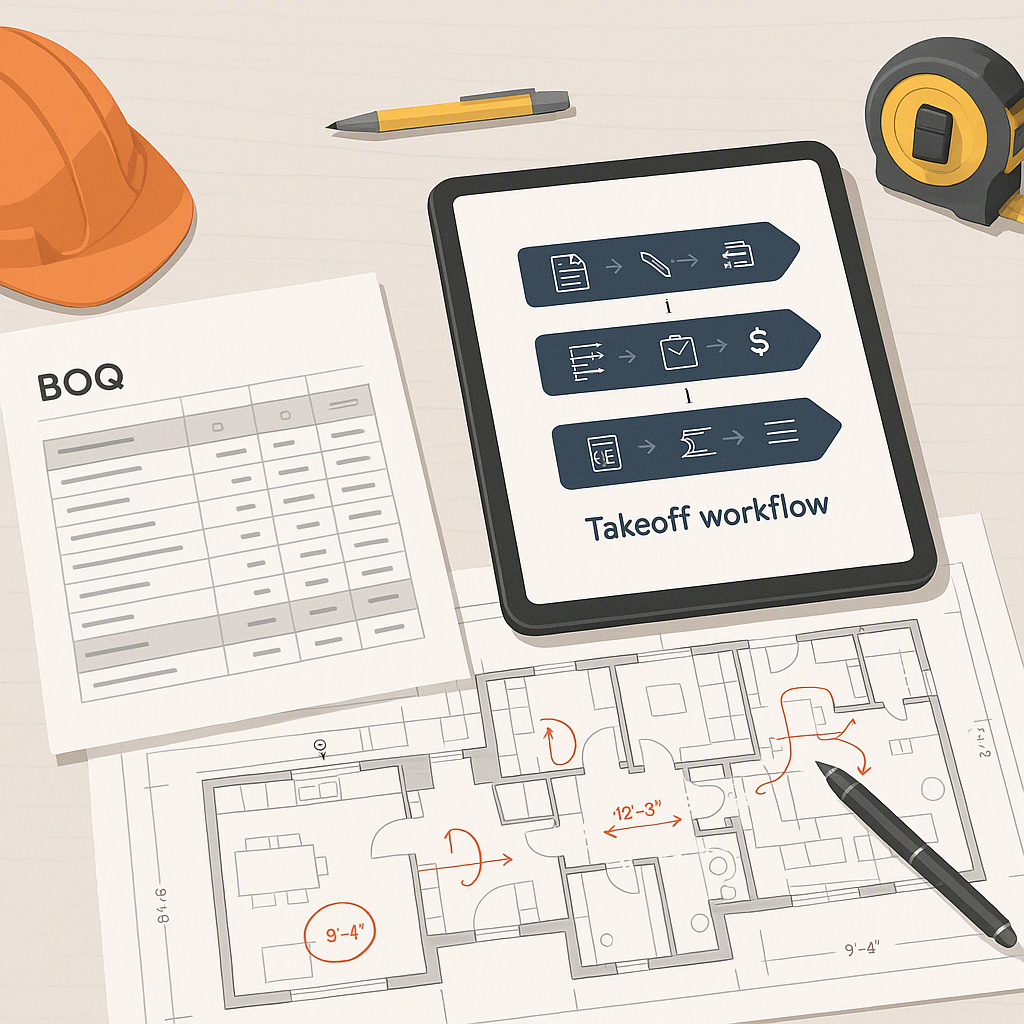
The BOQ, or Bill of Quantities, is a structured document that lists all the deliverables for a project, broken down into items with quantities, units, and rates. Think of it as the client’s formalized view of what they’re paying for in the project. It ensures that there is a clear agreement on the scope, pricing, and deliverables from the outset.
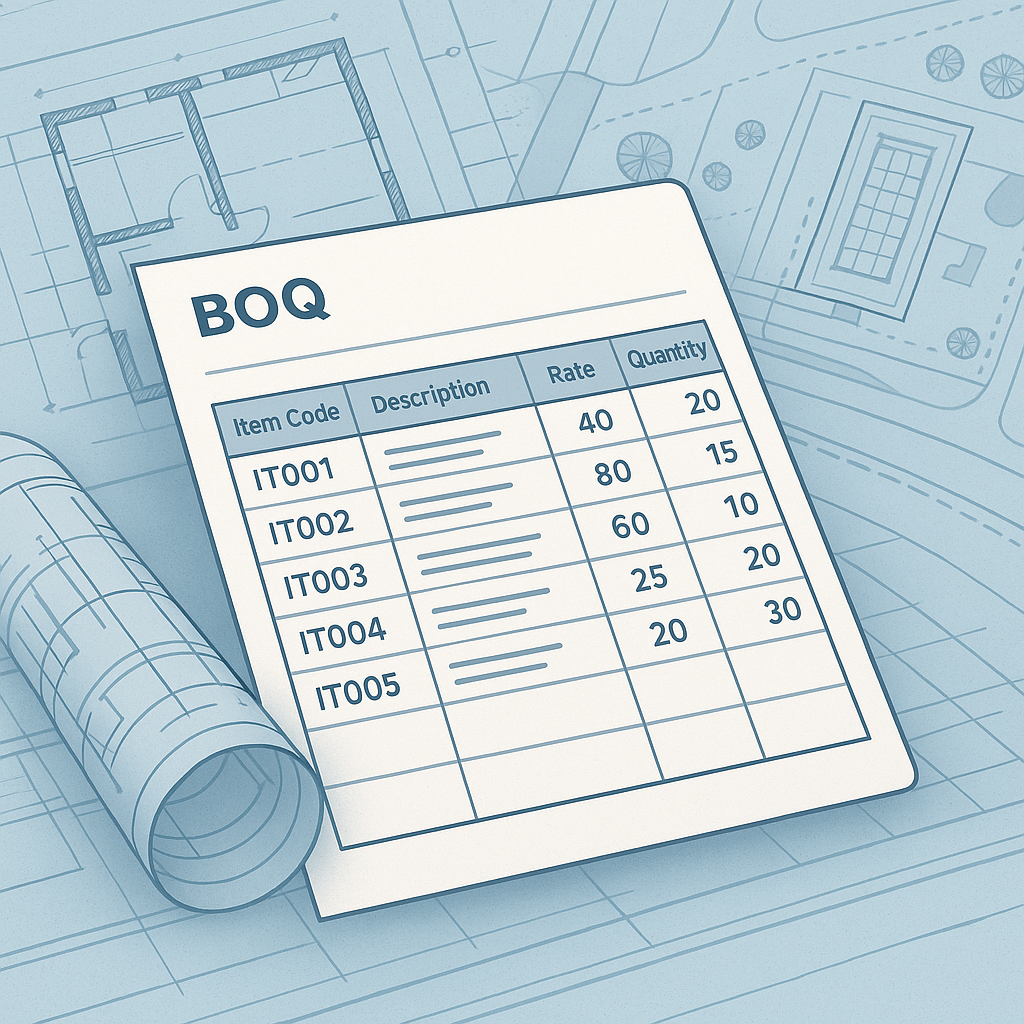
Here’s an example of how a BOQ might look:
| Item Code | Description | Unit | Quantity | Rate | Amount |
|---|---|---|---|---|---|
| CIV001 | Excavation | CUM | 500 | ₹120/CUM | ₹60,000 |
| MEP101 | Electrical Wiring | M | 1,000 | ₹55/M | ₹55,000 |
Notice the structure:
- Item Code: A unique identifier for quick referencing.
- Description: A clear and concise definition of the work item.
- Unit: The unit of measurement (e.g., cubic meters, meters, etc.).
- Quantity: The amount required for the task.
- Rate: The agreed-upon cost per unit.
- Amount: The total cost for that line item, calculated as Quantity × Rate.
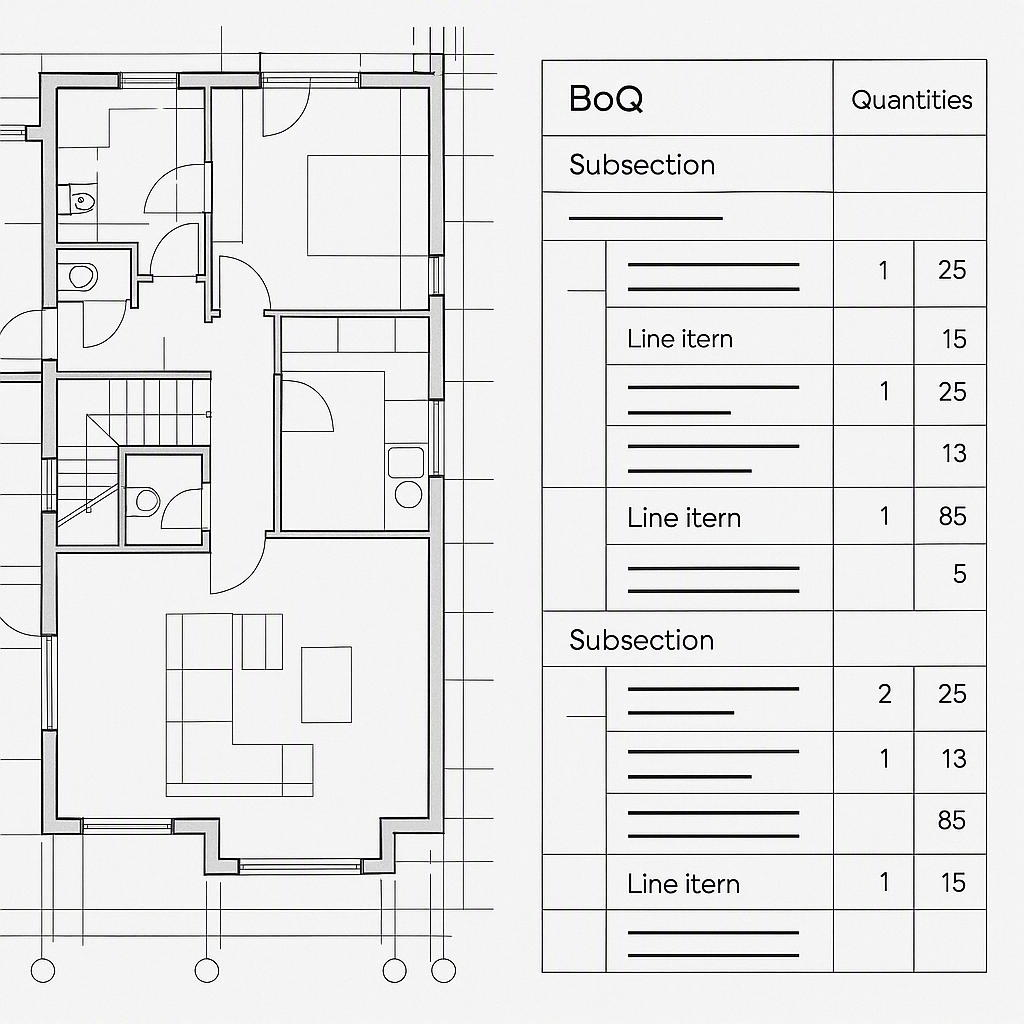
In this hierarchy, categories such as “Civil Works,” “MEP,” and “Finishing” act as parent groups, while individual line items define specific tasks. This structure ensures that nothing is left ambiguous and that there’s alignment between the contractor and client.
Why BOQ Preparation Is Critical
A poorly prepared BOQ can snowball into significant project issues. Let’s break down why getting it right matters:
1. Incorrect Quantities
Underestimating quantities means that you’ll run out of resources mid-project, leading to delays, cost overruns, and strained relationships with clients. Overestimating, on the other hand, exposes you to client pushbacks and increases the likelihood of losing bids due to inflated costs.
Actionable Steps:
- Always validate quantities using historical project data or site-specific surveys.
- Use measurement tools and software to ensure accuracy when calculating quantities for excavation, concrete, or other material-heavy tasks.
2. Ambiguous Descriptions
If your BOQ descriptions are vague, you’re inviting disputes. For instance, a line item labeled “Electrical Wiring” is unclear — does it include labor, materials, or both? Ambiguity leaves room for interpretation, which can derail timelines and budgets.
Actionable Steps:
- Define each item in detail. Instead of “Electrical Wiring,” specify: “Supply and installation of 4-core copper wire, 1,000 meters, including labor.”
- Cross-check descriptions with the scope of work to avoid overlaps or gaps.
3. Rate Mismatches
If your rates are outdated or disconnected from market benchmarks, two things can happen: you’ll either price yourself out of the competition or leave money on the table, eroding your margins.
Actionable Steps:
- Conduct a market survey before finalizing rates. Compare current material and labor costs in your region.
- Use cost estimation software to ensure your rates align with industry standards.
4. Unlinked Execution Scopes
A BOQ that isn’t tied to execution scopes results in chaos during project delivery. If the BOQ isn’t linked to labor teams, materials, equipment, and subcontractors, you’ll struggle with tracking progress and aligning costs to actuals.
Actionable Steps:
- Invest in tools that integrate BOQs with project execution workflows.
- During the BOQ preparation phase, map each item to its execution plan.
Methods for Creating an Effective BOQ
The following methods can help you prepare a BOQ that is both accurate and practical:
1. Use a Standard Format
A consistent structure ensures clarity and avoids confusion. Follow standard industry templates, such as those provided by organizations like RICS (Royal Institution of Chartered Surveyors).
2. Validate Quantities
Double-check all quantities using:
- Site inspections
- Historical data from similar projects
- Software tools for quantity takeoffs, such as PlanSwift or Bluebeam Revu
3. Incorporate Market Trends
Staying updated on market trends for materials and labor can make or break your bid. Use tools like RSMeans or CostX for real-time cost data.
4. Collaborate with Experts
Engage quantity surveyors or cost estimators to review your BOQ. Their expertise can catch errors you might miss.
Practical Example: Linking BOQ to Execution in JobNext
Let’s talk about solutions that simplify BOQ preparation. Platforms like JobNext streamline the process by ensuring that every BOQ item ties seamlessly into execution workflows. How does that work?
1. Auto-Population from Quotes
When you win a contract, BOQ items from your quotation can auto-populate into the job setup. This reduces the likelihood of manual errors and saves time.
2. Scope Linking
Each BOQ item connects to a defined scope. For example, an “Excavation” item in the BOQ might automatically link to scopes for labor teams, rented machinery, and material procurement. This ensures that everyone involved in execution knows their responsibilities.
3. Progress Tracking
Progress measurements roll up to BOQ items. For instance, if 250 out of 500 cubic meters of excavation are complete, the system automatically calculates the percentage of work completed and updates the billing status.
For further reading, check out this article from EstimateNext, which explains how AI-powered tools can streamline preconstruction estimation and takeoffs.
Common Mistakes in BOQ Preparation
1. Skipping Rate Analysis
Never copy rates from previous projects without validating them. Market conditions change, and blindly reusing rates can sink your margins.
2. Ignoring Unit Consistency
Mixing up units (e.g., cubic meters versus square meters) can lead to massive calculation errors. For example, excavation quantities calculated in cubic meters cannot be directly compared to concrete work measured in square meters.
3. Not Validating Quantities
Failing to validate quantities against site conditions can lead to under- or overestimations. For instance, excavation rates depend heavily on soil type — rocky soil requires more effort than loose sand.
4. Late Scope Linking
If scopes aren’t linked to BOQ items early in the process, you’ll face issues with progress billing, subcontractor payments, and procurement.
Comparison: BOQ vs BOM
| Aspect | BOQ | BOM |
|---|---|---|
| Purpose | Used for billing and project costing | Focuses on components for execution |
| Focus | Deliverables for the client | Materials and resources for contractors |
| Level of Detail | Higher-level items (e.g., excavation) | Detailed components (e.g., cement bags) |
| Audience | Clients and quantity surveyors | Contractors and procurement teams |
FAQ: BOQ in Construction Projects
Q1: How is BOQ different from BOM?
A: BOQ (Bill of Quantities) lists deliverables for billing and cost estimation, while BOM (Bill of Materials) focuses on the specific components and materials needed for execution.
Q2: Can BOQs be revised after contracting?
A: Yes, but only through a formal revision process. Once a contract is signed, BOQs are typically locked to prevent disputes, and any changes require client approval.
Q3: How can I ensure BOQ accuracy?
A: Use software tools for quantity takeoffs, validate rates with market data, and collaborate with quantity surveyors to eliminate errors.
Q4: Is a BOQ legally binding?
A: Yes. A BOQ is often included as part of the contract and serves as a legally binding document outlining the agreed scope and pricing.
Q5: What software tools can help with BOQ preparation?
A: Tools like JobNext, PlanSwift, and CostX are specifically designed to streamline BOQ preparation and reduce manual errors.
Final Thoughts
The BOQ is not just a document — it’s your margin blueprint. Preparing a comprehensive BOQ requires attention to detail, market awareness, and proper integration with project workflows. If you’re struggling with manual workflows or disconnected systems, modern tools like JobNext can help you streamline BOQ preparation, scope linking, and billing. Get started free →
Learn more at EstimateNext