Why This Matters
Ask any contractor what eats into their margins, and you'll hear a lot about material price hikes, delays, and labor inefficiencies. But here's one silent killer you might not notice: unclear or mismatched expectations between what's in the Bill of Quantities (BOQ) and what's in the quotation. It's more common than you'd think. And the fallout? Underbidding or scope creep that destroys your profitability.
So, let’s get clear on this: what’s the difference between a BOQ and a quotation? And more importantly, how can you avoid costly mistakes?
What is a Bill of Quantities (BOQ)?
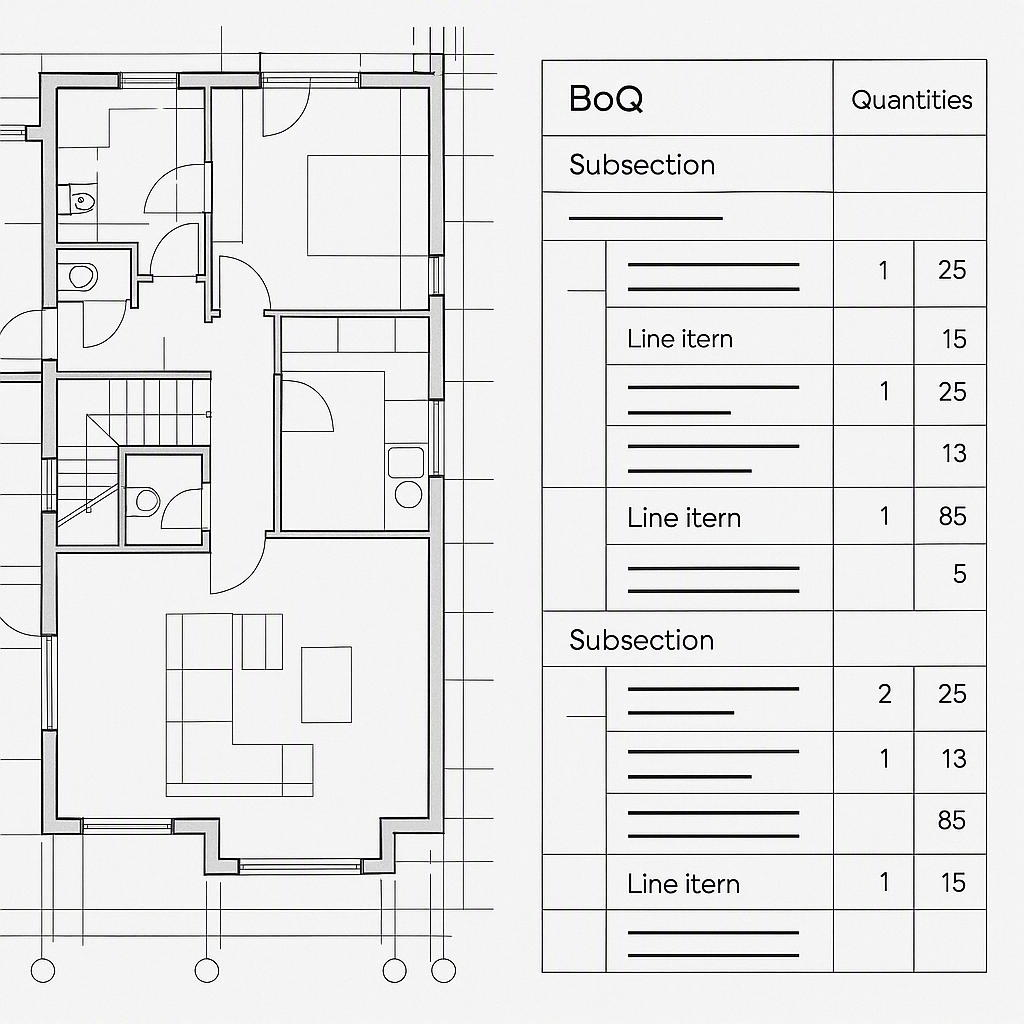
A BOQ is essentially the client's shopping list. It’s a detailed, structured document listing all the deliverables for a project. Each line item specifies:
- Item description
- Quantity
- Unit of measure (UOM)
- Rate
- Total cost per item
Think of it as the client’s way of saying, “Here’s what we want, in detail.” BOQs are hierarchical, often mirroring the project’s scope or work breakdown structure (WBS). For example, a residential project BOQ might have sections like “Foundation,” “Walls,” and “Roofing,” each broken into specific tasks or materials.
Why BOQs Matter
BOQs are critical because they define the scope of work in measurable terms. Without a clear BOQ, contractors lack the roadmap needed to estimate costs accurately. This document serves as the foundation for bidding and contracting in most medium-to-large-scale projects. Misinterpreting the BOQ can lead to underbidding, overspending, or disputes.
Actionable Steps for Working with BOQs
- Review Every Line Item: Don’t skim over any part of the BOQ. Look at quantities, specifications, and units of measure carefully.
- Clarify Ambiguities Early: Flag vague descriptions or missing details with the client before quoting. For example, if a BOQ states "Plastering: 500 sqm," clarify the thickness and type of plaster.
- Understand Standards: BOQs often follow specific standards like CESMM (Civil Engineering Standard Method of Measurement) or IS 1200. Familiarize yourself with these frameworks to avoid misinterpretation.
What is a Quotation?
A quotation, on the other hand, is your response to the BOQ. It’s your pricing proposal. While it’s based on the BOQ, the quotation reflects:
- Your rates (which may include labor, materials, and overheads)
- Your execution plan (e.g., subcontractors, machinery, staging)
- Any markups (profit margins, contingencies)
Quotations can vary in format and complexity. For instance, a simple residential repair job might use a flat rate, while a larger EPC (Engineering, Procurement, and Construction) project might need a detailed cost breakdown per activity or resource.
Why Quotations Matter
Quotations translate the client’s requirements into actionable pricing. They are your opportunity to:
- Cover costs accurately
- Define exclusions and assumptions upfront
- Protect profit margins
If a quotation isn’t detailed enough or doesn’t align with the BOQ, disputes and scope creep can arise.
Actionable Steps for Preparing Quotations
- Align with the BOQ: Ensure your quotation corresponds to the BOQ line-by-line. Don’t leave gaps or assumptions about what’s included.
- Include Exclusions: Clearly list what is not covered in your quotation. For example, “Excludes excavation in rocky soil conditions.”
- Factor in Risks: Account for contingencies like price fluctuations, unforeseen site conditions, or regulatory changes.
- Use Accurate Rates: Base rates on current market prices and realistic labor costs. Don’t guess.
Key Differences Between BOQ and Quotation
| Aspect | Bill of Quantities (BOQ) | Quotation |
|---|---|---|
| Purpose | Defines client requirements | Proposes contractor pricing and terms |
| Perspective | Client’s view of deliverables | Contractor’s view of costs and execution |
| Detail Level | Usually highly detailed, itemized | Depends on contractor’s pricing strategy |
| Adjustable? | Fixed once agreed upon in the contract | Adjustable until accepted by the client |
| Ownership | Created and owned by the client | Created and owned by the contractor |
Common Pitfalls
1. BOQ Misinterpretation
A poorly understood BOQ can lead to underbidding. For example, if the client lists "Earthworks: 10,000 cubic meters," but you miss that it’s in difficult soil conditions, you’ll be stuck footing the bill for extra effort.
How to Avoid This:
- Always visit the site before quoting.
- Cross-reference BOQ details with site conditions.
2. Quotation Gaps
Quotations often fail to match BOQs line-for-line. This can lead to disputes later when the client expects something “included” that you didn’t price.
How to Avoid This:
- Use software tools to map BOQ items directly to your quotation.
3. Scope Creep
If your quotation doesn’t clearly define exclusions or assumptions, clients may assume everything in the BOQ is covered.
How to Avoid This:
- Clearly state exclusions and assumptions in your quotation.
- Include a clause for variation orders.
How JobNext Simplifies This Process
Here’s where tools like JobNext shine. JobNext’s preconstruction module bridges the gap between BOQs and quotations by:
- Direct BOQ Imports: You can directly import client BOQs into the system, preserving their structure.
- Four Quoting Methods: From quick "Easy Quotes" for small jobs to detailed "Estimate-based Quotes" for complex projects, JobNext helps you match the right pricing strategy to the job.
- Scope Linking: Every BOQ item can be linked to your execution plan, ensuring clarity between what’s promised and what’s priced.
How This Works in Practice
Let’s say a BOQ lists "Concrete (M30 Grade): 500 cubic meters." Using JobNext’s Estimate-based Quote, you can break this into:
- Materials (cement, aggregates, water, admixtures)
- Labor (formwork, mixing, placing, finishing)
- Equipment (batching plant, pumps, vibrators)
This ensures your profit margins are baked in from the start.
Learn more about how JobNext tackles preconstruction challenges →
FAQs
Q: Can a BOQ be changed after the contract is signed?
A: Only through a variation order, which must be agreed upon by both parties. This is why getting the BOQ right upfront is critical.
Q: Do all projects require a BOQ?
A: No. Smaller projects might skip formal BOQs in favor of lump-sum agreements. But for larger projects, a BOQ is essential to define the scope clearly.
Q: What’s the best way to prepare a BOQ?
A: Use a standard method like CESMM or IS 1200. These ensure consistency and reduce disputes.
Q: How do I price items in a BOQ accurately?
A: Break each item into its components (materials, labor, equipment), account for contingencies, and use realistic market rates.
Q: What happens if the BOQ doesn’t match actual site conditions?
A: Raise this as a variation order immediately. Document the discrepancy with evidence.
Decision Framework: BOQ vs Quotation
| Scenario | Use BOQ | Use Quotation |
|---|---|---|
| Defining project scope | Yes | No |
| Calculating costs | No | Yes |
| Resolving disputes | Yes (if scope-related) | Yes (if cost-related) |
| Adjusting after award | No (requires variation order) | Yes (before acceptance) |
Conclusion
Understanding the difference between BOQs and quotations isn’t just academic. It’s about protecting your margins and avoiding costly disputes. By aligning your quotation to the BOQ and clearly defining exclusions, assumptions, and risks, you’ll safeguard your profitability.
If you’re struggling with mismatches, it’s worth exploring tools like JobNext that simplify the process.
Get started with JobNext today →
Learn more at EstimateNext