Why Manual Takeoffs Are Killing Your Margins
Every estimator knows the pain of manual takeoffs. You’re scrolling through CAD drawings, cross-referencing BOQs (Bills of Quantities), and double-checking quantities for hours. All while the clock is ticking on your bid submission. It’s slow, repetitive, and worse — error-prone.
A single miscalculation can wreck your margins. Forget to account for a key material? You’re already bleeding money before the project starts. Overestimate quantities? You’ve just bid yourself out of the competition.
And let’s not even talk about the time cost. On average, manual takeoffs take 30 to 40 hours per project. That’s an entire workweek spent on something AI can handle in less than an hour. EstimateNext.ai reports that their AI-powered takeoff tools reduce this time to just 10 minutes. That’s a 98% time savings.
But there’s more to the story. Let’s dig deeper into how manual takeoffs are not just killing your margins but also holding your business back.
The Real Costs of Manual Takeoffs
Manual takeoffs don’t just consume time — they create ripple effects throughout your operations. Here’s how they impact your bottom line:
1. Human Error
Even the most experienced estimator is prone to mistakes. A study by the Construction Industry Institute found that errors in cost estimation account for 5–10% of total construction costs. For a ₹10 crore project, that’s ₹50 lakh to ₹1 crore lost to preventable errors.
Example: Consider a contractor bidding on a ₹5 crore residential project. A minor oversight in the drywall quantity calculation results in underestimating material costs by ₹2 lakh. By the time the error is caught, it’s too late to revise the bid. The contractor eats the loss, and margins are slashed from 15% to 10%.
2. Slower Bid Turnaround
The longer you spend on takeoffs, the fewer bids you can submit. If your competitors are using AI-powered tools, they’re likely submitting 3–4 times more bids in the same timeframe. This puts you at a significant disadvantage in a competitive market.
Case Study: A mid-size contracting firm in Mumbai reported a 60% increase in bid submissions after adopting AI-powered takeoff tools. With manual methods, they submitted 10 bids per month. With AI, they scaled to 25 bids — and won 30% more projects.
3. Labor Costs
Manual work is expensive. If your estimators are spending 80% of their time on repetitive tasks like takeoffs, that’s time they’re not spending on higher-value activities like client management or strategic planning.
Here’s a breakdown of costs for a team of 3 estimators:
- Manual Takeoffs: 30 hours per project x 20 projects/month = 600 hours
- Hourly Rate: ₹1,500/hour
- Monthly Cost: ₹9,00,000
Switching to AI reduces this workload to 10 hours per month:
- AI Takeoffs: ₹1,50,000/month
- Savings: ₹7,50,000/month or ₹90,00,000 annually
How AI-Powered Takeoff Tools Work
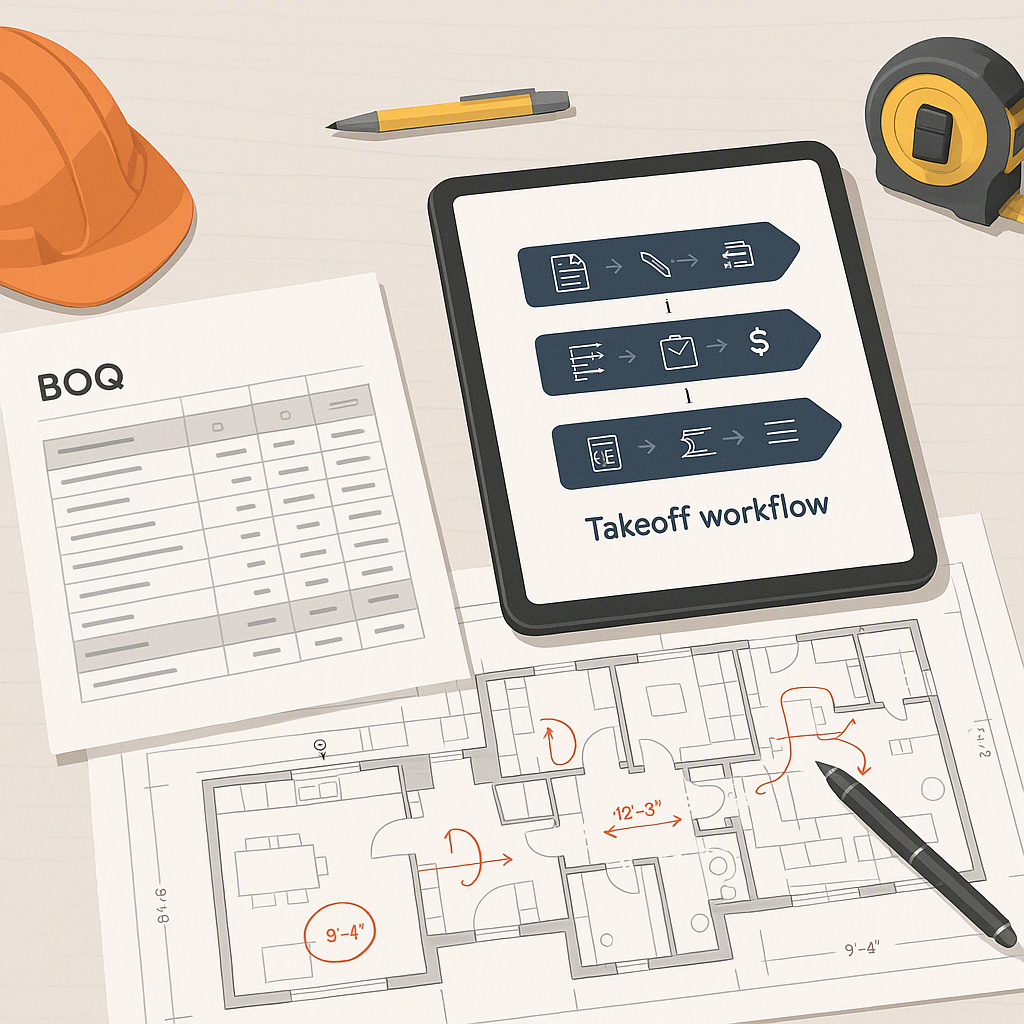
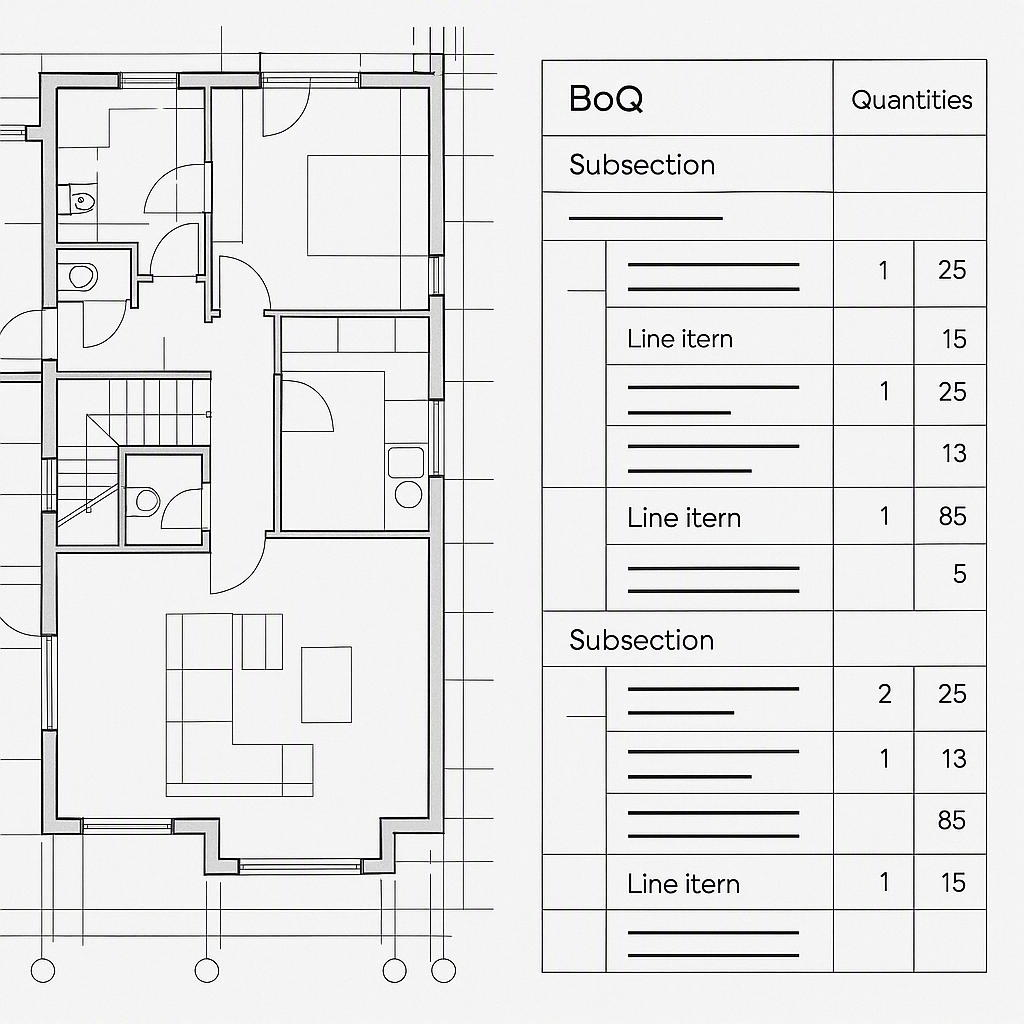
AI takeoff software uses machine learning to read and process drawings automatically. Instead of manually measuring and inputting quantities, the tool extracts data directly from the CAD files. It identifies walls, windows, doors, and other components, then maps them against your BOQs in real-time.
Key Features of AI-Powered Tools
- Automated Quantity Extraction: The software scans drawings and extracts quantities for materials like concrete, steel, and drywall.
- Real-Time BOQ Mapping: AI cross-references extracted quantities with your BOQ to ensure every line item is covered.
- Error Detection: Tools like JobNext flag discrepancies, such as missing items or mismatched quantities, before they become costly mistakes.
- Custom Integrations: Many tools integrate seamlessly with your existing estimating software or ERP system.
Concrete Example
Imagine you’re bidding on a 50,000 sq. ft. commercial project. The CAD drawings include:
- 200 doors
- 1,000 windows
- 20,000 sq. ft. of drywall
With manual takeoffs, it takes 30 hours to measure and input quantities. With AI, the software processes the drawings in under 10 minutes, automatically generating a detailed BOQ. The result? You save time and eliminate the risk of missing critical components.
The Numbers: Time and Cost Savings
Let’s break it down further. Say your team handles 20 bids a month, each requiring an average of 30 hours for takeoffs. That’s 600 hours spent on manual work. If your team is paid an average of ₹1,500 per hour, that’s ₹9,00,000 per month just on takeoffs.
Now, let’s say you switch to an AI tool like JobNext. Assuming it reduces takeoff time to 30 minutes per project, you’re looking at just 10 hours of work per month. That’s ₹1,50,000 in labor costs — a savings of ₹7,50,000. Over a year, that’s ₹90,00,000 in savings.
And this doesn’t even factor in the opportunity cost of freeing up your estimators to focus on higher-value tasks like bid strategy and client negotiations.
Additional Benefits
- Faster Bid Submissions: Submit more bids in less time, increasing your chances of winning contracts.
- Reduced Rework Costs: Accurate takeoffs mean fewer errors, reducing the need for costly rework.
- Improved Team Morale: Estimators can focus on strategic tasks rather than repetitive, time-consuming work.
Beyond Time Savings: Why Accuracy Matters
Time savings are great, but let’s talk about accuracy. According to EstimateNext.ai, AI tools not only cut down on time but also improve accuracy by up to 99%. That means fewer missed items, more precise quantities, and ultimately, more reliable bids.
Impact of Accuracy on Profit Margins
- Missed Items: A single missed line item can cost lakhs. For example, forgetting to include rebar in a foundation estimate can result in a 5–10% loss on the project.
- Over-Estimations: Overestimating materials inflates your bid, making you less competitive.
Proactive Error-Checking
JobNext, for instance, ensures every material, labor, and equipment cost is tied directly to your approved BOQ. If a line item doesn’t match, the system flags it before it’s too late. This kind of proactive error-checking is what separates successful contractors from those constantly chasing their tails.
Addressing Common Objections
“AI sounds great, but is it worth the cost?”
Let’s tackle this head-on. Many contractors assume that AI-powered tools are expensive. But when you compare the cost of the software to the labor savings, it’s a no-brainer. For most small to mid-size contractors, the ROI is immediate. You can pay for the tool with the savings from your first project.
“Will it replace my team?”
The answer is no. AI tools don’t replace humans; they enhance them. Your estimators still need to validate the data, adjust for project-specific nuances, and make judgment calls. AI just takes care of the grunt work.
“Is it difficult to implement?”
Most modern AI tools are designed to integrate seamlessly into your existing workflows. If your team can use Excel or CAD software, they can use AI takeoff tools with minimal training.
How to Get Started
If you’re ready to stop wasting time on manual takeoffs, start by evaluating your current workflow. How many hours are you spending on takeoffs? What’s your error rate? Use these metrics as a baseline to measure the impact of AI.
Steps to Implement AI Takeoff Tools
- Assess Your Needs: Identify bottlenecks in your current estimating process.
- Research Solutions: Compare tools like JobNext, PlanSwift, and Bluebeam to find the best fit for your team.
- Run a Pilot Project: Test the tool on a smaller project to measure time and cost savings.
- Train Your Team: Ensure your estimators are comfortable using the software.
- Scale Up: Once you see results, integrate the tool into your standard workflows.
FAQ
1. How accurate are AI takeoff tools? AI tools like JobNext achieve up to 99% accuracy by cross-referencing drawings with BOQs and identifying potential mismatches.
2. Can AI handle complex projects? Yes, AI excels at complex projects with large BOQs. It processes thousands of line items in minutes, something manual methods struggle with.
3. Are AI tools expensive? While there’s an upfront cost, the ROI is immediate. Savings in labor and error reduction often cover the cost within the first project.
4. Do I need technical expertise to use AI takeoff tools? Not at all. Tools like JobNext are user-friendly and designed with contractors in mind. If you can navigate Excel, you can use these tools.
5. What’s the first step to implementing AI takeoffs? Start by identifying bottlenecks in your current workflow. Then, choose a tool like JobNext that integrates seamlessly with your existing processes.
Comparison Table: Manual vs. AI-Powered Takeoffs
| Feature | Manual Takeoffs | AI-Powered Takeoffs |
|---|---|---|
| Time Per Project | 30–40 hours | 10–30 minutes |
| Accuracy | 90–95% (prone to errors) | 99%+ |
| Labor Cost (₹1,500/hr) | ₹45,000/project | ₹750/project |
| Scalability | Limited | High |
| Error Detection | Manual | Automated |
If you’re tired of wasting time and losing margins to manual takeoffs, JobNext can help. Get started today →
Learn more at EstimateNext