The Hidden Danger in Contractor Markup
Margins aren't just about multiplying your costs by a percentage. If that's your strategy, you're already losing money. Here's why.
Markup calculations often ignore hidden costs buried in the BOQ (Bill of Quantities). These include scope changes, procurement overruns, and subcontractor inefficiencies. For example, a BOQ item may seem profitable on paper but could have negative margins once you account for labor delays or material wastage.
Why Markup Miscalculation Happens
Contractors often fall into the trap of oversimplifying markup calculations. The assumption is that applying a fixed percentage to costs guarantees profitability. But this approach ignores real-world complexities:
- Hidden Costs: Procurement overruns, increased compliance expenses, and labor inefficiencies are rarely accounted for upfront.
- Scope Creep: Minor changes in project scope can lead to exponential increases in costs, especially for large-scale projects.
- Subcontractor Failure: Subcontractors who underbid often deliver subpar work, causing delays or reworks that erode margins.
To illustrate, a construction company in India took on a municipal project with a 25% markup on estimated costs. Midway through the project, delays from a subcontractor added ₹7,00,000 to indirect costs, wiping out their projected profit margin entirely.
How to Spot Margin Erosion Early
Step 1: Introduce Weekly Margin Tracking
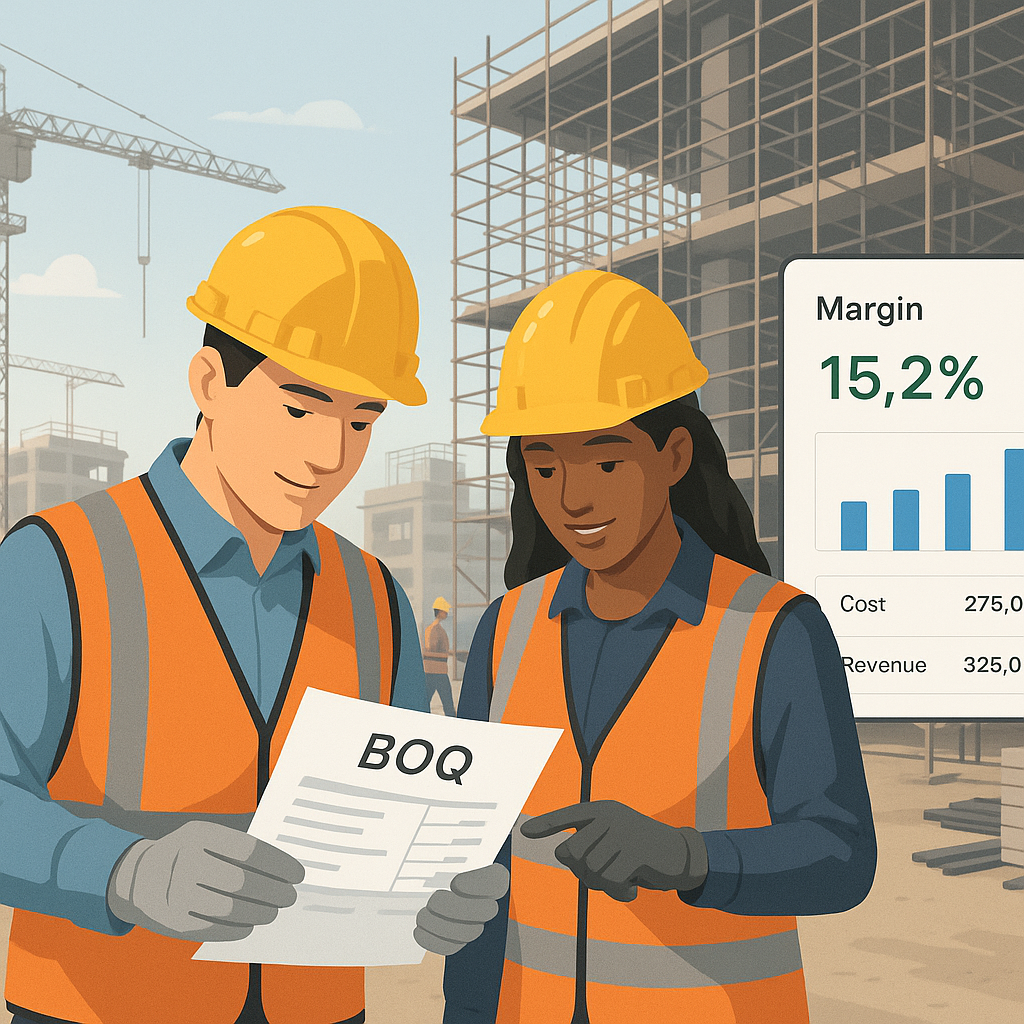
One of the most effective tools for combating margin erosion is the BOQ Margin Report. This report analyzes project profitability by comparing contracted rates to actual costs (labor, material, plant, subcontractor, overhead) per BOQ item.
Actionable Steps to Implement Weekly Margin Tracking:
- Set Up Software: Use software like JobNext or EstimateNext to automatically generate BOQ Margin Reports.
- Flag Negative Margins: Review flagged items weekly to identify estimation errors or scope creep.
- Create Accountability: Assign team members to investigate and resolve flagged items immediately.
Case Study: Weekly Tracking in Action
A mid-size contractor used JobNext’s BOQ Margin Report for a commercial office build. Weekly reviews revealed that scaffolding costs were higher than estimated due to subcontractor delays. By renegotiating terms mid-project, the contractor saved ₹2,50,000 and avoided further overruns.
Real Example: Subcontractor Overruns
Subcontractor inefficiencies can devastate your margins. Let’s say you hire a subcontractor for scaffolding installation. The initial bid looks great—lowest price wins, right? Wrong.
Why "Lowest Price" Often Means "Highest Cost"
- Poor Quality: Low-cost subcontractors might use inferior materials or lack skilled labor.
- Delays and Rework: If the subcontractor fails to meet deadlines, the delay cascades into other areas of the project.
- Hidden Costs: Delays add indirect costs like extended equipment rentals or increased labor hours.
A Comparative Framework for Subcontractor Selection:
| Criteria | Lowest Bid Option | Competitive Bid Option | Best Value Option |
|---|---|---|---|
| Upfront Cost | ₹5,00,000 | ₹5,50,000 | ₹6,00,000 |
| Quality Assurance | Low | Medium | High |
| Timeline Adherence | Poor | Good | Excellent |
| Long-term Savings | Negative | Neutral | Positive |
Actionable Tip: Use software like JobNext to enforce competitive evaluation workflows. This ensures every bid is scored on cost, quality, and timeline adherence—not just upfront price.
Markup Percentage Formula: The Right Way
Stop guessing your markup percentage. Use a bottom-up approach:
Step 1: Estimate Costs Precisely
Break costs into Labor, Material, Plant, Subcontractor, and Overheads. Tools like EstimateNext simplify this process.
Step 2: Factor Hidden Costs
Include contingency for scope changes, procurement delays, and compliance expenses. For instance, if labor overruns are common in your region, add a 10–15% buffer to labor costs.
Step 3: Apply Transparent Markup
Add a markup that aligns with your risk profile and desired profit margin.
Example Formula:
Markup % = [(Selling Price – Total Cost) / Total Cost] × 100
If your total cost is ₹10,00,000 and you want a margin of ₹3,00,000, your markup is: Markup % = [(₹13,00,000 – ₹10,00,000) / ₹10,00,000] × 100 = 30%
Pro Tip: Avoid using fixed markup percentages across all projects. For high-risk projects, increase your markup to account for potential overruns.
Fixing Procurement Chaos
Procurement inefficiencies are another silent killer of margins. Rushed timelines or unstructured workflows inflate costs and reduce profitability.
Common Procurement Pitfalls:
- Vendor Limitations: If fewer than three vendors respond to an RFQ (Request for Quotation), your comparative analysis is meaningless.
- Lack of Documentation: Without proper documentation, procurement decisions often rely on gut instinct rather than data.
- Unstructured Workflow: A chaotic workflow results in missed deadlines and inflated costs.
Actionable Steps to Streamline Procurement:
- Standardize Workflow: Implement a structured process: Material Request → RFQ → Comparative Statement → Purchase Order.
- Expand Vendor Pool: Regularly onboard new vendors to ensure competitive bidding.
- Use Procurement Software: JobNext’s procurement module enforces structured workflows and documents every vendor decision.
Case Study: Structured Procurement Saves ₹4,00,000
A contractor in Pune streamlined their procurement process using JobNext’s RFQ module. By ensuring three competitive bids per purchase order, they saved ₹4,00,000 on material costs over six months.
Why AI Estimation Tools Are Game-Changers
Manual estimation eats up 40 hours per bid. That’s 40 hours you could spend refining your markup strategy. AI tools like EstimateNext cut this time to minutes by automating rate matching and cost breakdowns.
Benefits of AI Estimation Tools:
- Speed: AI tools reduce estimation time by up to 95%.
- Accuracy: Automated rate matching ensures precise calculations.
- Scalability: Handle multiple bids simultaneously without sacrificing quality.
Actionable Tip:
If you’re still using Excel for estimation, you’re losing time and money. Transition to AI tools to stay competitive.
Case Study: AI Cuts Bid Time by 90%
A contractor bidding on a ₹50 crore infrastructure project used EstimateNext. The tool reduced bid preparation time from 40 hours to under 4 hours, allowing the team to focus on negotiations and project planning.
FAQ Section
Q: What's the difference between margin and markup?
A: Margin is profit as a percentage of selling price. Markup is profit as a percentage of cost. For example, a 30% markup on ₹10,00,000 costs results in a 23% margin on ₹13,00,000 selling price.
Q: How do I prevent scope creep?
A: Use detailed BOQ estimates and monitor margin erosion weekly with tools like the BOQ Margin Report. Also, draft contracts that clearly define scope and include clauses for additional work.
Q: What’s the ideal markup percentage?
A: It depends on your industry, risk tolerance, and cost structure. 20–30% is common but should be calculated bottom-up based on project specifics.
Q: How do I select the best subcontractor?
A: Evaluate subcontractors on cost, timeline adherence, and quality. Avoid choosing based solely on price. Use structured workflows like JobNext to document and evaluate bids.
Q: Are AI tools expensive?
A: Most AI estimation tools offer tiered pricing based on project size. The initial cost is quickly offset by time and money saved on accurate bids.
Call to Action
If you're dealing with hidden costs killing your margins, JobNext can help. Its BOQ Margin Report and procurement workflows ensure you stay profitable. Get started free →
Learn more at EstimateNext