Why Cost Estimation Errors Destroy Margins
Margins in construction are razor-thin. If you’re off by even 5% on your bid, you could lose money before the project even starts. And yet, many contractors don’t take cost estimation seriously enough. They rely on gut feel or outdated spreadsheets, ignoring structured methods that can save them millions over a career.
This article breaks down the four core types of cost estimation methods, provides actionable strategies for improving accuracy, and includes practical FAQs to help contractors navigate the challenges of cost estimation.
The Impact of Cost Estimation Errors
Before diving into methods, let’s quantify how errors in cost estimation can affect a business. According to a 2022 report by Deloitte on construction industry trends, 70% of large projects experience cost overruns. These overruns average 16-20% above the initial estimate. On a ₹100 crore project, this could mean a loss of ₹16-20 crore—enough to wipe out profit margins entirely.
Example: The Sydney Light Rail Overrun
A real-world example of cost estimation pitfalls is the Sydney Light Rail project in Australia. Initially budgeted at $1.6 billion AUD, the project ended up costing $2.9 billion AUD—a staggering 81% increase. The primary reason? Poor initial cost estimation that didn’t account for utility relocation and contractor claims.
This is why structured cost estimation is critical. Let’s explore the four main methods and how to use them effectively.
1. Analogous Estimation
How it works: Analogous estimation involves basing your cost estimate on similar past projects. If your last school construction cost ₹50 crore, you assume the next one will be similar.
Best for: Repeatable projects with predictable variables. Think facilities maintenance contracts, basic landscaping jobs, or standardized building types like warehouses.
Pros:
- Fast and straightforward
- Useful for early-stage budgeting
Cons:
- Relies heavily on past data accuracy
- Doesn’t account for market fluctuations (e.g., material or labor costs)
Practical Example: A contractor bidding on a metro station project modeled costs on a similar station built two years prior. However, when aluminum costs skyrocketed mid-project, their budget went off-track, resulting in losses.
Actionable Tips:
- Adjust for Inflation: Use an inflation index to update past project costs to current conditions.
- Check Material Trends: Tools like EstimateNext provide real-time material price trends, ensuring you don’t base bids on outdated rates.
- Validate Assumptions: Cross-check with suppliers and subcontractors to ensure assumptions hold true for the current project.
2. Parametric Estimation
How it works: Costs are calculated using formulas based on measurable parameters. For example, you might estimate ₹1,000 per cubic meter of concrete or ₹5,000 per square meter of roofing.
Best for: Projects with easily quantifiable components, like civil works, road construction, or modular builds.
Pros:
- More accurate than analogous estimation
- Useful for projects with standard units
Cons:
- Relies on accurate and frequently updated unit rates
- May overlook project-specific complexities
Case Study: In a road construction project, a contractor used ₹10,000 per kilometer as a parametric rate. However, they didn’t account for a section requiring a bridge, which increased costs by 40%.
Practical Application:
Platforms like JobNext integrate parametric estimation into workflows, enabling contractors to build estimates line-by-line. For instance:
- Break Down Components: Divide the project into measurable units (e.g., square meters of flooring, cubic meters of concrete).
- Use Updated Libraries: Ensure your rate library is updated quarterly to reflect market conditions.
- Factor in Variability: Adjust unit rates for site-specific conditions like labor productivity or terrain.
3. Bottom-Up Estimation
How it works: Calculate costs for every activity or resource, then sum them up. This is the most detailed and time-intensive method.
Best for: Complex projects with multiple scopes, like high-rise buildings or EPC (Engineering, Procurement, and Construction) contracts.
Pros:
- Highly accurate
- Reflects true project complexity
Cons:
- Time-consuming
- Prone to errors if done manually or under time pressure
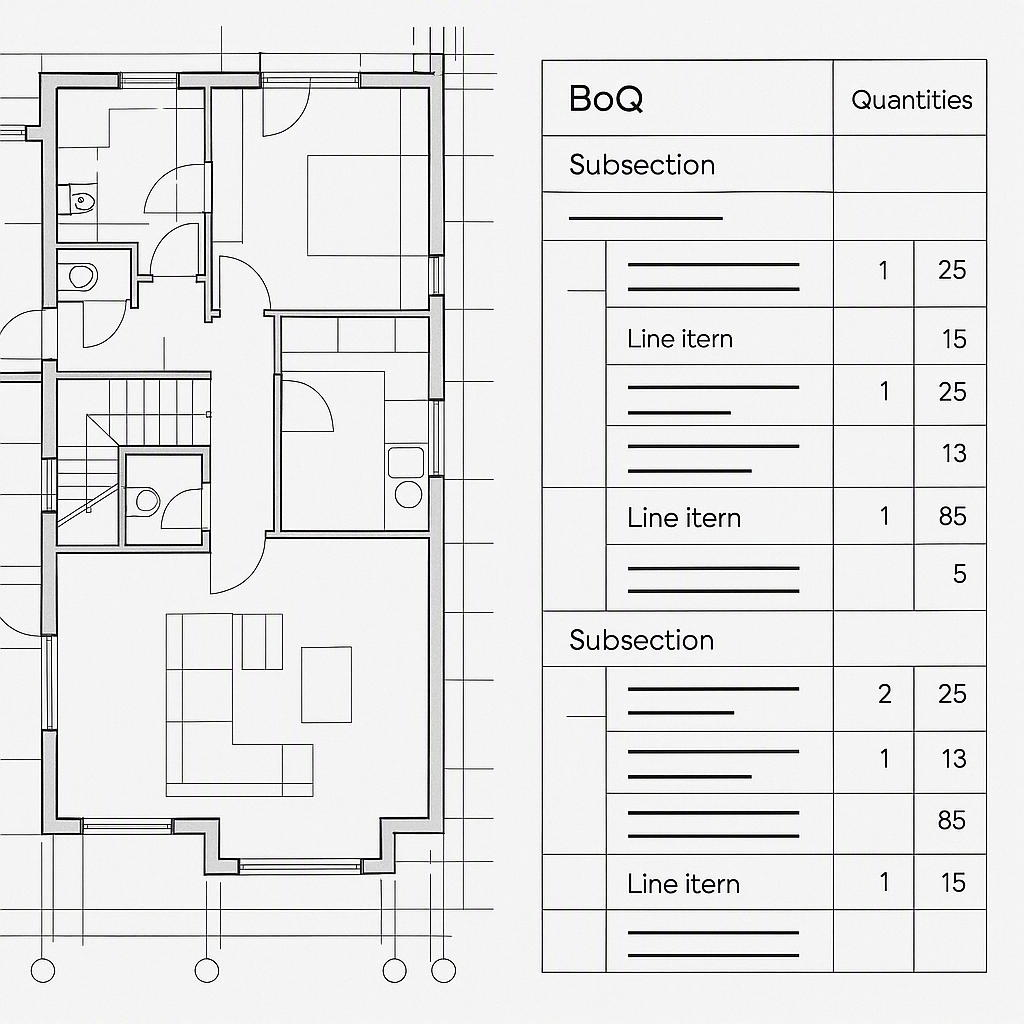
Example: A contractor working on a high-rise building broke down the BOQ (Bill of Quantities) into granular components—labor, material, equipment, etc. Each item was estimated individually, but errors in labor productivity assumptions led to cost overruns.
Actionable Steps:
- Invest in Software: Tools like JobNext allow you to automate this process, reducing errors and saving time.
- Train Your Team: Ensure your estimation team understands how to break down BOQs accurately.
- Validate Estimates: Use automated rate validation features to catch inconsistencies before approval.
4. Three-Point Estimation
How it works: This method calculates three scenarios—optimistic, pessimistic, and most likely—then averages them. It’s primarily used for risk-heavy projects.
Best for: Projects with high uncertainty, such as large infrastructure builds or greenfield developments.
Pros:
- Accounts for risk and uncertainty
- Encourages realistic planning
Cons:
- Requires experience and judgment
- Time-intensive compared to analogous or parametric methods
Real-World Application: A contractor working on a greenfield airport development used three-point estimation to account for potential delays due to environmental approvals. This helped them create a more realistic budget and timeline.
Steps to Implement:
- Gather Data: Identify risks that could impact costs (e.g., delays, material shortages).
- Develop Scenarios: Create best-case, worst-case, and most-likely cost estimates.
- Use Weighted Averages: Assign weights to each scenario (e.g., 20% optimistic, 60% most likely, 20% pessimistic) to create a balanced estimate.
How to Choose the Right Estimation Method
Choosing a method isn’t about preference—it’s about context. Use the table below to guide your decision:
| Method | Speed | Accuracy | Best For |
|---|---|---|---|
| Analogous | Fast | Low | Repeatable projects |
| Parametric | Medium | Medium | Quantifiable components |
| Bottom-Up | Slow | High | Complex scopes |
| Three-Point | Medium | High | Risk-heavy, uncertain projects |
Why Good Estimation Tools Matter
Without a structured workflow, even the best estimation method can fail. That’s where platforms like JobNext shine. By centralizing rate libraries, automating approval chains, and linking estimates directly to procurement budgets, tools like these eliminate manual errors and save time.
Benefits of Estimation Software:
- Faster Turnaround: Reduce bid preparation from days to hours.
- Improved Accuracy: Automated rate validation minimizes errors.
- Streamlined Workflows: Connect estimation to procurement and project management.
Case Study: EstimateNext demonstrated how AI-powered rate matching slashed bid preparation time for a contractor from 36 hours to minutes, allowing them to focus on winning more projects.
FAQs
Q: Can I mix estimation methods in one project?
A: Absolutely. Many contractors start with analogous estimates for early budgeting and switch to bottom-up for detailed scopes later.
Q: How often should I update my unit rates?
A: At least quarterly. Inflation, labor shortages, and material price volatility can shift rates dramatically. Regular updates ensure your estimates remain relevant.
Q: Is AI replacing human estimators?
A: No, but it’s augmenting them. AI tools like EstimateNext handle repetitive tasks, freeing estimators for higher-value work like risk analysis and scenario planning.
Q: How do I manage client expectations if costs increase mid-project?
A: Communication is key. Use tools to track real-time cost changes and provide clients with transparent updates.
Q: What’s the biggest mistake contractors make in estimation?
A: Relying on outdated data or skipping risk analysis. Both can lead to inaccurate bids and costly overruns.
Call to Action
If inaccurate estimates are eating into your margins, tools like JobNext can help. From Estimate-Based Quotes to procurement-ready budgets, JobNext simplifies the entire estimation process. Get started today →
Learn more at EstimateNext