The Brutal Truth About Bid Markups
Bid markups can make or break your contracting business. Yet, many contractors rely on guesswork when determining their markup. Maybe you’ve added a flat percentage based on a competitor’s rate, or you’ve used a gut feeling instead of a precise calculation. The result? Margins disappear faster than you’d think, especially when costs don’t align with your bids. The solution lies in understanding the root causes of markup mistakes, leveraging tools like the BOQ Margin Report, and applying proven strategies to protect your profitability.
Why Markup Mistakes Happen
Markup errors often stem from three primary issues:
-
Hidden Costs: Contractors commonly overlook indirect expenses such as overhead, warranties, equipment depreciation, or even the cost of financing a project. For example, you might allocate ₹1 lakh for equipment but fail to include maintenance or downtime costs.
-
Scope Creep: This occurs when clients request changes to the project scope without adjusting the budget. Imagine agreeing to add a deck to a home renovation project mid-way. If you don’t track and re-estimate costs, your markup won’t cover the added expenses.
-
Poor Tracking: Many contractors set their markup once and never revisit it. Without regularly reviewing BOQ (Bill of Quantities) margins, small cost overruns can snowball into major profitability issues.
Case Study: Hidden Costs in a Commercial Renovation
A contractor bidding on a ₹50 lakh office renovation project underestimated indirect costs. They accounted for labor and materials but missed ₹3 lakh in overhead, including insurance, fuel, and administrative expenses. By the end of the project, their margin had shrunk from 15% to 8%. This could have been avoided with better cost tracking and markup adjustment.
What Is the BOQ Margin Report?
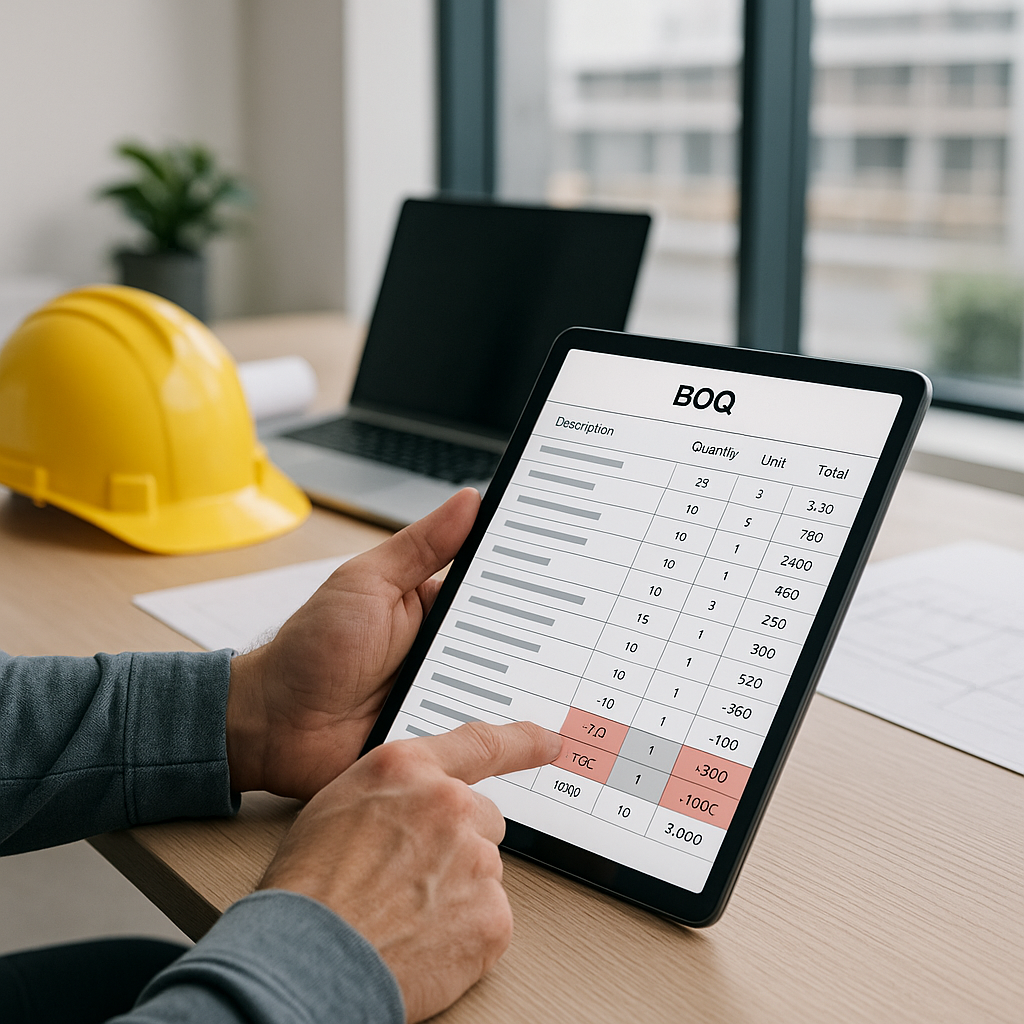
The BOQ Margin Report is a powerful tool in JobNext that compares your contracted BOQ rates against actual costs for labor, materials, equipment, subcontractors, and overhead. It identifies BOQ items with negative margins, giving you a real-time view of profitability and the ability to address issues before they spiral out of control.
Why This Report Matters
Negative-margin BOQ items are red flags indicating one of the following issues:
- Estimation Errors: For instance, you might estimate ₹200 per square foot for flooring materials, but supplier prices rise mid-project to ₹250.
- Scope Changes: Clients may request additional features (e.g., custom fixtures or extra landscaping) that weren’t included in the original contract.
- Procurement Overruns: Vendors can sometimes charge more than initially quoted, or you may face unexpected freight costs.
Real-Life Example: Avoiding a ₹10 Lakh Loss
A contractor working on a ₹1 crore housing project used the BOQ Margin Report to spot labor costs exceeding estimates by ₹5 lakh after the first month. Without this insight, they would have completed the project with a ₹10 lakh loss. Instead, they renegotiated terms with the client and reallocated resources to stay profitable.
How to Calculate Bid Markup the Right Way
At its core, the formula for selling price is simple:
Selling Price = Cost + Markup
However, determining the right markup percentage can be tricky. Here’s a step-by-step approach:
Step 1: Identify Total Costs
Include both direct costs (labor, materials, equipment) and indirect costs (overhead, insurance, warranties).
Step 2: Determine Desired Profit
Decide on a realistic profit margin for the project. For example, let’s say you want a 15% profit margin.
Step 3: Apply the Markup Formula
Use this formula:
Markup = (Desired Profit ÷ Total Costs) × 100
Example Calculation:
If your total costs for a project are ₹10 lakh and you want a 15% profit:
Markup = (₹1,50,000 ÷ ₹10,00,000) × 100 = 15%
Step 4: Adjust for Indirect Costs
For indirect costs like overhead, use tools like the BOQ Margin Report to ensure all expenses are accounted for. For instance, if overhead adds ₹2 lakh to your total costs, calculate markup based on ₹12 lakh instead of ₹10 lakh.
Common Pitfall: Flat Markup Percentages
Many contractors apply a flat 10% or 20% markup without analyzing project specifics. A ₹5 lakh project with high labor costs may require a different markup than a ₹50 lakh project dominated by material expenses.
Tools That Simplify Markup Calculation
Manually calculating markup is prone to errors. That’s where AI-powered tools like EstimateNext come in. These tools streamline the estimation process by generating detailed cost breakdowns in minutes, not hours.
Key Features of EstimateNext:
- AI-Driven Analysis: Automates cost estimation for labor, materials, and equipment.
- Speed: Reduces preconstruction time by up to 90%.
- Integration: Pairs seamlessly with JobNext’s BOQ Margin Report to catch hidden costs.
Example:
A contractor saved 40 hours of manual estimation work on a ₹2 crore project by using EstimateNext. The tool flagged discrepancies in material costs that would have resulted in a ₹5 lakh loss.
Real-Life Example: Catching Margin Erosion Early
Imagine you’re bidding on a ₹1 crore interior design project. Here’s the breakdown of your initial estimates:
| Cost Component | Estimated Cost (₹) |
|---|---|
| Labor | 25,00,000 |
| Materials | 40,00,000 |
| Equipment | 10,00,000 |
| Subcontractors | 15,00,000 |
| Overhead | 5,00,000 |
| Total Costs | 95,00,000 |
You set a 20% markup, expecting a ₹20 lakh profit. However, halfway through, the BOQ Margin Report reveals that labor costs have exceeded estimates by ₹5 lakh due to overtime and unexpected site conditions. Without this report, you’d only discover the issue at the end of the project, slashing your profit to ₹15 lakh.
By catching the issue early, you can renegotiate terms, adjust resource allocation, or explore cost-saving measures to protect your margins.
Key Takeaways
- Markup errors are a leading cause of margin erosion.
- The BOQ Margin Report is an essential tool for catching issues in real-time.
- AI-powered tools like EstimateNext simplify estimation and reduce costly errors.
- Regularly review and adjust your markup to account for hidden costs, scope changes, and procurement overruns.
Stop guessing your markup. Start using tools that protect your margins and ensure profitability.
FAQ
1. What’s the difference between markup and margin?
Markup is the percentage added to your costs to determine the selling price. Margin, on the other hand, is the percentage of profit you retain after subtracting costs from revenue.
For example, if your costs are ₹10 lakh and you apply a 20% markup, the selling price is ₹12 lakh. Your margin is ₹2 lakh, or 16.67% of the selling price.
2. How often should I review BOQ margins?
Weekly reviews are ideal. Regularly monitoring your BOQ margins helps you catch small errors or overruns before they escalate. Some contractors prefer daily reviews during critical project phases.
3. Can AI tools eliminate markup mistakes completely?
No, AI tools like EstimateNext improve cost accuracy and speed up estimation, but they can’t replace human oversight. Pair these tools with regular BOQ margin reviews for the best results.
4. What’s the best way to handle scope creep?
Include a clear change order process in your contracts. When clients request changes, document the additional costs and adjust your markup accordingly. Never proceed with additional work without written approval.
5. How do I account for inflation in my markup?
Use historical data and market trends to forecast cost increases for labor and materials. Tools like JobNext can help you adjust your estimates dynamically to reflect inflation.
If you’re tired of losing margins to poor cost tracking, JobNext can help. Explore features →
Learn more at EstimateNext