The Silent Killer of Margins: Broken Takeoff Processes
Let’s start with a basic truth: most contractors don’t lose money because of bad execution. They lose it before the first brick is laid. A sloppy quantity takeoff process is often to blame. When you miscalculate material quantities, labor hours, or equipment needs, you’re already bleeding cash before the project begins. Fixing those errors mid-project? Forget about it—it’s too late by then.
In this expanded version, we’ll dive deeper into common takeoff mistakes, actionable solutions, real-world examples, and practical tools that can help contractors avoid costly errors. By the end, you’ll have a clear roadmap for overhauling your takeoff process.
Common Takeoff Mistakes That Cost You Big
1. Over-reliance on manual methods
Many contractors still rely on Excel sheets or paper-based methods to handle takeoffs. While these methods may seem straightforward, they’re inherently prone to human error. A single misplaced decimal point can lead to thousands in unnecessary spending.
A 2023 McKinsey report revealed that manual estimation processes often result in 15-20% material wastage on large projects. For example, if a project’s materials budget is $500,000, that’s $75,000-$100,000 wasted due to estimation errors.
Concrete Example: A Florida-based contractor working on a $3M residential complex miscalculated lumber requirements by 18%. This led to surplus inventory sitting idle on-site, tying up cash flow and storage space. Worse, additional labor costs were incurred to manage the unneeded materials.
Actionable Step: Transition to digital tools like EstimateNext or JobNext that automate takeoff calculations, drastically reducing the margin for error.
2. Unstructured BOQ workflows
A Bill of Quantities (BOQ) is the backbone of project planning, yet many contractors treat it as a pricing sheet rather than a dynamic document. Jumping straight into pricing without linking BOQ items to execution activities results in incomplete cost tracking. Subcontractor payments, idle equipment charges, and other indirect costs often get overlooked.
Concrete Example: A mid-size EPC contractor in Oman—let’s call them BuildFast—was losing 10% of their project value to unbilled BOQ items. Their problem? No structured workflow for transitioning BOQs from tender to execution. Items got lost in the shuffle, and subcontractor costs ballooned as a result.
Actionable Step: Adopt a structured BOQ system where every item is linked to specific tasks, scopes, and work breakdown structures (WBS). This ensures seamless integration across planning, procurement, and execution.
3. Ignoring variation tracking
Projects rarely stick to the original plan. Scope changes, client demands, and unforeseen site conditions often result in variations. If you’re not actively tracking these changes against your BOQ, you’re absorbing those costs yourself.
Concrete Example: A contractor in Sydney handling a $10M hospital renovation ignored change orders for plumbing upgrades. By the end of the project, they had absorbed $250,000 in unbilled costs. The culprit? A lack of variation tracking in their takeoff process.
Actionable Step: Use digital tools with built-in variation tracking to automatically update BOQs and ensure every change is accounted for. Tools like Procore or JobNext excel at this.
A Real Example: Why Structure Matters
Let’s revisit BuildFast, the mid-size EPC contractor in Oman. Their 10% project value loss came down to one key oversight: an unstructured BOQ workflow. Here’s how they fixed it:
- Problem: BOQ items weren’t linked to execution activities, leading to unbilled costs and subcontractor disputes.
- Solution: They implemented JobNext and integrated BOQ items with scopes and WBS. This improved visibility across departments and ensured every cost was tracked throughout the project lifecycle.
- Result: Within six months, BuildFast reduced unbilled BOQ costs by 80% and improved their profit margins by 5%.
The Fix: A Structured BOQ Workflow
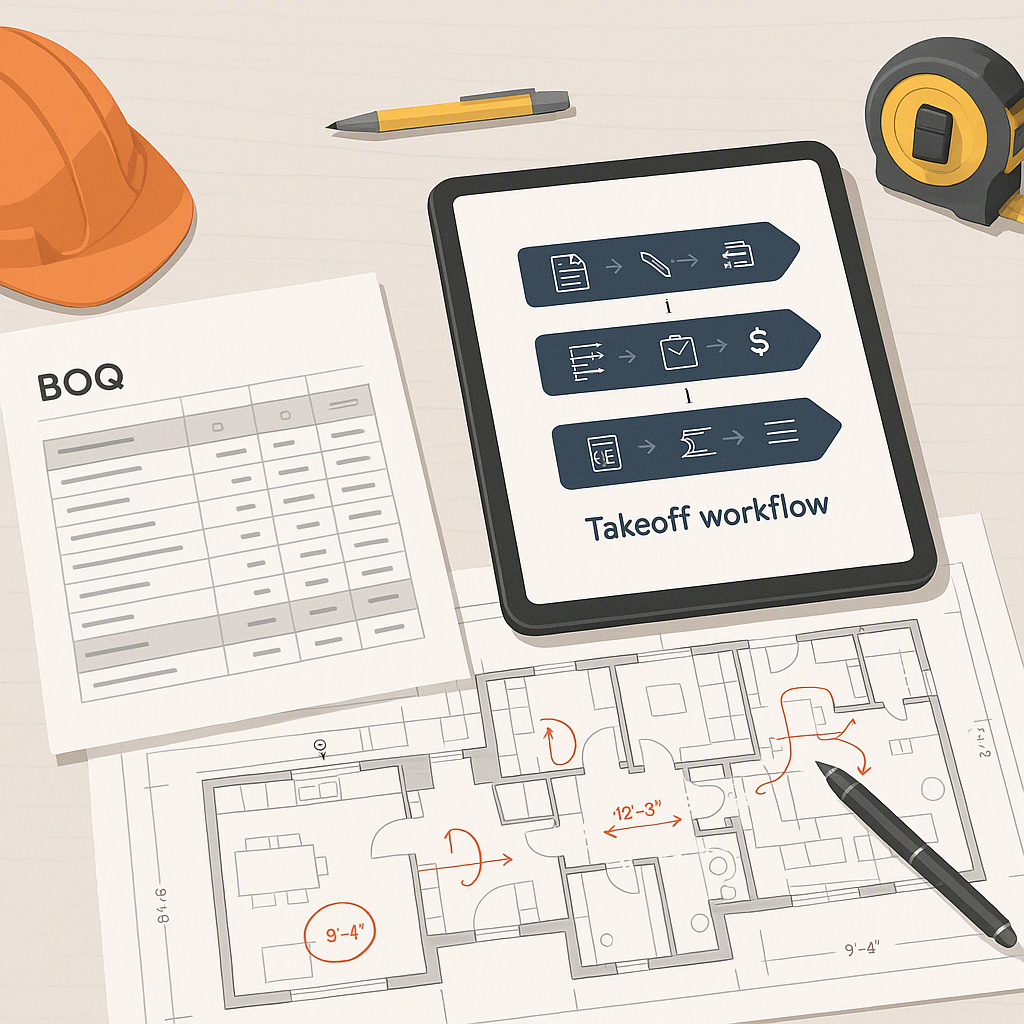
A solid BOQ workflow isn’t just about listing quantities. It’s about integrating that data across your entire project lifecycle—planning, procurement, execution, and billing. Let’s break it down step by step:
1. Set up the BOQ
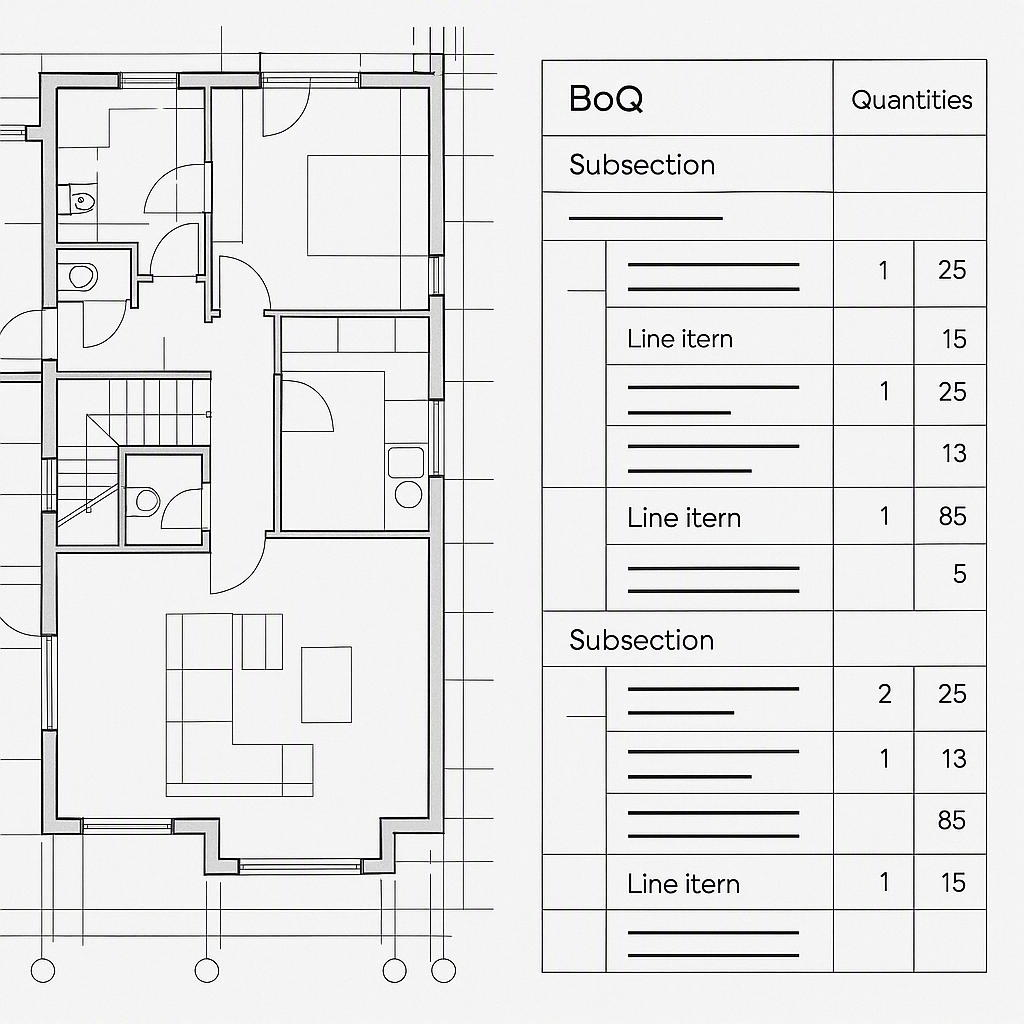
Define every item in a group → item hierarchy. For example:
| Group | Item | Unit | Quantity | Rate |
|---|---|---|---|---|
| Civil Works | Excavation (500 CUM @ ₹120/CUM) | CUM | 500 | ₹120 |
| Electrical | Wiring (1000 M @ ₹15/M) | M | 1000 | ₹15 |
Tools like JobNext make this process easier by allowing you to upload BOQs directly or create them manually within the system.
2. Link BOQs to Scopes and WBS
Every BOQ item should link to a project scope or work breakdown structure (WBS). This ensures that nothing is left out during execution.
3. Build Estimates
Use bottom-up costing to estimate labor, material, equipment, and subcontractor costs for each BOQ item. Digital tools like JobNext’s Estimate Quote method break each rate into granular components and ensure consistent pricing across projects.
4. Track Progress
As work is executed, record measurements directly against BOQ items. For example, if you’ve completed 50% of excavation, the system should calculate your progress and update pending quantities automatically.
5. Bill Accurately
Use the BOQ as the foundation for billing. Whether you’re issuing RA Bills, stage-wise invoices, or one-time charges, linking bills to BOQ items ensures nothing falls through the cracks.
Why Automation Changes the Game
Manually managing BOQs is a nightmare. It’s error-prone and time-consuming. Automating the process with a tool like JobNext isn’t just a “nice-to-have”—it’s essential.
What Automation Solves:
- Error Reduction: Automated BOQ workflows eliminate manual data entry errors by linking every BOQ item to project scopes, estimates, and bills.
- Time Savings: According to EstimateNext, AI-powered tools can reduce takeoff time from 40 hours to 10 minutes per project.
- Real-Time Tracking: JobNext’s dashboards let you monitor progress and profitability in real-time, so you can catch cost overruns before they spiral out of control.
A Practical Checklist for Contractors
Want to master your takeoff process? Start here:
- Audit Your Current Workflow: Identify where errors and delays occur.
- Adopt a Structured BOQ: Use a group → item hierarchy and link every item to scopes and estimates.
- Invest in Automation: Tools like JobNext and EstimateNext streamline everything from takeoffs to billing.
- Train Your Team: Even the best tools fail if your team doesn’t know how to use them.
- Monitor Variations: Track every change order or variation against your BOQ.
FAQ Section
1. What is a BOQ, and why is it important?
A Bill of Quantities (BOQ) is a document that lists all materials, labor, and equipment needed for a project, along with their estimated costs. It’s crucial for accurate budgeting, planning, and billing.
2. How can automation improve my takeoff process?
Automation eliminates manual errors, saves time, and ensures real-time tracking of project progress and costs. Tools like JobNext integrate BOQ workflows across planning, execution, and billing.
3. What’s the difference between manual and digital takeoff methods?
Manual methods rely on spreadsheets or paper-based calculations, which are prone to errors. Digital methods use software to automate calculations, link BOQs to scopes, and track variations.
4. How do I handle scope changes or variations effectively?
Use tools with built-in variation tracking to update BOQs in real-time. This ensures that every change order is accounted for in your billing.
5. What are the best tools for BOQ management?
Popular tools include JobNext, Procore, and EstimateNext. These platforms offer features like automated takeoffs, variation tracking, and billing integration.
Final Thoughts: Don’t Let Margins Slip Away
In my opinion, most contractors underestimate how much poor BOQ management costs them. It’s not just about losing margins—it’s about losing control. If you’re serious about fixing this, stop relying on spreadsheets and guesswork. Invest in tools that work.
Need help mastering your BOQ workflow? Get started with JobNext →
Learn more at EstimateNext