The Real Problem: Procurement and Payroll Aren’t Just Admin Tasks
Most Indian contractors treat procurement and payroll as necessary evils — tasks to be completed, not optimized. But here's the harsh reality: inefficient workflows in these areas are quietly bleeding project margins dry. Duplicate material requisitions. Subcontractor payments misaligned with actual progress. Payroll errors that inflate project costs or create compliance risks. The list goes on.
We used to think this was just bad management. "Hire better people," we'd say. "Set tighter controls." But no matter how many processes we documented or how many training sessions we held, the errors kept creeping in. Why? Because the tools themselves were broken.
Why the Old Belief Persisted
For years, we assumed procurement errors happened because site teams weren’t disciplined. We thought payroll issues stemmed from poor HR oversight. This made sense — after all, contractors often work across multiple sites, each with separate teams, vendors, and approval hierarchies. Mistakes are inevitable in manual workflows.
And let’s be honest: ERP systems didn’t inspire much confidence. Most contractors we spoke to complained about generic platforms that didn’t understand their business. "We tried one," they'd say, "but it didn’t solve anything."
What We Do Differently Now
The shift came when we started using ERP systems designed specifically for construction companies. These tools enforce discipline in ways manual workflows can’t.
Procurement Fix: Automated Validation Against Budgets
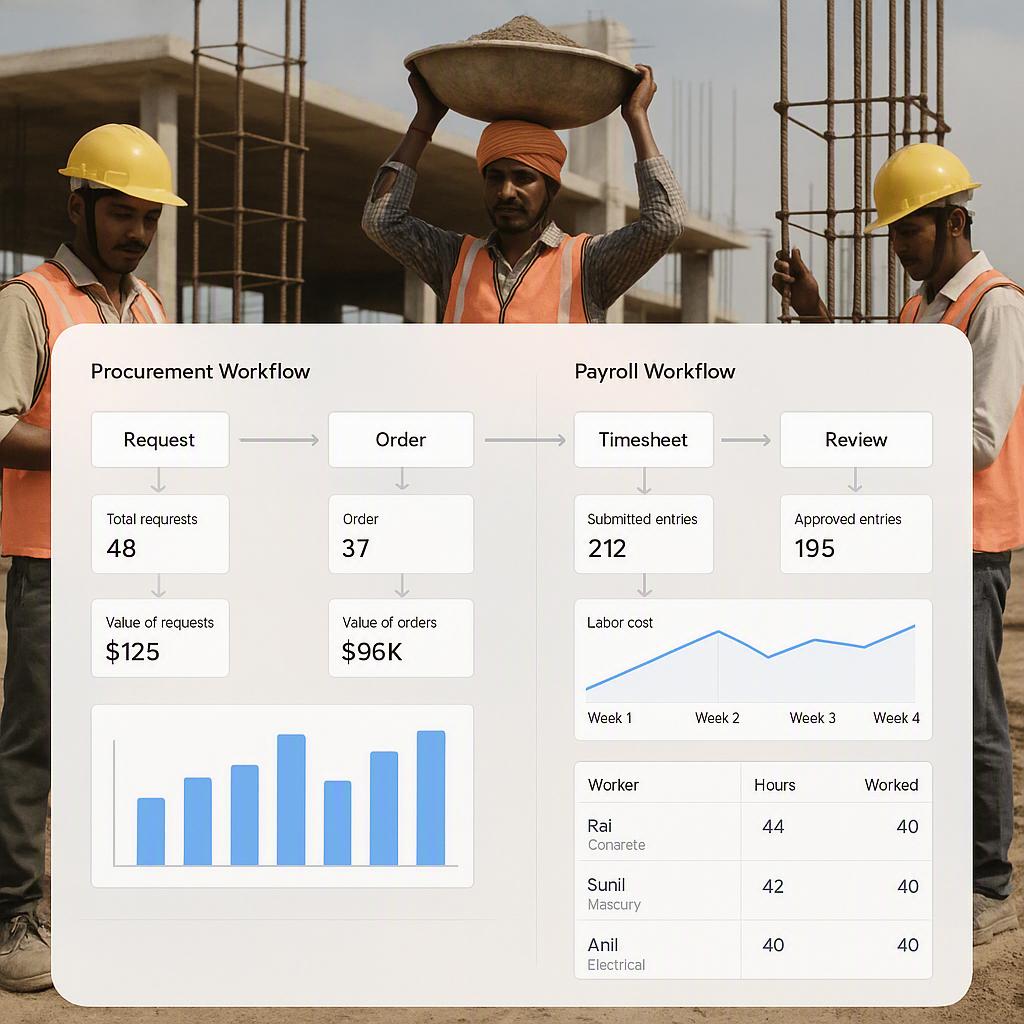
ERP systems integrate procurement workflows directly with approved budgets. Every material requisition, RFQ, and vendor offer is validated against the BOQ and scope hierarchy before a PO is raised. This eliminates duplicate orders and ensures that site teams can’t bypass approval workflows.
Illustrative example — Procurement Workflow:
| Procurement Issue | Before ERP | With ERP |
|---|---|---|
| Duplicate POs for aggregates | Frequent | Eliminated |
| Vendor rates misaligned across sites | Common | Auto-validated |
| Budget overshoots due to manual errors | Regular | Enforced discipline |
Payroll Fix: Multi-Site Workforce Management
Payroll complexity increases exponentially when you’re managing staff across multiple sites. ERP systems track attendance, payroll, leave, and staff allocation across camps and project sites. Ghost workers disappear because every staff allocation triggers a verification process.
The system also ensures compliance with Indian statutory requirements like PF, ESI, and TDS. When payroll is finalized, GST calculations are automated, and data is exported directly to accounting software for reporting.
Illustrative example — Payroll Workflow:
| Payroll Issue | Before ERP | With ERP |
|---|---|---|
| Ghost workers | Regular | Eliminated |
| Statutory compliance errors | Frequent | Auto-validated |
| Multi-site payroll tracking | Manual | Centralized |
What Being Wrong Cost Us
Here’s the hard truth: thinking you can fix systemic issues with better training or tighter oversight costs you money. It costs you time. And it costs you credibility when clients see delays and errors.
Even with ERP, the problems don’t vanish overnight. Implementation takes time. Old habits die hard. And no system — no matter how good — can replace common sense. But the difference is night and day. What used to take hours of manual cross-checking now happens in seconds.
FAQ
1. How does ERP prevent duplicate POs?
ERP systems validate every material requisition and PO against the BOQ, scope, and approved budgets. If a duplicate is detected, the system flags it and prevents submission.
2. What happens when staff are allocated to multiple sites?
ERP systems with multi-site HR tracking ensure every staff allocation is verified. If a worker is already assigned to another site, the system flags the conflict.
3. Does ERP handle compliance for Indian payroll?
Yes. ERP systems automate PF, ESI, and TDS calculations and integrate directly with accounting software for statutory reporting.
4. What about subcontractor payments?
Subcontractor payments are tied directly to measurement-based progress tracking. If work hasn’t been certified, payments can’t be processed.
5. How long does ERP implementation take?
Implementation timelines vary, but most contractors can go live within a few months with proper planning.
The Fix
If you're tired of margin erosion from procurement and payroll errors, consider exploring ERP systems tailored for construction workflows.
Learn more at EstimateNext