BOQ Hierarchies: Practical Insights for Indian & GCC Contractors
Margins are tight. Every contractor knows that. But here's the uncomfortable truth: plenty of margin erosion happens because of sloppy BOQ management. If your BOQ isn’t structured properly—or worse, isn’t being tracked well—you’re leaving money on the table. Let’s break down how to avoid that.
Why BOQ Hierarchies Matter
The Bill of Quantities (BOQ) is your project's foundation. It’s not just a list of deliverables; it’s a contractual roadmap. Every BOQ item defines what you owe your client: quantity, units, and rate. But here’s the catch—if your BOQ isn’t organized hierarchically, you could end up:
- Overlooking key deliverables during execution: Without clear structure, teams might miss items that aren't easily visible in a flat BOQ.
- Misaligning client expectations with actual progress: A poorly managed BOQ leads to disputes over billing, progress, and deliverables.
- Losing track of variation orders and scope changes: If variation orders aren’t tied to BOQ items, contractors risk absorbing additional costs.
What Is a BOQ Hierarchy?
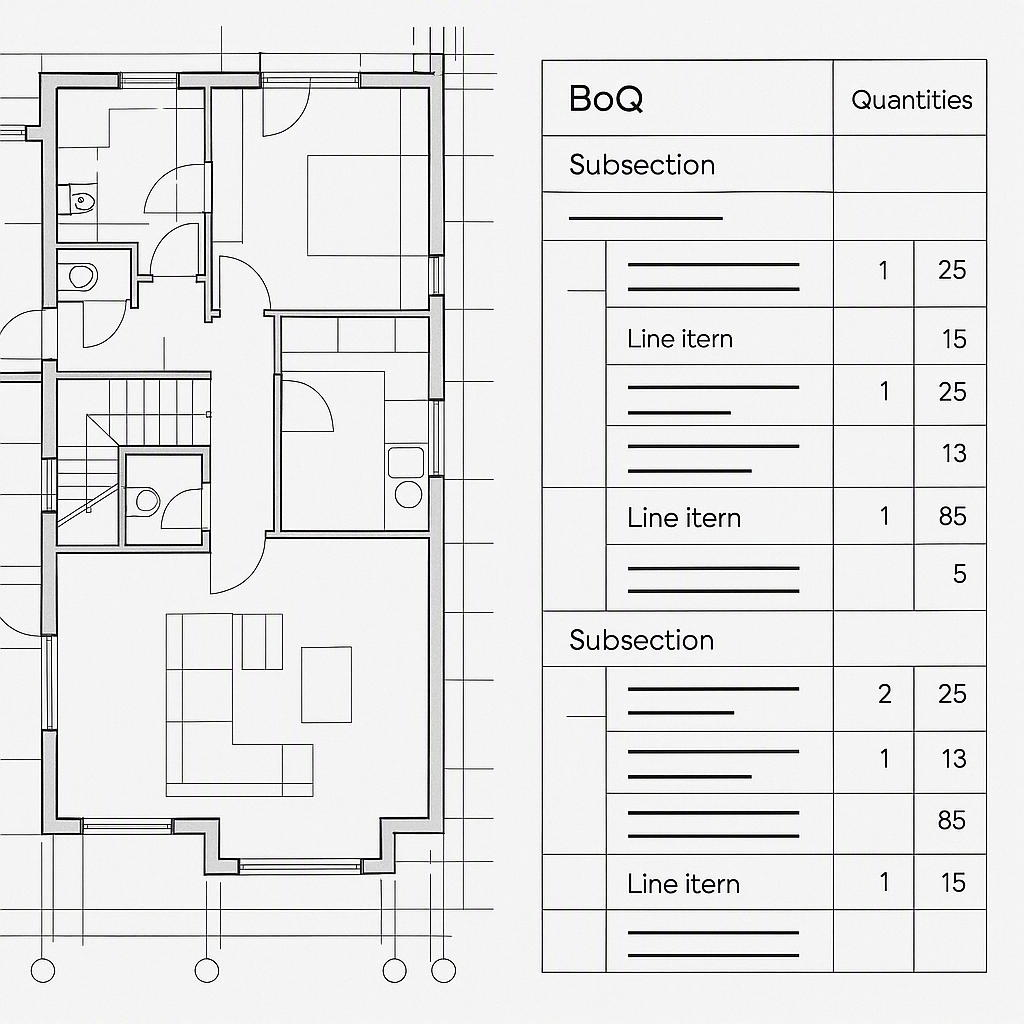
A BOQ hierarchy organizes items into logical groups, making them easier to track, execute, and bill. Here’s a typical structure:
| Level | Purpose | Example |
|---|---|---|
| Group | Categorizes related BOQ items | "Civil Works" |
| Sub-section | Subdivides groups into specific tasks | "Foundation" |
| Item | Defines measurable deliverables | "Excavation — 500 CUM @ ₹120" |
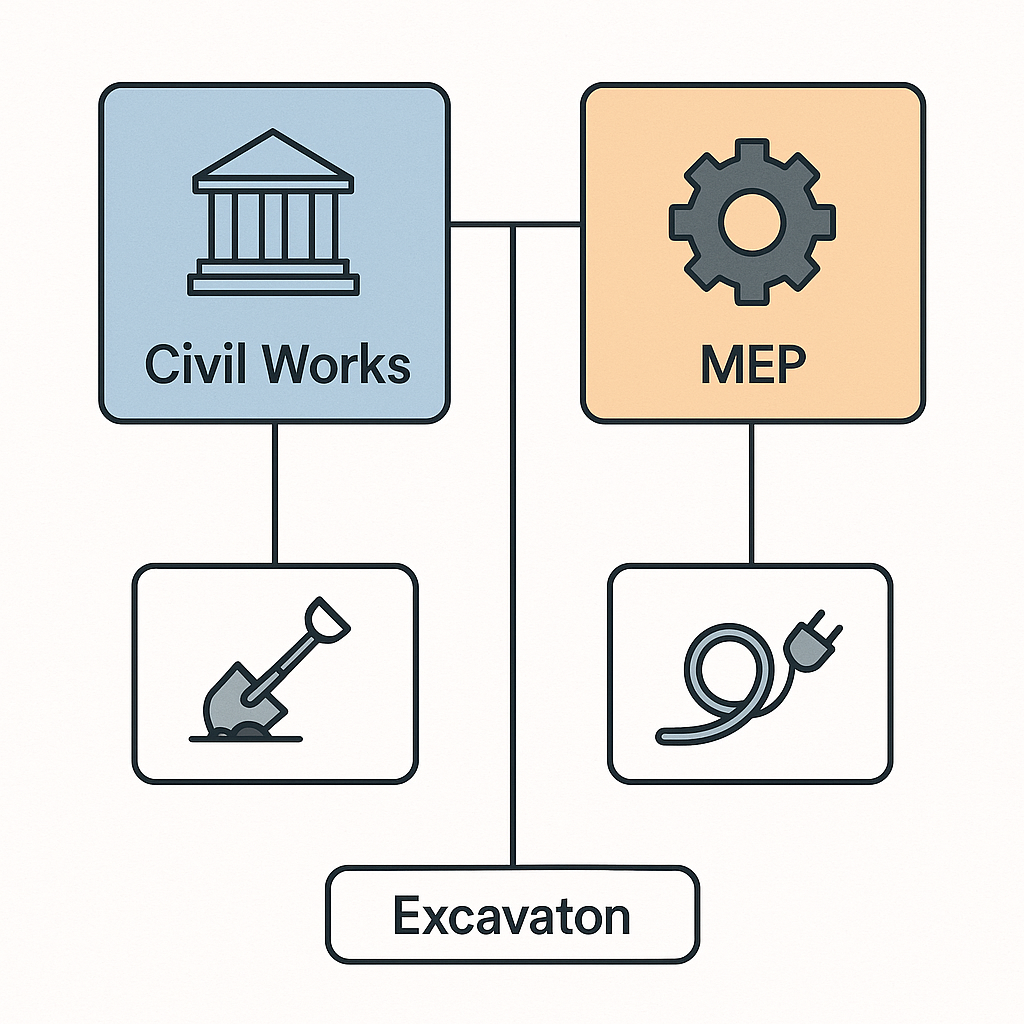
Example Hierarchy for a Construction Project
- Section: Civil Works
- Sub-section: Foundation
- Item: RCC M25 for foundation
- Item: Excavation for foundation
- Sub-section: Foundation
- Section: MEP
- Sub-section: Electrical
- Item: Wiring
- Item: Switches
- Sub-section: Electrical
Why Hierarchies Matter
Without a clear hierarchy, your BOQ becomes a mess. Imagine you’re halfway through a project, and your client disputes a deliverable because the BOQ was vague. This type of confusion usually stems from poor organization.
A well-structured BOQ prevents:
- Execution errors: Teams always know where to focus.
- Billing disputes: Clear deliverables mean fewer arguments over invoices.
- Scope creep: You can easily tie variation orders to existing BOQ items.
Common Problems in BOQ Management
1. Missing Links Between BOQ and Execution
A BOQ is the client’s view of deliverables. But your execution team works differently—they map scopes, not BOQ items. This disconnect results in confusion during project execution.
Solution: Bridge BOQ and Scopes
Link BOQ items to execution scopes using dedicated software or manual methods. For example:
- Software-Based Solution: Tools like JobNext allow you to link scopes directly to BOQ items. This ensures alignment between client deliverables and execution activities.
- Manual Method: Use spreadsheets to map each BOQ item to corresponding tasks, then share this mapping with your team.
2. Inefficient Progress Tracking
How do you know if you’re on schedule? Progress tracking often gets ignored at the BOQ level, leaving contractors blind to whether they’re meeting milestones.
Solution: Track Progress at the BOQ Level
Progress tracking should roll up from execution tasks to BOQ items. Here’s how:
- Set Milestones: Define stage percentages for each BOQ item. For example, "Excavation — 500 CUM" could be marked as 25% complete when 125 CUM is done.
- Use Software: Platforms like JobNext provide real-time progress tracking based on execution tasks linked to BOQ items.
3. Poor Variation Order Management
Variation orders are a fact of life in construction. But if they aren’t tied back to the BOQ, you risk billing disputes or absorbing costs that should’ve been passed on to the client.
Solution: Structure Variation Tracking
- Workflow Integration: Use tools where variation orders are directly linked to BOQ items. This ensures costs are allocated correctly.
- Manual Process: Create a variation register and document all changes explicitly, with reference to the BOQ item affected.
Practical Tips for Structuring BOQs
1. Build Groups Around Trade Categories
Organize BOQ items into logical groups like “Civil Works” or “MEP.” This keeps everything clean and easy to navigate.
Actionable Steps:
- Identify Trade Categories: Start by listing all major trades involved (e.g., Civil, Structural, MEP).
- Group BOQ Items: Assign each BOQ item to a relevant trade category.
2. Use Clear Descriptions and Units
Every BOQ item should have a clear description and unit of measure. Avoid vague terms like “miscellaneous works.” If the unit isn’t measurable (e.g., lumpsum), document it explicitly.
Actionable Steps:
- Standardize Descriptions: Use consistent terminology across all BOQ items.
- Specify Units: For example, use "CUM" for concrete, "M2" for plastering, etc.
3. Follow the Client’s Format
Clients usually provide their own BOQ formats. Stick to it. But if the format is flawed (e.g., missing hierarchy), restructure it internally while preserving their format for billing.
Actionable Steps:
- Preserve Original Format: Use the client’s format for submission.
- Internal Restructuring: Reorganize the BOQ to improve execution efficiency.
4. Automate Where Possible
Manual BOQ management is prone to error. Tools like JobNext let you upload BOQs directly and organize them hierarchically. This eliminates human error.
Actionable Steps:
- Choose Automation Tools: Evaluate platforms like JobNext for BOQ management.
- Train Teams: Ensure your team understands how to use the tool effectively.
FAQ
Q: What’s the difference between BOQs and scopes?
A: BOQs are client-facing deliverables; scopes are how your team executes them. BOQs define what needs to be done, while scopes define how you’ll do it.
Q: How can I handle variation orders efficiently?
A: Use a system that ties variations back to BOQ items. This ensures accurate billing and prevents margin erosion.
Q: Can BOQs track progress?
A: Yes. Systems like JobNext roll up progress from scopes to BOQs, giving you real-time visibility into project milestones.
Q: Should I standardize BOQ formats?
A: Internally, yes. Externally, stick to the client’s format but restructure internally for easier execution and tracking.
Q: What tools are best for BOQ management?
A: JobNext, spreadsheets, or ERP systems like SAP can help streamline BOQ organization and tracking.
Decision Framework: Manual vs Automated BOQ Management
| Factor | Manual Methods | Automated Tools (e.g., JobNext) |
|---|---|---|
| Accuracy | Prone to human error | Highly accurate |
| Efficiency | Time-consuming | Streamlined processes |
| Cost | Low upfront cost | Higher upfront cost but saves money long-term |
| Scalability | Difficult for large projects | Easily scalable |
| Progress Tracking | Requires manual updates | Automated real-time tracking |
| Variation Order Management | Manual documentation required | Integrated workflows |
Common Mistakes
- Ignoring Hierarchical Structure: Flat BOQs lead to confusion.
- Unclear Units: Every BOQ item must have a measurable unit.
- Poor Progress Tracking: If you’re not tracking progress at the BOQ level, you’re flying blind.
- Neglecting Variation Orders: Variation orders must always be tied to BOQ items.
Call to Action
If BOQ mismanagement is killing your margins, JobNext can help. It bridges BOQs, scopes, and billing into one unified platform. Learn more →
External References:
- How AI-Powered Tools Enhance Preconstruction Estimation: Streamline rate matching and improve accuracy in BOQ management.
- How AI Enhances Preconstruction Takeoff Efficiency: Learn how AI reduces manual effort in quantity takeoffs.
Key takeaway: BOQ hierarchies are non-negotiable. Get them right, and you save time, disputes, and money. Get them wrong, and you bleed margins.
Learn more at EstimateNext